



In 1915, as World War I raged across Europe, Lebanon faced a devastating famine known as Kafno, claiming an estimated quarter to a third of Mount Lebanon’s population. More than a century later, Dr. Amine Jules Iskandar draws striking parallels between this tragedy and Lebanon’s 2019 financial collapse.
1915: Kafno, the famine that echoes a century later
1915: Kafno, the famine that echoes a century later
By Michella Rizk | November 11, 2026

Reading time: 6 min
On November 11, 1918, Germany signed an armistice with the Allied powers and the guns fell silent on Europe's Western Front, after more than four years of one of the deadliest conflicts the world had seen.
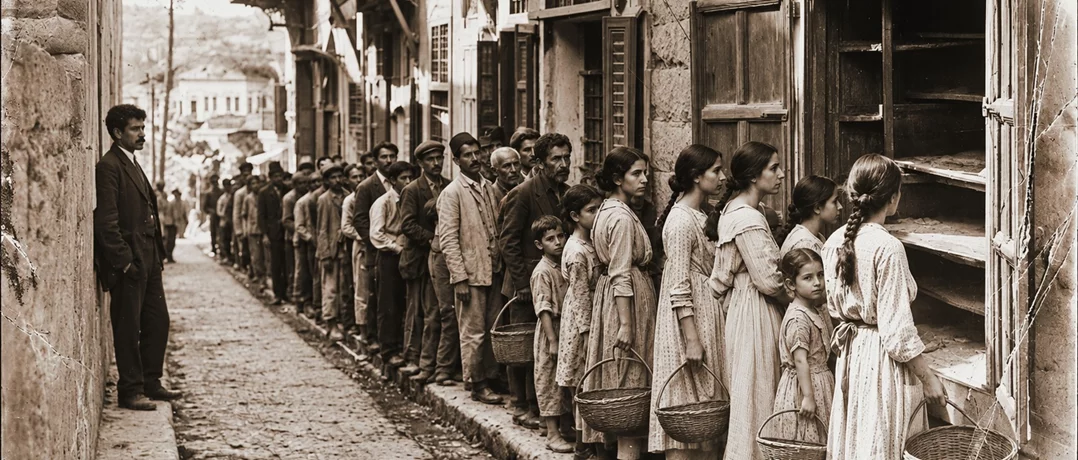
Lebanon's war had looked very different. The war reached Lebanese homes as empty markets, rising food prices, disease and hunger. Families sold their belongings to buy bread, and parents struggled to feed their children.
Between 1915 and 1918, famine swept through Mount Lebanon and Beirut. Historical estimates suggest that roughly a quarter to a third of Mount Lebanon's population died.
Before the war
In 1914, Lebanon was not yet the country we know today. The territory was part of the Ottoman Empire, and its regions were governed in different ways. Mount Lebanon had enjoyed a degree of autonomy since 1861, following the violence of 1860 and an internationally backed administrative settlement. Under this arrangement, known as the Mutasarrifate, the mountainous district was governed by a Christian Ottoman official appointed by Istanbul.
Beirut belonged to a separate Ottoman province and had grown into an important Mediterranean commercial center. Tripoli, Sidon, Tyre and the Bekaa Valley also lay outside the autonomous district.
The economy depended heavily on international trade. Silk was especially important in Mount Lebanon, where factories employed thousands of workers, many of them women, and merchants exported to European markets. Growing numbers of Lebanese were also settling in the Americas and elsewhere, and the money they earned supported families back home.
The weakness in all this was grain. Mount Lebanon did not grow enough to feed its population, so many households relied on imported food, income from silk exports and money sent by relatives abroad. As historian Graham Auman Pitts has explained, “the dependence on global markets that had sustained Mount Lebanon's economy before 1914 left it particularly vulnerable once war disrupted trade”.
1914: The war reaches Lebanon
World War I began in Europe in July 1914, after the assassination of Archduke Franz Ferdinand in Sarajevo, and spread across the continent within months. In late October, the Ottoman Empire entered the war on the side of Germany and Austria-Hungary, bringing its Middle Eastern territories into the fighting.
Lebanon felt the consequences immediately. Ottoman authorities tightened military control, imposed restrictions and redirected resources toward the war effort. Trade declined, transportation became more difficult and essential goods grew more expensive.
Cemal Pasha, commander of the Ottoman Fourth Army and one of the empire's most powerful wartime leaders, exercised extensive authority across the region.
Britain and France, meanwhile, imposed naval restrictions along the Eastern Mediterranean coast to weaken the Ottoman war effort. These disrupted maritime commerce and limited access to imported goods.
The Great Famine
By 1915, hunger was spreading across Mount Lebanon. The catastrophe became known as Al-Majaa (المجاعة), or the Great Famine, also remembered as Kafno in Syriac historical memory.
The Allied naval blockade disrupted trade, while Ottoman military requisitions diverted food and essential supplies toward the army. Transportation restrictions, rising prices and profiteering made food increasingly difficult to obtain.
In the spring of 1915, swarms of locusts swept across the Eastern Mediterranean, destroying crops, vegetables and fruit trees. Food became scarce, and many families could no longer afford what little was available. Malnutrition spread, followed by diseases such as typhus and malaria.
In an interview with The Beiruter, Dr. Amine Jules Iskandar of the Syriac Maronite Union–Tur Levnon argues that Ottoman policies played a deliberate role in the famine and were intended to impoverish and displace Mount Lebanon's population.
According to Iskandar, Ottoman authorities forced residents to exchange their foreign currencies for Ottoman money before sharply devaluing it, leaving families with savings that had lost much of their worth. He also points to the transfer of food, fuel and other supplies away from Mount Lebanon.
There was a project to suffocate this population, kill it and displace it.
From 1915 to 2019: Is history repeating itself?
For Iskandar, the economic devastation of the Great Famine bears striking similarities to Lebanon's financial collapse beginning in 2019.
"What happened during World War I is exactly what happened today," Iskandar told The Beiruter.
The comparison begins with the loss of access to foreign currency, followed by the depreciation of local money, the erosion of savings and mounting economic hardship that pushes families to emigrate.
According to Iskandar, Ottoman-era monetary policies resemble the restrictions Lebanese depositors faced when trying to access their dollars after 2019, followed by the sharp depreciation of the Lebanese pound.
The parallels also extend to political repression, with Iskandar comparing the Ottoman authorities' persecution of political opponents to what Iskandar describes as present-day pressures on dissent.
These similarities, Iskandar argues, are not coincidental but reflect a recurring strategy of impoverishing communities and encouraging their displacement.
The two crises, however, unfolded under different historical and political circumstances. Although both brought severe economic hardship and emigration, the similarities do not establish that they shared the same causes or political intentions.
Repression and the end of Ottoman rule
As the famine continued, Ottoman authorities intensified political repression.
Cemal Pasha's administration targeted suspected opponents, including Arab political activists, journalists and intellectuals.
On May 6, 1916, Ottoman authorities executed political figures in Beirut and Damascus, accusing them of acting against the empire. The date is commemorated today as Martyrs' Day in Lebanon and Syria.
By autumn 1918, Ottoman forces were retreating across the Middle East. On October 30, the empire signed the Armistice of Mudros, ending its participation in World War I.
Germany's armistice followed on November 11.
But the end of the war did not immediately restore normal life. Lebanon was emerging from years of hunger and disease, and its political future remained uncertain.
From the Great War to Greater Lebanon
The Ottoman Empire's collapse opened a new chapter for the region.
At the Paris Peace Conference in 1919, competing political movements proposed different futures. Some supported an independent Arab state incorporating Greater Syria, while others advocated a separate Lebanon.
In April 1920, the Allied powers selected France to administer Syria and Lebanon under a mandate system.
On September 1, 1920, French General Henri Gouraud proclaimed the State of Greater Lebanon, incorporating Mount Lebanon, Beirut, Tripoli, Akkar, the Bekaa Valley, Sidon, Tyre and surrounding areas.
The settlement was contested. Some welcomed the new state, while others favored unity with Syria or opposed French rule. Lebanon would remain under French authority until independence in 1943.
A century later
On November 11, 2026, the world marks 108 years since the armistice with Germany.
In Europe, World War I is remembered through its trenches, battlefields and fallen soldiers. In Lebanon, its memory is also tied to hunger, lost livelihoods, families separated by migration and communities devastated by disease.
World War I changed Lebanon's borders and political future. But for generations of Lebanese, its most enduring memory was something far more immediate: the struggle to survive.
-
-

-
Michella RizkContent Manager/WriterFocusing on social affairs.
-
