After more than 50 years serving generations in Tripoli, legendary ice cream maker Abou Hassan is bringing Lebanon's centuries-old tradition of authentic booza to Australia, preserving a family craft that began in 1865.


After more than 50 years serving generations in Tripoli, legendary ice cream maker Abou Hassan is bringing Lebanon's centuries-old tradition of authentic booza to Australia, preserving a family craft that began in 1865.

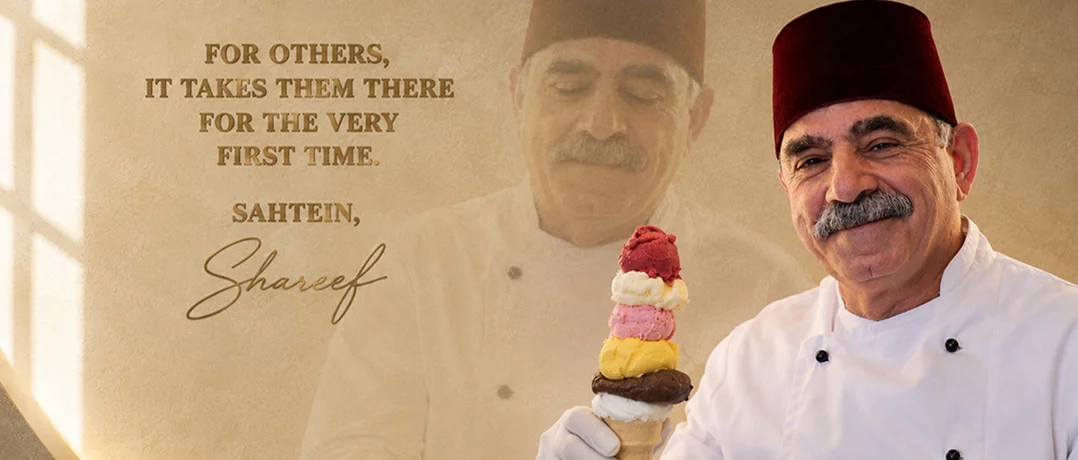
For more than half a century, not even war could stop Abou Hassan from serving ice cream.
He opened his shop, Originale, in Tripoli in 1973 and kept its doors open through years of conflict, destruction and uncertainty.
Now, after building a life around one of Lebanon’s most recognisable desserts, the ice-cream maker is beginning a new chapter in Australia.
Abou Hassan has brought the traditional art of Lebanese booza to Sydney, where he is working under Miski w Salep in Parramatta and preparing to open his own standalone store later this year.
It is an unlikely new beginning for a man whose customers in Lebanon spanned multiple generations.
For Abou Hassan, however, the move is less about starting over than carrying forward a commitment he has spent decades refining.
“Since 1973, through years of war and uncertainty in Lebanon, I have never closed my doors,” he said.
“I have an unconditional love for this work. Over five decades, I have served generations of families, watching children grow up, become fathers, and return with their own young ones asking for a scoop served just as it was when they were young.”
That long history did not make him resistant to change.
Across the decades, he continued introducing new flavours, techniques and desserts, treating innovation as a way to build on the tradition rather than replace it.
His shop became a constant in a city repeatedly tested by instability, with generations coming to know him behind the counter.
“Regardless of what happened outside, ice cream needed to be served,” he said.
Travel also shaped the way Abou Hassan approached his craft.
He drew inspiration from the distinct imprint of different cultures, but wanted to create something of his own rather than simply reproduce what was already available.
After spending time in Sydney, he believed the city was missing a refined showcase of Lebanese ice cream.
However, Sydney presented a different challenge.
Rather than rebuild the exact business he had left behind, Abou Hassan saw an opportunity to introduce Australians to an elevated version of authentic Lebanese ice cream while protecting the traditions that distinguish it from gelato and standard ice cream.
“Its not about selling a brand. It’s sharing a feeling and a tradition rooted in care. Everyone who works in our atelier must carry that same intention,” he said.
“It shows in how every guest is greeted, spoken to, and cared for, whether they step into our shop or experience our catering at a wedding.”
Abou Hassan’s connection to ice cream stretches far beyond the shop he opened in 1973.
He says the family trade began in 1865 with his great-great-grandfather and was handed down from father to son for generations.
“I was born into this craft,” he said.
That inheritance is most visible in booza arabye, the traditional Lebanese ice cream that remains at the centre of his work.
For Abou Hassan, ashta remains the defining flavour. The rich milk-based ice cream is rolled in freshly crushed pistachios, creating a dessert that is as recognisable for its appearance and texture as it is for its taste.
“The Lebanese booza arabye stands out because of its signature ingredients and the traditional, labor-intensive method used to create it. That craft produces its uniquely rich, elastic, and stretchy texture,” he said.
The distinctive consistency comes from ingredients including salep and mastic, combined through a process that demands time and precision.
For Abou Hassan, preserving the recipe is also a form of hospitality: offering guests the tradition on its own terms.
“After spending time in Sydney and watching how people react to our flavors, it became clear that adapting to local tastes would mean giving people something they already had,” he said.
“Introducing true booza allowed us to offer a completely genuine experience, and the response has been overwhelmingly positive.”
Among Lebanese Australians, the strongest response has been emotional.
“Taste is a powerful sense, and the traditional flavors immediately transport people back to childhood. The rich ashta rolled in freshly crushed pistachios brings home back in an instant,” he said.
“People notice the difference from standard ice cream or gelato straight away, appreciating the rich aromatic notes of salep and mastic that give it a distinct, sophisticated profile.”
The response in Sydney echoes the loyalty Abou Hassan remembers in Tripoli, where his shop became a destination for locals and returning travellers.
“In Tripoli, guests would drive straight to the shop from the airport,” he said.
What stayed with him most was not the size of the business, but the small rituals around it: pistachios added generously, a scoop handed across the counter and the expressions of children tasting it for the first time.
Those memories now inform the experience he wants to create in Australia. Sydney offers a new audience and a new city, but his measure of success remains deeply personal.
“That connection, that lasting imprint left on everyday guests, newlyweds, and young children, is what inspired me to open in Sydney,” he said.
“Recreating those moments for a new audience is deeply meaningful.”
More than 50 years after opening his Tripoli shop, Abou Hassan is again introducing customers to booza one scoop at a time.
This time, he is also carrying with him a family craft that began more than 160 years ago, and a taste of Lebanon that survived war, migration and distance.
