Featuring exclusive interviews with Chinese affairs specialist Dr. Nader Rong Huan and Moroccan economist Dr. Khaled Al-Shatta, the report explores the economic and strategic stakes facing Morocco behind China's proposal for a free trade agreement.




Featuring exclusive interviews with Chinese affairs specialist Dr. Nader Rong Huan and Moroccan economist Dr. Khaled Al-Shatta, the report explores the economic and strategic stakes facing Morocco behind China's proposal for a free trade agreement.

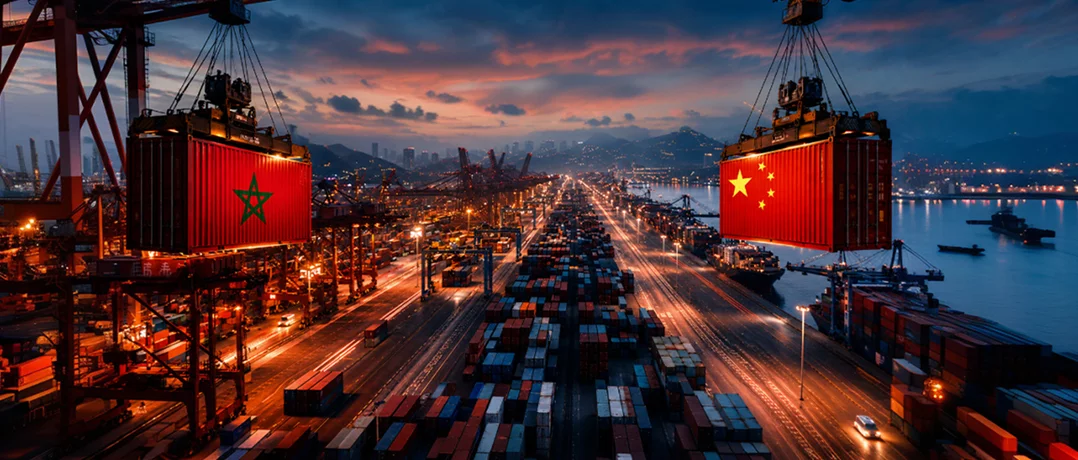
China has formally proposed that Morocco negotiate a bilateral free trade agreement, Morocco's Industry and Trade Minister Ryad Mezzour confirmed in an interview published on June 12. It is the first public acknowledgment of an initiative that has been quietly taking shape amid rapidly expanding bilateral trade and growing Chinese investment in Morocco's industrial sector.
"It is under reflection," Mezzour said, noting that Rabat has yet to begin formal negotiations and is conducting a sector-by-sector assessment before deciding whether to proceed.
The proposal comes as Morocco increasingly positions itself as a manufacturing and logistics hub connecting Europe, Africa, and the Middle East. While a free trade agreement could attract further investment and industrial development, it also raises questions over trade imbalances, domestic competitiveness, and Morocco's relationships with its traditional Western partners.
Trade between the two countries reached $10.96 billion in 2025, up from $9.04 billion a year earlier, making China Morocco's third-largest trading partner globally and its largest in Asia. However, the relationship remains heavily one-sided. Chinese exports to Morocco totaled $9.88 billion, while Moroccan exports to China reached only $1.08 billion, leaving Rabat with a trade deficit approaching nine to one.
Despite the imbalance, Morocco possesses considerable negotiating leverage. The kingdom holds the world's largest phosphate reserves, estimated at around 50 billion metric tons, and controls more than 90% of global argan oil production. Cobalt, citrus products, olive oil, and an expanding automotive components industry further strengthen its export base.
Morocco's previous trade agreements also provide valuable experience. The free trade agreement with the United States, which entered into force in 2006, quadrupled bilateral trade but also saw the U.S. goods surplus increase from $35 million in 2005 to $3.4 billion by 2024. A Brookings Institution study published in late 2025 concluded that the agreement had an overall negative impact on Moroccan exports, including strategic sectors such as agri-food and automotive.
Khalid Chiat, a professor of international law at Mohammed First University in Morocco, argued that the kingdom’s long history of economic integration, spanning European cooperation agreements from the 1960s, the Greater Arab Free Trade Area, the Agadir Agreement, and the 1996 Association Agreement with the European Union, has generated an institutional knowledge base that could inform a more disciplined approach with Beijing. Chiat said,
“The challenge is not whether Morocco can engage in free trade, but how it can do so while safeguarding both its domestic economy and its strategic relationships abroad.”
Chiat identified small and medium-sized enterprises as the segment most exposed to intensified Chinese competition, given their limited capacity to absorb price pressure from lower-cost imports. At the same time, he said Morocco’s established positions in automotive manufacturing, aerospace, and advanced transportation could be strengthened through Chinese technology transfers and industrial partnerships; if the terms of any agreement were structured to require them. “Trade agreements may create opportunities,” he said, “but a country’s ability to capitalize on them rests on the strength of its domestic foundations.”
Chinese investment in Morocco has accelerated independently of any formal trade agreement. The Mohammed VI Tangier Tech City has signed agreements with 42 enterprises, 34 of them Chinese, with committed investment totaling approximately $3.5 billion. BTR New Material Group is constructing cathode and anode material facilities at the site, projected to create more than 1,100 jobs. Gotion High-Tech has announced a $6.8 billion investment in Kenitra to build what would be Africa’s first electric vehicle battery gigafactory, with an initial production phase of 20 gigawatt-hours targeted for 2026. Chinese firms have also participated in the Noor concentrated solar power complex in Ouarzazate, among the largest such installations in the world.
That industrial expansion has drawn scrutiny from European capitals. Ahmed Aboudouh, a researcher at Chatham House, warned that China risks moving to “dominate the whole vertical supply chain” in Morocco; from phosphate extraction and processing to battery production and port logistics. “This is what concerns the EU,” Aboudouh said, “and it should.” The European Union’s Critical Raw Materials Act, adopted in part to reduce dependence on Chinese-controlled supply chains, complicates Morocco’s ability to simultaneously deepen ties with Beijing and preserve its preferential access to European markets.
The international trade environment has also shifted since the proposal emerged. The Trump administration imposed a 10% tariff on Moroccan goods in April 2025 under emergency economic authority, despite the existing bilateral free trade agreement. The measure was subsequently struck down by the Supreme Court in February 2026, reimposed under a separate statutory authority, and invalidated again by the Court of International Trade in May; legal proceedings remain ongoing, and the tariffs are set to expire July 24 unless Congress acts. Separately, China has unilaterally eliminated import duties on goods from 53 African countries, including Morocco, under a policy that took effect in 2024.
Chiat argued that Morocco’s strategic positioning extends beyond the bilateral question with China. Disruptions to traditional maritime routes, including heightened tensions around the Strait of Hormuz, have led an increasing number of countries, particularly in Latin America, to seek stronger economic ties with Rabat as an alternative logistics and manufacturing node. “Morocco offers a good platform,” said Hassan El Ansari, honorary president of the Moroccan Chinese Business Council, citing the kingdom’s proximity to European consumer markets, workforce capacity, and its unusually broad network of trade agreements. “Chinese investments committed in Morocco already exceed $10 billion.”
Moroccan officials have not publicly indicated when or whether a formal response to the Chinese proposal will be issued. What is clear is that the decision carries consequences well beyond trade statistics: any agreement would test the durability of Morocco’s relationship with the European Union, its largest trading partner and its primary source of foreign investment, at a moment when both sides are still navigating a stalled bid for a deeper free trade arrangement that Morocco itself suspended in 2014.
In an interview with The Beiruter, Chinese affairs specialist Nader Rong Huan said Beijing views Morocco as a strategic economic partner and an emerging gateway to both African and European markets. He explained that China’s broader objective is to expand economic globalization through free trade agreements and deeper commercial integration with key international partners.
According to Rong Huan, Morocco’s geographic location, political stability, and access to major markets make it particularly attractive for Chinese investment. He noted that Morocco benefits from free trade agreements with both the United States and the European Union, while also possessing significant resources linked to the electric vehicle and battery industries. These factors have encouraged Chinese companies, particularly in the electric vehicle sector, to establish manufacturing facilities in the kingdom.
He added that Morocco has developed a relatively mature automotive industry and a skilled workforce, making it a natural destination for Chinese manufacturers seeking to build local production bases. In Beijing’s view, a free trade agreement would facilitate greater access for Chinese products to American, European, and African markets through Morocco.
Addressing concerns over Morocco’s significant trade deficit with China, Rong Huan argued that trade balances should not be viewed solely through the lens of imports and exports. He stressed that trade deficits are shaped by market dynamics and economic conditions rather than by any deliberate Chinese policy.
He maintained that increased Chinese investment would generate tangible benefits for Morocco, including economic growth, job creation, and improvements in living standards. Chinese capital and advanced technologies, he said, could contribute to Morocco’s industrial development and strengthen its role as a manufacturing hub serving African markets.
Rong Huan also emphasized that China’s technological capabilities and financial resources could help Morocco accelerate local industrial development. If a free trade agreement is ultimately concluded, Morocco would gain greater access to Chinese technology and investment, potentially expanding its domestic production capacity and long-term economic competitiveness.
Rong Huan said China regards Morocco as an independent economic partner and one of Africa’s rising economies. Beyond trade, he argued that stronger economic cooperation could contribute to faster development, greater social stability, and improved living standards in Morocco over the long term.
He concluded that deeper Chinese-Moroccan cooperation could help position Morocco as a regional engine of economic growth, serving as a bridge between Africa, the Arab world, and Europe while strengthening its role in global supply chains.
Ultimately, Morocco's decision will hinge on balancing economic opportunity with strategic caution. While a free trade agreement with China could accelerate investment, industrialization, and global integration, it also carries risks related to trade imbalances and geopolitical alignment. The challenge for Rabat will be securing long-term economic gains without compromising its domestic industries or longstanding partnerships.