

Germany and the UAE are deepening their partnership through major investments, energy cooperation, technology projects and security ties as Berlin seeks new strategic partners in a changing global landscape.
A new chapter between Berlin and Abu Dhabi
A new chapter between Berlin and Abu Dhabi
By Nami El Khazen | September 16, 2026

Reading time: 7 min
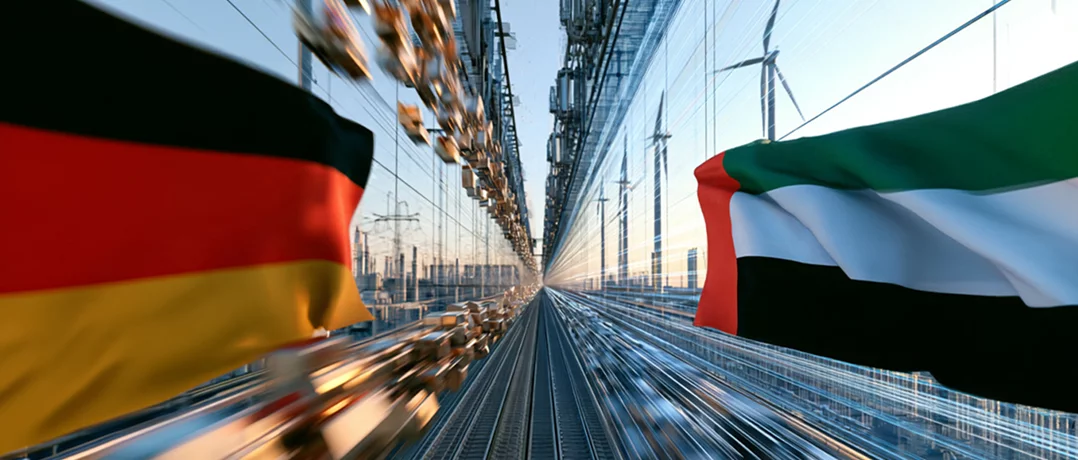
More than fifty years after Germany and the United Arab Emirates established diplomatic relations, Sheikh Mohammed bin Zayed Al Nahyan arrived in Berlin in September 2026 for the first state visit by a UAE president to Germany.
In Berlin’s diplomatic protocol, a state visit occupies a category of its own. It is the highest form of ceremonial recognition Germany can extend to a foreign leader, reserved for only a small number of occasions each year. The flags, military honors and state banquet therefore carried a message before any agreement was signed or any declaration issued: Germany had chosen to elevate the relationship.
The more interesting question is why. After decades in which ties had continued to deepen without such a gesture, what had changed enough for Berlin and Abu Dhabi to decide that 2026 was the moment to make one?
From diplomatic ties to strategic partnership
West Germany established diplomatic relations with the newly formed UAE on May 17, 1972, only months after the federation itself was created. Abu Dhabi opened its embassy in Bonn four years later, before expanding its diplomatic presence with a consulate general in Munich in 1997.
Economic ties were central almost from the beginning. As the Emirates used oil revenues to build roads, cities and infrastructure, Germany offered the machinery, vehicles, engineering and industrial expertise demanded by a rapidly developing state. Political contact followed. Chancellor Helmut Schmidt visited Abu Dhabi in 1981, but another German chancellor would not return for more than two decades.
Chancellor Gerhard Schröder’s arrival in 2003 therefore marked an important shift. During the visit, he and Sheikh Zayed bin Sultan Al Nahyan agreed to establish a strategic partnership, giving political form to a relationship whose commercial foundations were already substantial. Bilateral trade had reached €3.5 billion that year, and in April 2004 the two governments formalized their ambitions through a memorandum covering a wide field of economic and technological cooperation.
More than two decades later, the strategic partnership agreed in 2003 and formalized the following year is being expanded again. During Sheikh Mohammed bin Zayed Al Nahyan’s 2026 visit, he and Chancellor Friedrich Merz announced a new Strategic Dialogue explicitly intended to revitalize the Comprehensive Strategic Partnership. Its scope spans international and regional security, defense, trade and investment, energy and climate, emerging technologies, digitalization, transportation, the environment, culture and education.
Emirati capital meets German industry
The most striking economic commitment of the visit was its scale. The UAE announced plans to invest €40 billion in Germany, adding to an existing Emirati investment stock of roughly €34 billion. Alongside the package, German and Emirati companies signed 29 agreements worth more than €9.35 billion, while previous investments had already placed Abu Dhabi inside some of Germany’s largest industrial companies.
The commitment comes at a difficult moment for German industry. Industrial production has declined every year since 2022, and the weakness has been particularly severe in sectors exposed to high energy costs. For example, output in energy-intensive industries was still 17.8 percent below its 2021 level in 2025.
The strain is also visible in the automotive sector. Volkswagen, long a symbol of German industrial strength, is now undertaking the largest restructuring in its history, setting aside around €16 billion for job cuts and potential plant closures as it considers the future of several German factories expected to lose their current production models. Against that backdrop, fresh capital can help Germany preserve industrial capacity while financing the modernization of sectors facing profound structural change.
For Abu Dhabi, Germany offers a different kind of opportunity. Despite its recent difficulties, it remains Europe’s largest economy, with GDP of about €4.47 trillion in 2025, and one of the world’s most important centers of advanced manufacturing, engineering and industrial technology. Emirati capital therefore gains access to assets, industrial capabilities and technological expertise that fit the UAE’s own push to diversify its economy and expand its presence in high-value industries.
From energy security to AI infrastructure
Energy provided one of the earliest foundations for this broader cooperation. Germany and the UAE established a formal Energy Partnership in 2017, initially focused on renewable energy, energy efficiency and electricity markets before expanding into hydrogen and climate policy. By 2022, the relationship had moved from dialogue into physical supply chains: the first test shipment of low-carbon ammonia from the UAE arrived in Hamburg that year, part of an effort to develop future hydrogen imports for German industry.
The agreements surrounding the 2026 state visit reveal how broad that energy relationship has become, spanning both Germany’s immediate need for secure supply and the infrastructure of its longer-term transition. RWE and Masdar agreed to explore joint bids in Germany’s 2027 offshore wind auctions, with potential investment exceeding €3 billion, while Masdar and German developer Luxcara are considering more than €5 billion in offshore wind and energy-storage projects. At the same time, RWE and ADNOC advanced plans for long-term LNG supply agreements beginning in the early 2030s, and XRG opened discussions with Germany’s state-owned SEFE on further gas and LNG cooperation.
The Emirati investment package also includes plans for roughly 1 gigawatt of new data-center capacity in Germany. For comparison, all German data centers together had around 2.98 gigawatts of installed connection capacity in 2025. The two governments agreed as well to expand cooperation in artificial intelligence and emerging technologies through investment, research and joint development.
Toward deeper defense integration
During Sheikh Mohammed bin Zayed Al Nahyan’s visit, Germany and the UAE signed a Letter of Intent to explore deeper defense cooperation, backed by a high-level Defense Roundtable, alongside a separate agreement on police and security cooperation. The language chosen by both governments was particularly significant: they want to move beyond a traditional “supplier-and-recipient” relationship toward a broader strategic partnership.
That shift had already begun at the industrial level. At the IDEX defense exhibition in Abu Dhabi in February 2025, Germany’s Diehl Defence and an entity of the UAE’s EDGE Group signed an agreement to explore cooperation in the Emirates. Diehl’s portfolio includes ground-based air defense, guided missiles and ammunition, while the partnership was presented as a way to strengthen the UAE’s own sovereign defense capabilities.
Germany’s own policy toward Gulf defense cooperation has also become more permissive. During a Gulf tour in February 2026, Chancellor Friedrich Merz called for greater arms cooperation with partners in the region, and after Iranian attacks on Gulf states, the government temporarily eased export procedures for air and naval defense equipment to countries including the UAE. The shift reflected a growing recognition in Berlin that Gulf air and maritime security directly affect European energy supplies, commercial shipping and wider economic security.
The state visit took place against precisely that backdrop. Germany and the UAE jointly condemned Iranian attacks on the Emirates and other regional states, Tehran’s interference with navigation through the Strait of Hormuz, and the threats posed by Iran’s missile and drone programs and its support for non-state actors. Berlin also reiterated its solidarity with Abu Dhabi after the Iran conflict, during which the UAE helped facilitate the departure of more than 30,000 German tourists.
Their security dialogue extended further into the region, including support for consolidating weapons under Lebanese state authority and for the full implementation of UN Security Council Resolution 1701.
Germany’s search for new strategic partners
The deeper context for the rapprochement lies in Germany’s effort to broaden its network of strategic partners, with the UAE emerging as a particularly important partner given the breadth of cooperation already spanning energy, investment, technology, trade and security.
The language used during Sheikh Mohammed bin Zayed Al Nahyan’s visit reflected that logic. Germany and the UAE described the international environment as a “defining moment” and emphasized the growing importance of “reliable, like-minded partners” amid heightened geopolitical volatility.
“Like-minded” does not suggest complete alignment on every regional question. It points instead to a more practical measure of partnership: whether cooperation can remain durable across economic, technological and security fields as the international system becomes less predictable. By that measure, Abu Dhabi has gained considerably greater weight in Berlin’s strategic calculations.
-
-

-
Nami El KhazenJournalistFocusing on geopolitics and international affairs.
-
