

China’s new Arctic shipping corridor is transforming Asia-Europe trade by reducing transit times, bypassing the Suez Canal, and reshaping global logistics.
A new maritime corridor reshaping Asia-Europe trade
A new maritime corridor reshaping Asia-Europe trade
By The Beiruter | August 22, 2026

Reading time: 5 min
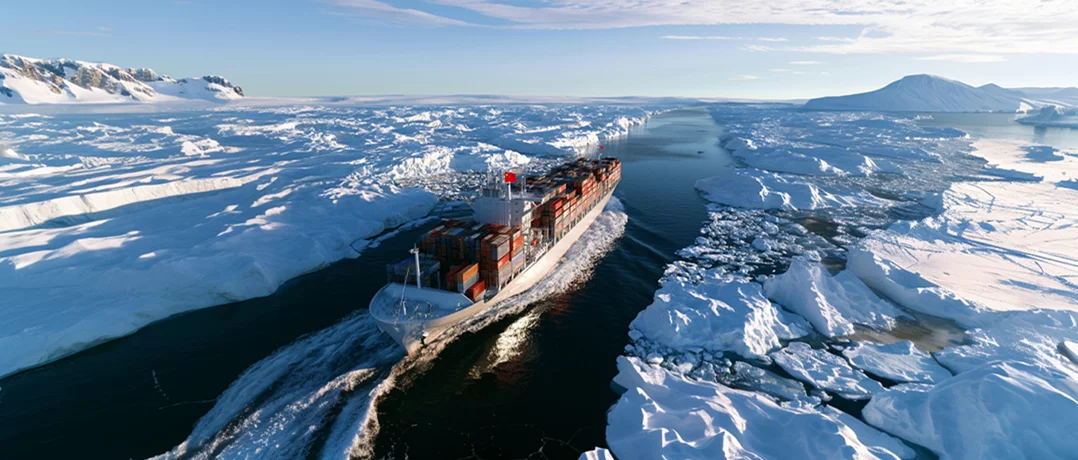
China has launched its first regular container shipping service to Europe via the Arctic Ocean, marking a significant milestone in the evolution of global maritime trade. Operated by Chinese shipping company Sea Legend, the service follows Russia’s Northern Sea Route (NSR), linking eastern China with northern Europe while bypassing the Suez Canal and the traditional maritime corridors through the Middle East.
The inaugural voyage, undertaken by the container vessel Dubai Tower, reflects Beijing’s growing efforts to diversify supply chains, reduce shipping times, and strengthen its presence in the Arctic under its long-term “Polar Silk Road” strategy.
A new route between China and Europe
The Dubai Tower departed from Ningbo-Zhoushan Port in eastern China on its maiden commercial voyage to Europe via the Arctic. Sailing through the Bering Strait before following Russia’s northern coastline along the NSR, the vessel is expected to reach the Port of Felixstowe in the United Kingdom (UK) before continuing to Hamburg in Germany and Gdynia in Poland.
Unlike the conventional Asia-Europe shipping corridor that passes through the South China Sea, the Strait of Malacca, the Indian Ocean, the Red Sea, and Egypt’s Suez Canal, the Arctic route offers a substantially shorter alternative during the summer navigation season. Sea Legend estimates that the journey can be completed in approximately 20 days, compared with roughly 40 days via the Suez Canal and around 50 days when vessels must sail around the Cape of Good Hope.
The company intends to operate the service on a weekly basis during the Arctic’s navigable season, which generally extends until October when melting sea ice permits safe passage without requiring continuous icebreaker assistance.
Commercial advantages of the arctic corridor
The new shipping corridor offers several economic benefits that have attracted growing attention from logistics companies and exporters.
The most obvious advantage is the reduction in transit time. Faster shipping enables manufacturers to deliver products more quickly to European markets, reducing inventory costs, improving supply chain flexibility, and allowing businesses to respond more efficiently to seasonal demand. Industries producing high-value or time-sensitive goods (including electric vehicles, lithium batteries, renewable energy equipment, and electronics) stand to benefit the most from shorter delivery schedules.
The Arctic’s naturally cold environment may also provide favorable conditions for transporting temperature-sensitive products such as energy storage systems and lithium-ion batteries, potentially lowering certain transportation risks associated with heat exposure.
Furthermore, the route enables vessels to avoid some of the world’s busiest maritime chokepoints. Recent disruptions affecting the Red Sea, Bab al-Mandeb Strait, and the broader Middle East have demonstrated the vulnerability of traditional shipping lanes to geopolitical instability. By bypassing these areas, the Arctic corridor provides an additional logistical option that could enhance supply chain resilience.
Part of China’s Polar Silk Road vision
The launch represents another step in China’s long-term Arctic strategy, often referred to as the “Polar Silk Road.” First proposed by President Xi Jinping in cooperation with Russia, the initiative forms part of the broader Belt and Road framework aimed at improving international connectivity through new transport corridors.
China is not an Arctic state but has steadily expanded its scientific, commercial, and diplomatic engagement in the region over the past decade. Since becoming an observer in the Arctic Council in 2013, Beijing has invested in Arctic research, shipping projects, and infrastructure cooperation while highlighting international collaboration and environmental protection.
The role of Russia
Russia occupies a central position in the development of the NSR. Stretching along Russia’s Arctic coastline, the route lies largely within waters administered by Moscow, with navigation permits issued by the NSR Administration under the state nuclear corporation Rosatom.
Russian authorities have invested heavily in Arctic infrastructure, ports, navigation systems, and the world’s largest fleet of nuclear-powered icebreakers to facilitate commercial shipping. Following Russia’s deteriorating relations with Western countries after the war in Ukraine, economic cooperation with China in the Arctic has become increasingly significant.
The growing China-Russia partnership has accelerated commercial activity along the route, although Russian administrative control also means that access remains dependent on Moscow's regulatory framework.
Practical limitations
Despite its commercial promise, the Arctic route cannot currently replace traditional shipping corridors.
Navigation remains highly seasonal because extensive sea ice limits accessibility during much of the year. Although climate change has expanded the annual navigation window, shipping operations remain dependent on weather conditions, ice coverage, and specialized maritime planning.
Operating in the Arctic also requires enhanced safety measures, highly trained crews, advanced navigation systems, and, in many cases, icebreaker support. Search-and-rescue capabilities remain relatively limited compared with established international shipping routes, increasing operational complexity and insurance costs.
Moreover, the relatively low volume of commercial traffic means that supporting logistics infrastructure (including repair facilities, emergency response capabilities, and port services) continues to develop gradually.
Environmental concerns
The expansion of Arctic shipping has generated significant concern among environmental organizations and climate researchers.
The same warming temperatures that have enabled greater navigation are themselves a consequence of accelerating climate change. Environmental groups warn that increased vessel traffic could further threaten the fragile Arctic ecosystem through emissions, underwater noise, potential fuel spills, and disturbances to marine wildlife.
Particular concern surrounds black carbon emissions, which can settle on ice surfaces, reducing their reflectivity and accelerating melting. Oil spill response in the Arctic also presents unique challenges because of the region’s remoteness, harsh weather, and limited emergency infrastructure.
While shorter sailing distances may reduce overall voyage emissions, there remains considerable debate whether these benefits outweigh the ecological risks associated with increased commercial activity in one of the world’s most sensitive environments. Nevertheless, by significantly reducing travel time between Asia and Europe while avoiding traditional geopolitical chokepoints, the NSR offers an attractive seasonal alternative for selected cargo and industries.
Therefore, although the route promises considerable commercial advantages, including significantly shorter transit times and reduced exposure to geopolitical disruptions, it also raises environmental, logistical, and geopolitical questions. As Arctic ice retreats due to climate change, the region is becoming increasingly accessible for seasonal navigation, transforming what was once a remote frontier into a potential component of international trade.
-
-

-
The Beiruter
-
