



Lebanon is caught between promised reform and an entrenched deep system, managing collapse rather than achieving real recovery.
A state rebranded, not rebuilt

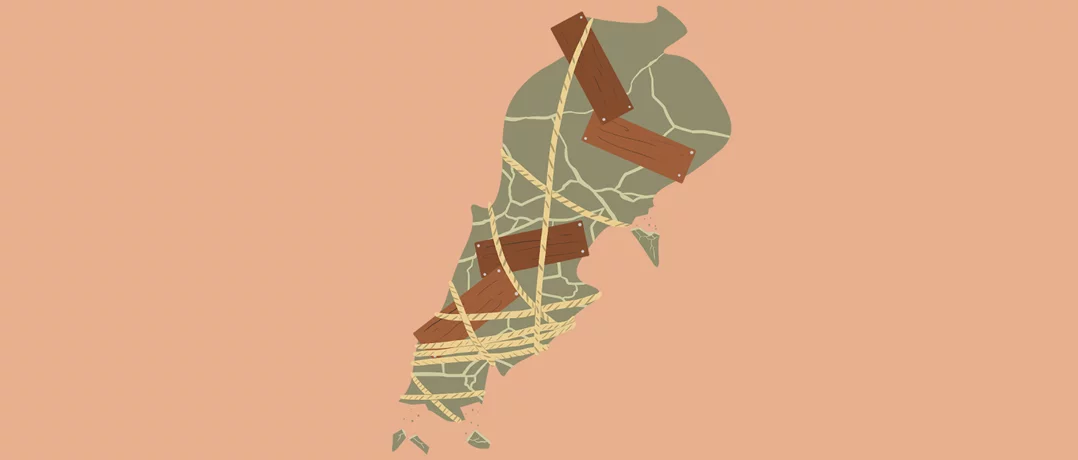
Lebanon is facing a highly delicate political phase, marked by a duality between the ambitions of the “new mandate,” represented by President Joseph Aoun and Prime Minister Nawaf Salam’s government seeking to rebuild state institutions, and a political and economic reality imposed by traditional power brokers، what is commonly known as the “deep system”. Although the war between Hezbollah and Israel ended more than a year ago, recovery efforts continue to run into funding obstacles and the refusal of international and Arab actors to provide financial support before the implementation of deep reforms and a resolution to the issue of militia weapons. Meanwhile, entrenched political forces still grip the levers of financial and legislative decision-making.
The Lebanese parliament has witnessed only limited legislative activity, which critics describe as “legislation of necessity, arguing that its doors open solely to pass specific items in the absence of broad political debate or structural reforms. The latest such episode was a session held on December 18, during which lawmakers approved a $250 million World Bank loan earmarked for “emergency response and reconstruction.” The loan has raised concerns over how the funds will be disbursed, amid fears they could be channeled through the Council of the South and institutions affiliated with the Shiite duo (Amal Movement and Hezbollah) to compensate their popular base, rather than through more inclusive and transparent state mechanisms.
The controversy centers on the Ministry of Finance's role as the authority responsible for disbursement. Available information indicates that the ministry transfers loan funds, at the cabinet's discretion, to executive bodies such as the Council of the South (affiliated with the Prime Minister’s Office) or the High Relief Committee. This mechanism revives fears of a repeat of post-2006 practices, when municipalities and local forces in the south and the southern suburbs "close to the Shiite duo" conducted damage assessments and compiled beneficiary lists, giving dominant political actors an advantage in steering compensation. This, in turn, reinforced their social and political influence using loans that burden the public treasury, amid skepticism over the effectiveness of donor oversight or that of the Court of Audit.
The financial sector
This sector is under the tightest scrutiny of the “deep system,” which uses it as a tool to restore the old order and renew its dominance, enabling it to manage the country and impose conditions to control the trajectory of affairs for years if not decades to come. The system directs funds to serve its interests, despite Lebanon’s immense needs, and blocks projects that could grant citizens independence from ruling parties.
The process begins at the Ministry of Finance, where the “seal” of the deep system remains firmly in place despite reform pledges. The ministry continues to play a game of “buying time.” It is not merely an accounting body but the state’s financial bottleneck: the third signature required for any spending. Not a single dollar leaves the treasury or international loan accounts at the central bank without a payment order from the ministry.
There is also another “finance ministry” operating outside state institutions: Hezbollah’s Al-Qard Al-Hassan association. After its infrastructure was damaged during the war, the institution adapted by transforming into a “ghost organization,” replacing destroyed headquarters with a covert network of commercial offices and apartments, while fortifying its gold reserves in secret locations to ensure the continuity of a cash-based economy.
In contrast, the state practices what can be described as “deliberate blindness.” Security agencies cite the absence of judicial warrants, while the judiciary evades action, arguing that the institution is registered as a “charitable association” with the Ministry of Interior and is not subject to the Monetary and Credit Law, creating a legal “grey zone” that prevents raids on its facilities.
Central Bank Governor Karim Saïd, for his part, has adopted a policy of protecting the formal banking sector by completely isolating it from any dealings with unlicensed entities. He argues that pursuing entities listed under international sanctions falls within the remit of security services and the judiciary, not the central bank. International institutions, including the U.S. Treasury, meanwhile, are calling for a shift away from a cash-based system toward modern card-based payments.
Depositors: A stalled file
Depositors’ funds in Lebanon have been subjected to what is widely described as the largest systematic write-off of wealth in modern history. The issue has remained unresolved since 2019. In the absence of a comprehensive recovery plan to restore depositors’ rights, the prevailing financial reality relies on multiple paths economists describe as the “melting” of deposits, driven by three lethal mechanisms. First is “lirification,” forcing depositors to withdraw their dollar savings in depreciated Lebanese pounds, eroding purchasing power and turning deposits into near-worthless cash. Second are circulars that release $300–$400 per month to buy time and appease small depositors, while large fortunes remain frozen for years. Third is the haircut: the system created a market for bank checks (“lollars”) sold at 10–15% of face value, transferring wealth from victimized depositors to major borrowers and politicians who repaid loans at bargain prices.
The crime is completed by classifying deposits as “eligible” and “ineligible,” paving the way to write off the latter, alongside the promotion of illusory schemes such as a “deposit recovery fund” in a bankrupt state whose treasury has long been depleted.
Security and borders
Despite talk of a tactical Hezbollah withdrawal south of the Litani River, multiple reports indicate the area has not been fully vacated. Hezbollah has redeployed forces in the Bekaa Valley, where it stores long-range missiles, and established facilities for assembling drones and rockets. In areas north of the Litani and in the southern suburbs, it stores guided missiles used to target vehicles and drone depots. On the funding front, Iran has resumed financial support through various channels, exceeding $1 billion over the past year, while official institutions have failed to cut off these routes. Security reports also point to a revival of the captagon trade as an additional funding source amid declining external support, posing growing security challenges. Arms smuggling into Lebanon continues via multiple routes, notably by sea from Turkish-controlled Cyprus to Lebanese ports, and overland from Syrian border areas near Shebaa and Kfar Shouba.
The judiciary
When Lebanese security forces arrested one of the most prominent drug traffickers, Syrian national Ali Shalish known as “Ali Issa” in Kaslik, the government hailed it as a major blow to drug trafficking. However, in Lebanon, cases often differ depending on who wields power. It later emerged that Shalish was also involved in smuggling weapons to Hezbollah from Syria and had his own supply lines. At that point, a senior militia official intervened, applying pressure for his release on claims of innocence and alleged fabrication of charges by security officers.
This discrepancy highlights how judicial files are handled through political interference. While the Beirut port explosion investigation remains frozen, preventing the questioning of several officials, other cases see swift judicial action. One example is a Beirut investigating judge issuing an indictment against a lawyer under Article 295 of the Penal Code (“undermining national sentiment”) over a social media post concerning Hezbollah’s “pager wounded,” prompting criticism over judicial priorities.
Infrastructure
The telecommunications sector is faltering. Ministerial promises to upgrade the network have collided with a lack of liquidity, resulting in “snail-speed internet at global prices,” alongside persistent security concerns over data breaches and a lack of privacy. The sector is in a state of “clinical death”: Ogero’s network suffered partial destruction in war-affected areas, repairs are proceeding at a glacial pace due to funding shortages, and chronic electricity outages are digitally isolating large regions.
The “billing without service” equation has become entrenched. Citizens pay hefty dollar-denominated bills for slow, intermittent internet, while revenues go toward covering salary deficits and maintenance contracts rather than technological upgrades keeping Lebanon effectively outside the digital age.
With Électricité du Liban unable to provide sustainable power, private generator operators have expanded into solar energy projects on public land and buildings, selling electricity at inflated prices. These de facto power brokers are accused of obstructing laws that would enable decentralized energy production to preserve their monopolies.
Environment
The environmental file has morphed from a conventional waste-management crisis into a compounded chemical and public-health disaster, managed with the same mafia-style, quota-based mentality. The most dangerous issue is that of “war rubble.” The conflict left millions of tons of contaminated debris in the southern suburbs and the south. Instead of scientific treatment, companies linked to ruling powers dump these toxins indiscriminately in valleys or illegally use them for land reclamation at sea, threatening groundwater and marine life amid a total absence of government oversight.
In parallel, waste-collection companies have resumed blackmailing the state for “fresh dollars,” threatening to flood streets with garbage over payment delays. With municipalities financially crippled, the practice of random waste burning has spread in villages, leading to record increases in cancer and respiratory diseases.
Elections
Politically, on November 7, 2025, the government approved a new draft law sent to parliament seeking to “suspend” District 16 reserved for expatriates with six seats for the 2026 election, and to revert to voting for all 128 MPs. The proposal has sparked division: the government cites logistical reasons, while the speaker of parliament avoids bringing it to debate, referring it to committees because it constitutes a new law.
The amendment aims to return to the 2022 electoral formula, whereby expatriates vote for the full slate of 128 MPs in their original districts inside Lebanon, rather than for six seats abroad.
Fragmented oppositions
Despite their fragmented efforts, opposition groups remain the sole voices exposing “loan deals” within parliamentary committees, seeking to prevent the deep system from using international funds to rehabilitate itself. Yet they are divided and have not coalesced into a single opposition; instead, they are multiple oppositions that disagree on nearly everything.
Lebanon today is not in a recovery phase but in a “managing collapse” phase under new labels. The new mandate may intend to do so, but the system holds the keys. While Lebanese citizens wait for electricity, water, and the return of their deposits, the real power focuses on rebuilding Hezbollah’s “mini-state” and redistributing the spoils of international loans, laying the groundwork for a phase that may prove more dangerous than the war itself: a “hijacked state” cloaked in legality, incapable of halting the tragedy.
