



AI in the Middle East is not just a question of advanced technology, but of how widely it is being used across different areas of the armed forces.
Advanced technologies in Middle Eastern militaries
Advanced technologies in Middle Eastern militaries
By The Beiruter | April 27, 2026

Reading time: 4 min
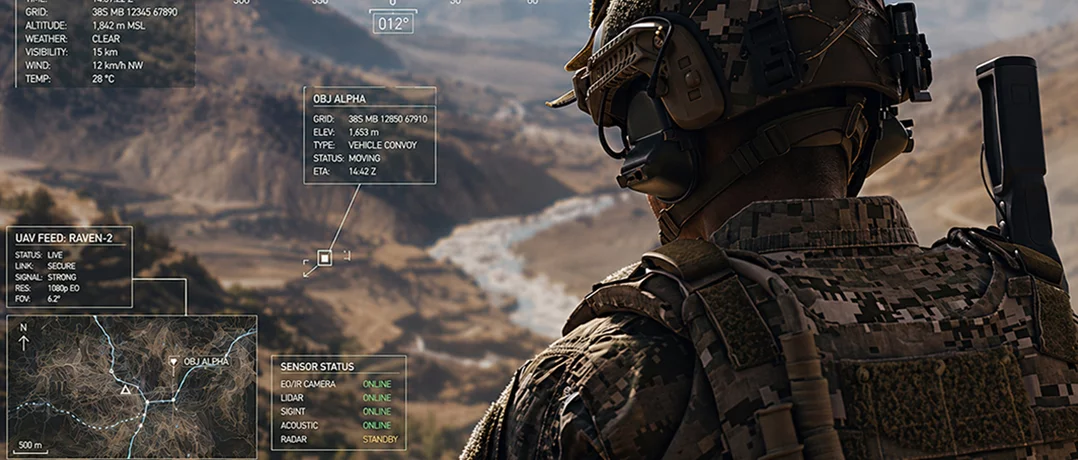
At least nine state and quasi-state actors across the Middle East are now deploying or testing artificial intelligence in military contexts, spanning four core functions and an expanding set of identified systems. A new analysis from the International Institute for Strategic Studies finds that AI adoption is no longer concentrated in isolated programs. Instead, it is diffusing across intelligence, command systems, and military operations, changing how these functions are carried out in practice.
Diffusion across actors and functions
AI adoption across the region is expanding in scope, even as capabilities remain unevenly distributed. The IISS study identifies Israel, Iran, Türkiye, Saudi Arabia, the United Arab Emirates, Egypt, Libya, and Syria as incorporating AI into military activity, alongside the United States through deployments and partnerships in Iraq, Syria, and Yemen. Across these actors, AI systems are grouped into four categories: command and control, intelligence and surveillance, weapons platforms, and logistics.
Rather than developing uniformly cross domains, adoption centers around specific functions. Intelligence, surveillance, and reconnaissance (ISR) capabilities appear across nearly every actor identified, suggesting that AI-enabled surveillance has become the most accessible entry point. By contrast, AI integration into weapons platforms is more concentrated, with clearer deployment in Israel, Iran, Türkiye, and the UAE. The study distinguishes between systems that are operational and those still in testing or joint exercises, indicating that while adoption is widespread, depth of integration varies significantly across states.
This pattern aligns with findings from the RAND Corporation, a U.S.-based policy research organization, which notes that militaries tend to adopt AI first in data-rich environments such as ISR, where large volumes of imagery and signals data can be processed at scale.Rather than replacing existing systems, AI is most often layered onto them, accelerating analysis and expanding coverage without requiring full structural overhaul. In practice, this produces a region where AI is increasingly present, but applied at varying levels across military systems.
Israel’s AI systems
This pattern of gradual integration across the full chain of military activity is most clearly illustrated in Israel. The IISS analysis provides a detailed account of how AI is being incorporated within military functions, identifying more than fifteen systems currently in use, each tied to a specific role within the broader cycle of intelligence, targeting, and coordination.
According to the study, Israeli systems such as The Gospel and Where’s Daddy are used for target identification and prioritization, drawing on large datasets to generate and rank potential targets. Tools like Lavender and Noisy Message are associated with data processing and coordination, helping filter information and streamline communication across units.
The analysis also identifies a separate set of systems focused on biometric identification and population monitoring. Blue Wolf, White Wolf, and Red Wolf, for instance, are described as facial recognition programs used to identify individuals and track movement, alongside broader large-scale facial recognition deployment in Gaza.
The significance, as the IISS analysis makes clear, lies not in any one AI system, but in how they are combined. Together, they form a layered architecture in which data collection, processing, and decision-making are increasingly interconnected, allowing information to move more quickly from detection to action.
The infrastructure behind military AI
A central finding of the study is the extent of reliance on external technological infrastructure. Israeli applications, for example, are linked to cloud platforms provided by Microsoft, Google, and Amazon, alongside connections to large language model providers such as OpenAI and Anthropic.
These systems are supported by underlying hardware, including data servers and imaging technologies from companies such as Cisco, Dell, Oracle, Sony, Hikvision, and Dahua. The inclusion of firms specializing in facial recognition further underscores the role of private-sector actors in enabling military capabilities.
This dependence reflects a broader point in the analysis, namely that access to compute, cloud infrastructure, and data is becoming as consequential as the development of the AI systems themselves. As a result, the study argues, military capability is increasingly influenced by the ability to integrate and sustain this technological infrastructure.
Governance gaps and uneven constraints
The expansion of these systems is matched by uneven and evolving governance. The IISS study also assesses the frameworks of major technology companies involved in AI-enabled military applications, including Google, Amazon, Palantir, Anthropic, Microsoft, Cisco, Dell, OpenAI, and Oracle, comparing their policies on weapons use, surveillance, human oversight, and alignment with international humanitarian law.
The findings show significant variation. Some companies, such as Microsoft and Google, maintain limited or conditional restrictions on military use, while others, like Amazon and Oracle, have no clearly defined constraints in key areas. Requirements for human oversight also differ, with some firms mandating human involvement in lethal decision-making and others offering less specificity.
As AI systems become more integrated into how militaries operate, the study argues, the distinction between civilian and military applications becomes harder to define, complicating efforts to establish consistent standards.
The implication is a broader shift in how military power is being shaped. AI is not influencing warfare through singular, highly visible systems. It is embedding itself across military functions, expanding through its integration into existing systems, and drawing increasingly on a network of private-sector technologies that extend well beyond the traditional boundaries of defense.
-
-

-
The Beiruter
-
