



Israeli overflights over Lebanon are among the most extensively documented sovereignty violations in the modern Middle East, yet decades of normalization have stripped them of political urgency.
Aerial sovereignty and the control of Lebanon’s skies
Aerial sovereignty and the control of Lebanon’s skies
By Katharine Sorensen | May 24, 2026

Reading time: 10 min
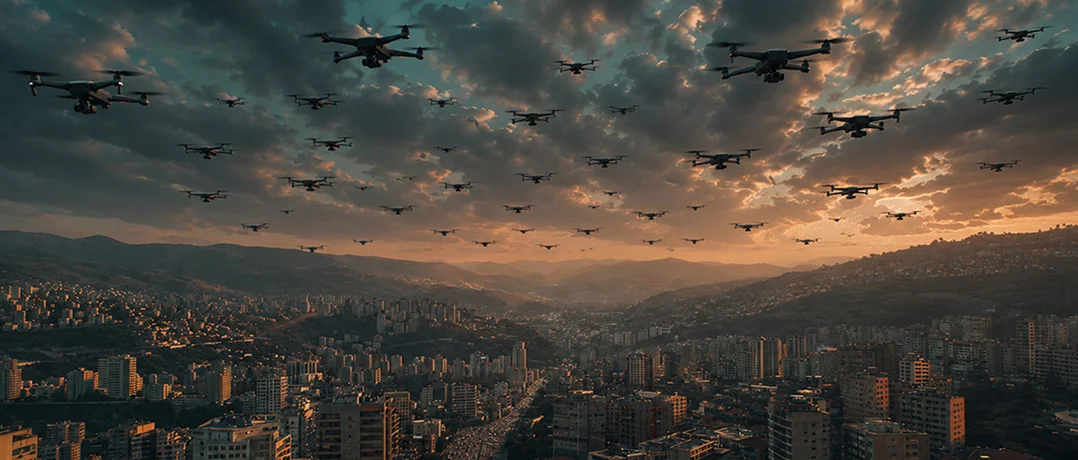
The drones in Hamra were particularly loud that day.
“Particularly,” because the drones’ low mechanical buzzing could never be described as soft. In Hamra, a Beirut neighborhood sheltering a disproportionate share of people displaced by the latest round of fighting between Israel and Hezbollah, the sound had become constant enough that its intensity was measured only in relative terms.
Outside one of the neighborhood’s school-turned-shelters, a group of three men sat together in plastic chairs. The facility was one of 633 shelters currently open to displaced people, according to the latest government figures. All born during or before the Lebanese Civil War (1975-1990), the period when Israeli aerial presence first intensified, none appeared especially alarmed by the sound overhead.
“It’s always been like this,” Hassan, one of the three men displaced from the southern village of Sultaniyah, said. “The jets, the drones, they’re nothing new.”
Half an hour later, the brief absence of the drones’ hum was noted
“Give it a moment,” Khaled, another of the men, said. “They’ll be back.”
Sovereignty from above
The presence of Israeli aircraft, whether jets, drones, or helicopters, is neither a novel phenomenon nor an undocumented one. Extensive reporting and policy analysis over the past decade has effectively solidified Lebanon’s reputation as a country that lives under drones, particularly as technological advancements have enabled unmanned systems to remain airborne for longer periods and conduct sophisticated surveillance.
Yet Lebanon's aerial violations do not exist in isolation. In 2026, a little over a month since the ceasefire came into effect and almost three months since the initial fighting first began, the erosion of Lebanon’s sovereignty is playing out simultaneously across land, sea, and air.
Israeli troops remain positioned in southern Lebanon (land), its newly proposed security zone extends into parts of the Mediterranean previously recognized as Lebanese maritime territory (sea), and Israeli aircraft continue conducting overflights across Lebanese airspace (air).
Hezbollah, for its part, complicates any claim to unified sovereignty from within. Its refusal to disarm and its independent use of force challenge the state’s monopoly on military power, a foundational principle of sovereign authority.
Indeed, by any metric, Lebanon’s sovereignty is imperiled. But while land occupation generates international headlines, aerial violations fail to prompt the same urgency, despite being the most exhaustively documented of the three. Rarely do discussions of Israeli overflights explicitly frame them as what they are: a sustained assault on Lebanese sovereignty.
Consider what the equivalent would look like elsewhere, with Chinese drones hovering continuously over Washington D.C. or Russian jets regularly breaking the sound barrier over New York. Given the intense political and media reaction to the Chinese “spy balloon” that crossed the United States for six days in 2023 before being shot down off the East Coast, it is difficult to imagine any major power tolerating such sustained aerial incursions without triggering a major diplomatic or military response.
But in Lebanon, the sheer frequency of these violations has gradually stripped them of the political shock they would provoke almost anywhere else. Although Lebanese sovereignty is frequently invoked as an abstract political concept, it has concrete applications that extend well above the ground.
That gap demands scrutiny: What does sovereignty mean in an era where the sky itself is persistently controlled by another state? And why do repeated violations of Lebanese aerial sovereignty, despite being thoroughly recorded, generate so little sustained domestic or international political response?
Only when Lebanon has established sovereignty over all three of its territorial spheres — land, air, and sea — can it fully exercise state authority.
A continuous theater
Israeli aerial surveillance in Lebanon is older than most of the conflicts it is associated with. Aerial reconnaissance over Lebanon intensified during the 1970s as Palestinian armed groups expanded operations from southern Lebanon following the arrival of the Palestine Liberation Organization (PLO) in 1969. From Israel's perspective, aerial surveillance became essential for monitoring militant activity and gathering intelligence as the broader Arab-Israeli conflict increasingly spilled into Lebanese territory.
Even after the PLO's withdrawal from Lebanon in 1982, Hezbollah's subsequent rise and Syria's continued presence in the country sustained Israel's reliance on aerial monitoring.
“For Israel, from a military standpoint, Lebanon was always a theater of operation from which threats to it emanated,” Riad Kahwaji, a security and defense analyst and founder of the Institute for Near East and Gulf Military Analysis, said.
Nicholas Blanford, a senior fellow at the Atlantic Council and journalist who has reported from Lebanon for more than three decades, saw the same dynamic play out firsthand. If anything, he noted, the pattern deepened over time rather than receded.
Following the 2006 war ,Israeli surveillance intensified as Hezbollah’s military infrastructure became more visible on the ground, particularly with the expansion of training facilities in regions such as the Bekaa Valley. Many of these sites can now be identified through publicly available satellite imagery and mapping platforms.
Israel had already demonstrated the strategic value of aerial dominance during its 22-year occupation of southern Lebanon between 1978 and 2000, a ground presence that cost more than 900 Israeli soldiers their lives and that aircraft had helped sustain by enabling continuous monitoring without the full political cost of having boots on the ground.
Decades of overflights, Kahwaji noted, gradually normalized the presence of Israeli aircraft across much of Lebanon.
“There isn't anybody who isn't used to seeing Israeli warplanes in the skies of Lebanon since their childhood.”
Recorded, but unresolved
The scale of this surveillance has been exhaustively documented, even as it has been diplomatically ignored by much of the international community.
In the first year following the December 2024 ceasefire between Israel and Hezbollah, the United Nations Interim Force in Lebanon (UNIFIL) recorded more than 7,500 air violations inside Lebanese territory north of the Blue Line, the boundary drawn at the end of the 2000 Israeli withdrawal from southern Lebanon. Each one constituted a documented breach of UN Security Council Resolution 1701, passed after the 2006 war, which called for full respect for Lebanese sovereignty and the Blue Line, provisions Israel's continued overflights have rendered effectively unenforceable.
Meanwhile, the Lebanese government filed a separate case with the United Nations accusing Israel of violating its sovereignty 2,036 times between October and December 2025 alone. The non-profit Armed Conflict Location & Event Data (ACLED), tracking just November and December of that year, recorded 200 drone strikes and airstrikes across southern Lebanon, resulting in 53 casualties.
The documentation, clearly, is not the problem. Blanford described the situation plainly:
“The problem is that there’s no real diplomatic incentive to force Israel to cease and desist from their intrusions, and the Lebanese lack the means to kinetically thwart these overflights.”
Yet the function of these overflights extends beyond intelligence gathering alone. The aircraft also operate as highly visible and highly audible reminders of Israeli military dominance over Lebanese skies.
During the conflicts in both 2024 and 2026, Israeli jets repeatedly broke the sound barrier over Lebanese, sending sonic booms reverberating across the country.
“It’s clearly psychological,” Blanford said. “There is no military value in this.”
Kahwaji similarly argued that many of the sonic booms carried little military purpose beyond projecting dominance and presence.
It’s a sort of psychological warfare as well, reminding everybody that “we’re here.”
The age of drones
Although Israeli overflights have existed for decades, the technology behind them has evolved dramatically over time. “The biggest evolution in Israeli aerial presence is drones,” Blanford said. “It’s telling that the sounds of the drones have changed.”
The earlier systems, he explained, were not as large and produced a sharper, higher-pitched sound because they relied on smaller engines than the larger drones now frequently heard over Beirut. Israeli fighter jets, however, have remained the backbone of Israel’s aerial presence over Lebanon for decades, which Blanford described as the country’s “primary aerial platform.”
Helicopters, by contrast, have become increasingly rare. By the 2006 war, Israeli helicopters largely remained far offshore or flew at very high altitudes over southern Lebanon, already too vulnerable to Hezbollah’s growing missile arsenal to operate freely. They have not returned to the skies over Lebanon in any meaningful way since.
Israel’s primary drone platforms today–the Hermes 450 and Hermes 900, both manufactured by Haifa-based Elbit Systems–operate as airborne signals intelligence, or SIGINT, platforms capable of intercepting mobile signals, WiFi networks, GPS data, and telecommunications traffic. According to research by the Carnegie Endowment for International Peace, the resulting data can be used to map behavioral patterns and, with the support of artificial intelligence, build what the Israelis call “target banks:” pools of suspected operatives identified by name, face, or voice and marked for potential assassination.
At the same time, Hezbollah itself has devoted growing attention to drone warfare and anti-aircraft systems. As early as 2009, former secretary-general Hassan Nasrallah publicly argued that obtaining air defense systems could alter the balance of power by challenging Israeli air supremacy. A decade later, following an Israeli drone strike in Beirut in 2019, he vowed to shoot Israeli drones out of Lebanese skies altogether. By 2022, he claimed Hezbollah had already reduced parts of Israel's aerial activity through its anti-aircraft systems, and that the group had begun manufacturing drones of its own.
More recently, Hezbollah has developed fiber-optic guided drones, low-cost, high-precision weapons physically tethered to their operators via cables that can extend several kilometers, making them resistant to electronic jamming. During the latest conflict, rare footage released by Israeli forces in April 2026 showed a Hezbollah drone targeting a rescue helicopter as wounded soldiers were being loaded in Taybeh, southern Lebanon.
Still, Blanford noted, none of this has come close to threatening Israeli jets.
“The Lebanese, whether it's Hezbollah or the Lebanese army, lack the capabilities to shoot down Israeli aircraft,” he said.
An asymmetric sky
Lebanon’s inability to contest Israeli aerial dominance is not simply a matter of military capacity, although that gap is vast. It is also the product of a longstanding American security framework designed to preserve asymmetric air defense systems between Lebanon and Israel.
Although the Lebanese Armed Forces (LAF) have become significantly more capable over the past two decades, largely through American support since 2007, U.S. military assistance has always operated under a firm ceiling: Washington will not provide weapons systems that could threaten Israeli aircraft.
This doctrine, known formally as maintaining Israel's “qualitative military edge” and enshrined in U.S. law since 2008, commits Washington to ensuring that Israel maintains a technological and military advantage over its regional adversaries. Lebanon’s receiving air defense systems capable of contesting Israeli overflights from either the United States or other Western countries, Blanford argued, is therefore categorically off the table.
But not every government shares Washington’s calculus. Iran has offered weapons to the Lebanese Armed Forces before, most notably in September 2009 and February 2015, though the Lebanese government never moved forward with the proposals.
“Politically it would be very difficult for the Lebanese government to accept that kind of aid,” Blanford warned.
The United States would likely withdraw its support, and the Lebanese government would be accused of aligning the nation’s army with Tehran, an accusation that could destabilize a country whose post-war politics depend on avoiding the perception that the Lebanese army has fallen into any single regional camp.
Lebanon, in other words, cannot look east, west, or internally for a solution to its aerial sovereignty crisis.
As the current ceasefire negotiations continue, Blanford saw little prospect of change on the horizon. Israel, he explained, has made clear it will continue operating in Lebanese airspace for as long as Hezbollah remains armed and capable of threatening it from Lebanese territory
“We are headed for a prolonged stalemate that will include aerial violations.”
By any measure, it is difficult for a state to exercise sovereignty with an illegally armed militia that makes unilateral military decisions, while a hostile state occupies its land, lays claim to its maritime boundaries, and conducts overflights in its airspace.
For Lebanon that difficulty is not theoretical. It is an audible, inescapable reminder of the state’s inability to control its own skies.
-
-

-
Katharine SorensenReporterSpecializing in global affairs, technology and economics, with a focus on on-the-ground investigative reporting.
-
