



Bethlehem cautiously revives Christmas traditions as Christian communities face rising pressure and insecurity across the region.
After 2 years, Christmas returns to Bethlehem
After 2 years, Christmas returns to Bethlehem
By The Beiruter | December 08, 2025

Reading time: 3 min
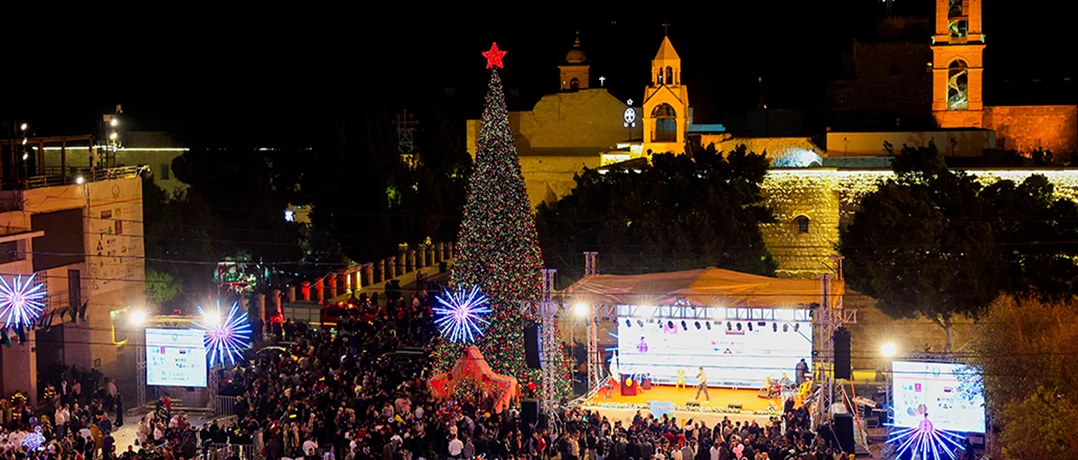
For nearly 2 years, the streets of Bethlehem carried an unusual stillness. Once filled with visitors, pilgrims, and the warmth of seasonal celebration, the city stood quiet under the shadow of war and uncertainty.
This December, however, a gentle transformation is unfolding. Lights have returned to windows, families gathered again in public squares, and the sound of festive music filled the streets, a modest yet meaningful sign of renewal.
Rising pressure on Christian communities in Israel and the West Bank
Despite being the traditional birthplace of Jesus Christ, numerous reports have documented an increase in hostility toward Christian communities in Israel and East Jerusalem throughout recent years. There seems to be a growing insecurity, social marginalization, and uncertainty about the future among the aforementioned community.
Christians currently make up about 1.8% of Israel’s population, with the majority identifying as Arab. However, physical harassment was the most common reported form of abuse, including spitting, verbal insults, and intimidation directed primarily at clergy and identifiable Christian figures. There were also multiple instances of vandalism against churches, cemeteries, and religious property, such as graffiti, stone-throwing, and attempted arson. In the cases where perpetrators were identified, they were described as mainly young men from ultra-Orthodox and national-religious Jewish groups.
Survey data revealed divided perceptions of belonging and acceptance. While around one-third of respondents said they felt accepted in Israeli society, a similar percentage said they felt unwelcome, with dissatisfaction particularly high among younger adults. Many participants cited the 2018 “Israel the Nation State of the Jewish People” law (also known as the Basic Law), which established Israel as the nation-state of the Jewish people and restricted the right to self-determination solely to the latter, as reinforcing their status as second-class citizens. This prompted a considerable proportion of Christians to consider emigration, most commonly due to security concerns and political instability.
A perfect example would be in the West Bank town of Beit Sahour (the hillside where, according to the Gospel of Luke, the news of Jesus’s birth was first proclaimed, as well as the last majority-Christian towns in the West Bank), whereby residents reported increasing anxiety after the appearance of a new Israeli settlement outpost on land originally designated for community development. Access to land, restricted movement, and growing settler expansion were identified as central factors contributing to fear of displacement and demographic decline. While improved reporting of incidents and increased police presence was apparent, trust in authorities remains limited.
Bethlehem revives the spirit of Christmas after years of silence
Today, local businesses, many of which survived only with difficulty, have cautiously reopened their doors. Among them are family-run restaurants, bakeries, and souvenir shops that have served pilgrims for decades. Their return is more than economic; it reflects emotional resilience after prolonged hardship. As a fragile calm holds in Gaza, Bethlehem’s residents have chosen to bring life back to their cherished traditions, even if the celebrations remain subdued.
Furthermore, tourism, a vital lifeline for the city, has slowly begun to recover. While crowds are noticeably smaller than in years past, the presence of visitors, both local and international, has restored a sense of purpose. Hotels have reported increasing reservations for the holiday period, offering hope after a steep economic decline that forced thousands to leave in search of work elsewhere.
Despite this fragile improvement, tension remains a daily reality in the wider West Bank. Military checkpoints, restricted movement, and sporadic violence have reshaped ordinary life. Many residents travel long hours for short distances, and uncertainty still hangs over the region’s future.
Beneath the towering Christmas tree in Manger Square, a quiet optimism persists. Families hold onto the belief that peace is not out of reach. The return of Christmas in Bethlehem may be modest in scale, but its meaning is profound: it is a reminder that even in the aftermath of conflict, hope can find its way back home.
-
-

-
The Beiruter
-
