



The April ceasefire briefly set off a mass return to southern Lebanon, but widespread destruction and the threat of occupation have driven many back into displacement.
After the ceasefire, movement without return
After the ceasefire, movement without return
By Katharine Sorensen | April 24, 2026

Reading time: 6 min
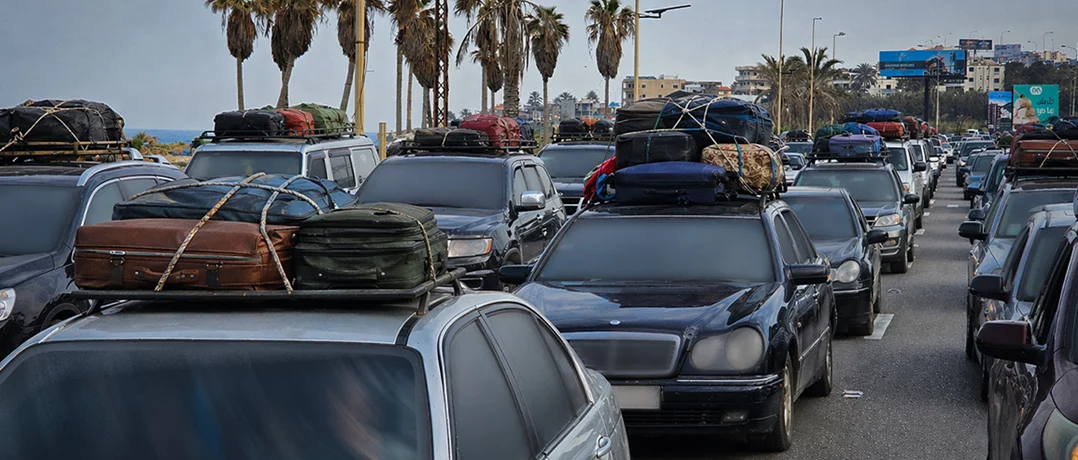
At 8:30am on Friday, April 17, the northern checkpoint before the coastal city of Saida, the largest in South Lebanon, was packed with cars. Some had mattresses and chairs strapped to their roof, others were filled with suitcases and bags, and many carried more than one family. All, however, were heading south.
Just over eight hours earlier, a 10-day ceasefire between Israel and Hezbollah had gone into effect, temporarily halting weeks of fighting that killed more than 2,400 people in Lebanon and displaced over one million. According to the Ministry of Social Affairs (MoSA), 141,000 displaced people were spread across 691 shelters on Thursday, the final day of the war.
For those heading home, the journey south would not be an easy feat. Prior to April 16, the Israeli military had destroyed or significantly damaged all the main bridges linking areas south of the Litani River, a major geographic divide in Lebanon, to the rest of the country.
The Qasmieh bridge, located 10 kilometres north of the southern city of Tyre, stood as the only primary crossing for civilian use despite it also being damaged in the April 8 attack, when Israel struck more than 100 targets across Lebanon in only ten minutes. Just before the ceasefire took hold, Israel destroyed that bridge as well. Access to the south was severely limited.
The damaged infrastructure, however, did not deter initial returns. By Saturday evening, MoSA figures showed the number of displaced in shelters had dropped to 92,000, residing in 613 locations. Within the span of two days, approximately 35% of those displaced had begun returning home.
But the next 24 hours marked a sharp shift from the first wave of returns.
By Sunday afternoon, the number of the displaced in shelters had risen to 107,500. By Monday evening, that number stood at 116,900. On Thursday night, just under one week since the ceasefire first came into force, 121,400 displaced were registered across 641 open shelters. Of the nearly 50,000 people who went back to their homes in the first 48 hours, approximately 30,000, or 60 percent, ended up back in shelters.
 Graph showing the number of displaced people in shelters and open shelters in the first week of the ceasefire, based on Ministry of Social Affairs (MoSA) data.
This striking reversal of movement begs the following questions: What pushed these families to leave their homes once more, after making the arduous trip back? Why didn’t they stay?
The answer might be deceptively simple. There is little to return to.
As Kher, head of one school-turned-shelter in Hamra, Beirut put it:
Everyone is returning back. What is left for them in the south?
Returns under occupation
The initial surge of returns to southern Lebanon echoed the movement seen after the late November 2024 ceasefire that temporarily halted the earlier war between Israel and Hezbollah, when tens of thousands of displaced residents returned within days, particularly to villages south of the Litani River.
But this time, the scale of destruction has been significantly greater. And the threat of becoming trapped in a restricted military zone under continued Israel presence has prevented sustained returns from taking hold.
Since the ceasefire in Lebanon, Israeli forces have maintained positions inside southern Lebanon rather than fully withdrawing. The Israeli military has framed this as part of an effort to establish a security “buffer zone,” extending roughly 5 to 10 kilometers into Lebanese territory, with a new northern boundary referred to as the “Yellow Line.”
This shift effectively moves beyond the Blue Line, the UN-recognized boundary established after Israel’s 2000 withdrawal. Critically, Lebanese citizens have been banned from entering this zone, which covers approximately 6% of the country, including 55 villages and towns.
Renée, the shelter in Hamra’s former school principal who has helped oversee the daily logistics, described the hesitation many of the shelter’s displaced felt towards the prospect of returning to homes they are no longer sure they can stay in
“What if Israel never leaves, what will they do?” she said. “Do we expect them to stay in a territory that is now occupied?”
Speaking on Saturday, two days after the ceasefire, Renée was skeptical about the continued movement of persons back to the south.
In a couple of days, you will see them returning on the other side of the road.
As it turned out, she was right.
 Footage of cars entering the Saida checkpoint at 8:30am on Friday, April 17, as families began returning south following the ceasefire.
A landscape marked by demolition
Beyond fears of becoming stuck in occupied territory, widespread destruction has left entire communities and homes in ruins, pushing many of the displaced back into shelters.
Over the past month, Israeli forces have intensified demolition operations across southern border villages. The increased destruction followed a March 22 statement by Israel’s Minister of Defence Israel Katz, announcing that he had ordered the expansion of the “demolition of Lebanese houses in the border villages…. in accordance with the Beit Hanoun and Rafah models in Gaza” to protect the residents in Israel’s northern communities. The Israeli military destroyed 90% of homes in Rafah, in south Gaza, sparking concerns that similar tactics could be replicated in southern Lebanon
According to official figures presented by Lebanon's National Council for Scientific Research, more than 62,000 housing units have been destroyed or damaged over roughly six weeks of Israeli attacks on Lebanon. Efforts to verify the full extent of the damage remain limited. Due to ongoing security risks and restricted access, neither United Nations peacekeepers nor Lebanese authorities have been able to carry out comprehensive surveys in the affected border areas.
Although the Israeli military has said it is targeting Hezbollah infrastructure, including tunnels and military facilities it claims are embedded in civilian homes, legal experts warn that the systematic destruction of towns and villages could amount to a war crime under international law. As the international watchdog group Human Rights Watch notes, “forcible displacement, wanton destruction and attacks deliberately targeting civilians are war crimes,” and under international humanitarian law, the destruction of civilian homes is prohibited unless there is a clear military necessity.
Even after the ceasefire, the demolitions of neighborhoods in towns and villages along the Lebanese border continued. Within the first week, Lebanon’s state-run National News Agency reported the “systematic demolition operations” in residential neighborhoods of Bint Jbeil and the villages of Beit Lif, Chama, Tayr Harfa, and Hanin, all located within the area of the buffer zone.
Bint Jbeil is Kher’s hometown.
He has not been since the start of the war, but received footage from neighbours who either stayed or briefly returned in the immediate aftermath of the truce. His house is demolished, one of many along a street that has been entirely reduced to rubble. All that remains is a lone cinder block in the middle of the debris, with a thin wisp of smoke rising from it in the video he obtained.
“That’s home,” he said, as he replayed the clip. “Or at least that is what’s left of it.”
Staying put, for now
For many of the displaced, the fear of occupation combined with the large-scale destruction of southern territory are preventing further returns.
As Renée explained, while only eight of the more than 180 families left the shelter in the first 48 hours of the ceasefire, nearly a week later, no others had left. Two families had even returned.
That hesitation has persisted even as the ceasefire itself has evolved. Even after the ten-day truce was extended by three weeks following talks between Israeli and Lebanese representatives at the White House, 119,300 displaced people remained registered across 638 shelters, according to Ministry of Social Affairs figures as of 2pm on Friday. While this reflects a decline of around 1,000 people since the extension, it falls far short of the scale of earlier departures.
For now, the possibility of return exists. The conditions for it, however, do not. And for many, that gap is what keeps them in place.
-
-

-
Katharine SorensenReporterSpecializing in global affairs, technology and economics, with a focus on on-the-ground investigative reporting.
-
