



Artificial intelligence promises to transform warfare, but underwater it encounters an environment that makes sensing, communication and coordination unusually difficult.
AI warfare meets the limits of the ocean

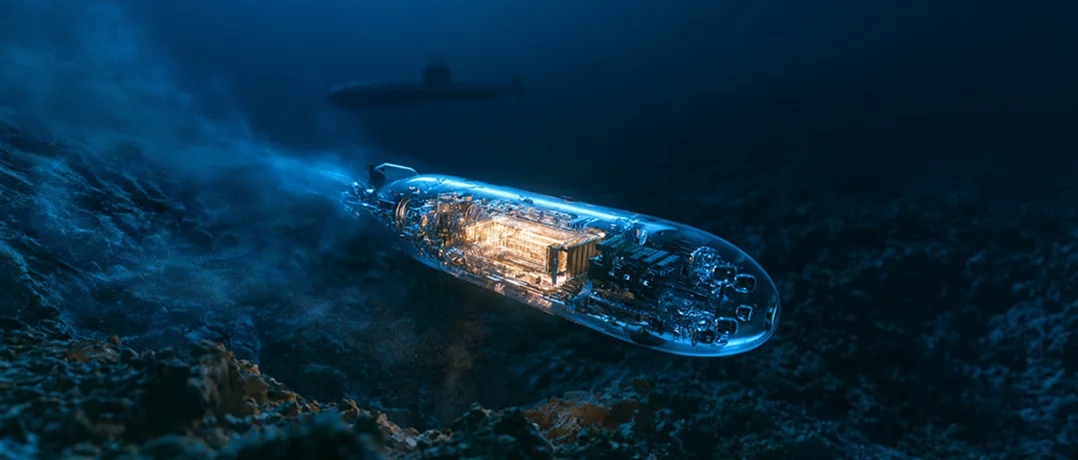
Artificial intelligence is changing how militaries find targets, coordinate weapons and operate autonomous systems. But take those technologies beneath the ocean, and many of the conditions that make them powerful begin to disappear. Radio waves travel poorly through seawater, GPS does not reach submerged vessels, and long-distance communication is severely constrained. At ranges of 10 to 100 kilometers, underwater acoustic networks may have only a few kilohertz of bandwidth, according to a March 2026 paper published by the International Telecommunication Union (ITU), leaving them able to transmit only a fraction of the information routinely exchanged over networks on land. These limitations strike at the foundations of modern AI warfare, which depends heavily on machines sensing their surroundings, exchanging information and coordinating their actions. A September 2026 Brookings report argues that this is likely to produce a very different technological revolution at sea from the one taking place in the air and on land. Rather than creating an ocean filled with seamlessly connected autonomous machines, AI may prove most consequential in smaller, more localized networks built to operate within the sea’s unusually severe constraints. Much of the promise surrounding AI-enabled warfare rests on connectivity. Sensors collect information, algorithms process it, and networks pass it to other systems that can decide how to respond. The ocean makes each stage harder. The ITU paper describes severe bandwidth limits, substantial delays and signals whose quality can change with surrounding conditions. Submerged platforms cannot assume that large quantities of information will move rapidly and reliably between machines. An autonomous vehicle may process information and make decisions independently, but coordinating many vehicles requires them to know what others are detecting and doing. Communication limits therefore restrict the size and geographic reach of the network itself. Bruce Jones and David Victor, the authors of the September 2026 Brookings report, argue that this favors what they describe as “pods, not swarms.” Instead of thousands of autonomous systems exchanging information across enormous distances, smaller groups of crewed and uncrewed platforms could operate within particular areas, especially chokepoints and contested coastal waters where proximity makes coordination more practical. This fragmented model also complicates expectations that enough sensors and powerful algorithms could make the oceans effectively “transparent.” Better processing cannot eliminate the physical difficulty of collecting and transmitting information. The same communications problem that limits underwater AI, however, also makes autonomy unusually valuable. Without constant contact with human operators, machines need greater capacity to navigate, interpret their surroundings and make decisions locally. AI could compensate for some of these limitations by identifying vessels, assessing changing acoustic conditions and adjusting how systems transmit or route information. Yet models trained using data from one environment can perform poorly somewhere else because underwater conditions vary significantly by location and time. The U.S. Defense Advanced Research Projects Agency, or DARPA, is pushing autonomy further through its Manta Ray programme, which is developing long-range uncrewed underwater vehicles designed to operate for extended periods without nearby human maintenance or logistical support. Turning those concepts into operational machines has proved difficult. The U.S. Navy's Orca Extra Large Unmanned Undersea Vehicle programme, launched in 2017, is developing large autonomous submarines capable of undertaking long-duration missions without crews, initially with the aim of deploying undersea mines in strategic waterways. A 2022 U.S. Government Accountability Office investigation found the programme was at least three years late and $242 million, or 64%, above its original cost estimate. AI also alters one of naval warfare's oldest contests: the struggle between finding an adversary and remaining hidden. A January 2026 report from RAND, a U.S. policy research organization, identifies “hiding versus finding” as one of four fundamental military competitions likely to be affected by AI. Algorithms can combine information from multiple sensors faster than human analysts, improving surveillance and target detection, while also enabling autonomous decoys and more sophisticated deception. The balance is particularly important beneath the ocean because stealth remains central to submarine warfare. Brookings therefore argues against assuming that improved sensors and AI will eliminate the value of traditional submarines. The authors expect solitary, stealthy vessels to remain important precisely because transmitting information can reveal a platform that would otherwise be difficult to locate. Governments are beginning to turn experiments in military autonomy into more permanent capabilities. On September 30, the Pentagon announced an Autonomous Warfare Command dedicated to expanding the use of robotics, drones and AI across the U.S. military. The command draws partly on lessons from Ukraine and the growing importance of relatively inexpensive autonomous systems. Some of those systems are already moving closer to combat roles beneath the water. In September, Britain's uncrewed XV Excalibur submarine launched a U.S. Mk 48 heavyweight torpedo during a British-American test in Scotland, demonstrating how autonomous platforms could eventually carry weapons as well as sensors. The strategic stakes beneath the surface reach well beyond submarine warfare. Oceans carry communications cables, energy infrastructure and trade routes while separating and connecting rival powers. Brookings notes that seabed cables carry more than 90% of U.S. military command-and-control communications, while their civilian counterparts form essential infrastructure for the global digital economy and the AI systems running on top of it. The emerging contest beneath the waves is therefore unlikely to reproduce the drone war visible in the skies above Ukraine. Geography, communications and stealth point toward something more fragmented, with autonomous vehicles and sensors concentrated where proximity can compensate for the ocean's technological constraints. AI is coming to the sea. But once underwater, the limits of the environment may matter as much as the capabilities of the technology.When connectivity breaks down
Learning to operate alone
Hiding from machines
The ocean's AI revolution
-
-

-
The Beiruter
-
