



In Al-Fakiha, carpet weaver Nahla Soukkarieh carries on a 200-year-old craft as economic hardship and changing times threaten its future.
Al-Fakiha carpets: A 200-year-old craft hanging by a thread
Al-Fakiha carpets: A 200-year-old craft hanging by a thread
By Vanessa Kallas | November 21, 2026

Reading time: 5 min
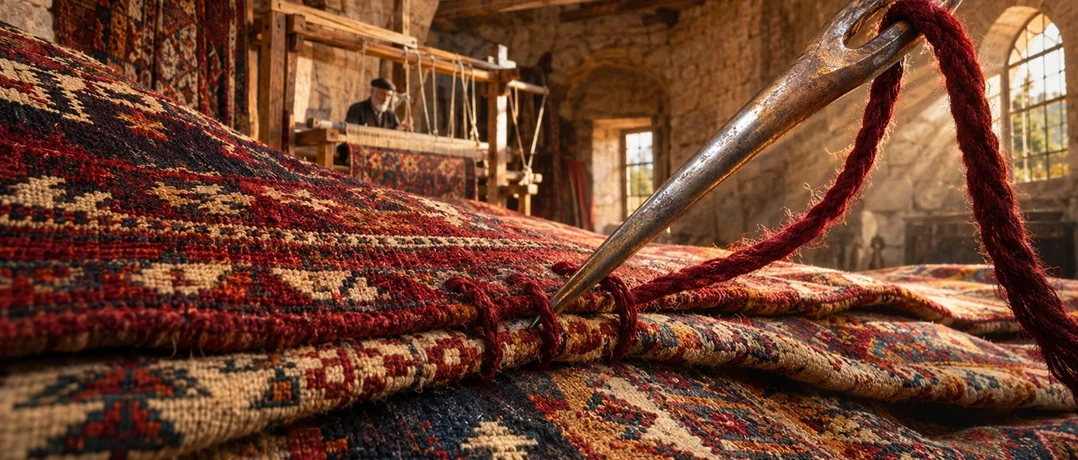
Some Lebanese villages are known for distinct crafts passed down through generations. In the small village of Al-Fakiha, in the north of the Bekaa, carpet weaving has been practiced for more than 200 years.
It all began when a villager from Fakiha married a Turkish woman from Aidamoun (Akkar) named Rahma and settled into Al-Fakiha. Rahma was skilled in carpet weaving, an ancient craft that has existed since the Ottoman Empire.
Rahma decided to pass on the craft to the women in Al-Fakiha. With time, women mastered this craft and turned it into a source of income for their families.
It didn’t take much time for Al-Fakiha to become Lebanon’s most famous and celebrated town for its carpet tapestry.
However, weaving those carpets was a long and intricate task. Women spent entire days pouring their hearts and souls into the art of tapestry. Women of Al-Fakiha lived off this work, supported their families and raised their children with it.
Now, very few women still practice this craft. One of them is Nahla Soukkarieh, a distant relative of the first woman who brought the craft to Al-Fakiha. The question remains whether Soukkarieh and other women will be able to revive the craft in the village or whether it will disappear with her generation.
A hobby that became a lifeline
Soukkarieh grew up as one of 11 children in a farming family. At 14, she was taken out of school. Her mother had just given birth to twins, and as the eldest daughter she was needed at home and in the fields at harvest time.
She found weaving almost by chance. Her sister-in-law kept a loom at home. Once she had finished for the day, she and her sister-in-law’s daughter would sit down at it. “We learned how to make the stitches,” Soukkarieh recalls. “Stitching is the first step in weaving.”
Soukkarieh married at 20. Like other brides in Al-Fakiha, she wove her own trousseau of carpets, floor mattresses and cushions, learning to comb, spin and dye the wool with her mother’s help.
About ten years later, her husband passed away, leaving her with four children to raise alone.
“I wanted us to live with dignity, so I started working in carpets,” she says. Weaving let her earn a living without leaving home, and it suited her temperament. “By nature, I don’t like anyone giving me orders. I like to be the one who makes the decisions.”
Since 1990 she has woven on commission for clients around Lebanon. Over time she began weaving people’s own pictures and logos, and her pieces have traveled as far as France, the United States and Australia.
The weaving process
Soukkarieh explains the weaving process from start to finish: “They shear the sheep, wash the wool and bring it to us raw. We comb it, spin it, wind it into balls, make it into skeins and dye it. Then we rinse it, dry it, wind it again, put it on the loom, and start weaving.”
Dyeing alone takes two days. The yarn boils in a large pot of powdered dye for 15 minutes. Then acid is added so the color holds fast and doesn’t come off on the weavers’ hands. After resting overnight, the yarn is rinsed at the spring or the river and hung on lines to dry.
Some colors are made naturally. When soaked overnight, straw gives beige, tea gives brown, and walnut and pomegranate leaves give green. “Anything natural and plant-based is more reliable than powder,” she says. “Natural dye lasts a lifetime.”
The original carpets were woven in red, black, navy, white and green. The motifs carried names drawn from village life, such as Abu Anqoud (the grape cluster), Abu al-Hamam (the pigeons), al-Sabe’ (the lion), walnut leaves and fig leaves. Later the women brought in new designs, including the many-colored “Box” pattern.
According to Soukkarieh, what sets Al-Fakiha carpets apart is their sturdiness and warmth. “If you lay out a full set, you’ll be comfortable even if the heater is low.” They are also fire-resistant. “If a hot ember falls on one, only the tips of the knots singe. The fire doesn’t go through and burn the whole thing.”
A dying profession
For years the orders came summer and winter. Then the war in Syria, Lebanon’s economic collapse and the pandemic dried up the work. “A woman used to make a carpet and sell it within the year, and that would cover her household expenses,” Soukkarieh says. “Now everything is expensive.”
A small square piece, 67 by 67 centimeters, now costs at least $150, against about $50 in the past, and buyers balk at the price. Yet the weaver’s margin has shrunk. Combing and spinning alone now cost $10 a kilo, and labor is hard to find.
Soukkarieh believes that the younger generation has moved on from this profession: “Most young women are educated, and those who aren’t prefer cleaner, steadier jobs.”
Lack of support has also caused the craft to dwindle at a faster pace. “There are many people in our area with capital, but not one of them has thought of opening a carpet workshop in Al-Fakiha to employ a few young women,” she says.
The last generation of carpet weavers
Soukkarieh considers herself part of the last generation of carpet weavers in Al-Fakiha. Yet she speaks of the work with nothing but pride. “It’s very tiring, and there’s dirt and dust,” she says. “But carpet weaving is the most honorable and most beautiful work for a woman. I find it better than any other job.”
Asked to sum up her career, she gives thanks for the health that kept her going. “I raised my children and never had to depend on anyone.”
Still, a thread of hope remains. Last month her granddaughters, aged 10 and 8, visited from Australia. At their mother’s home hangs a piece Soukkarieh wove for her, with a butterfly she once saw on the road. “Wow, your work is so beautiful, Teta (Grandma)! Can we learn it?” they asked.
She promised to teach them when they are older, if she is still here.
-
-

-
Vanessa KallasJournalistCovering socio-political, environmental, and human rights issues.
-
