

In an interview with The Beiruter, Alia Mansour explains that Syrian Foreign Minister Assaad al-Shaibani’s Beirut visit aims to reassure Lebanon and reshape relations around economic cooperation and stability.
Al-Shaibani’s Beirut signals a new chapter

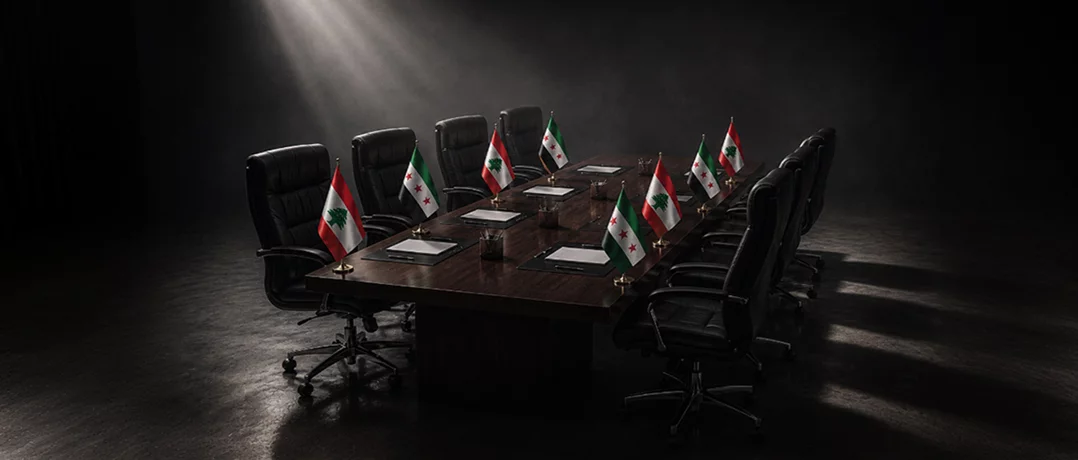
Syrian Foreign Minister (FM) Asaad al-Shaibani’s visit to Beirut has attracted considerable political attention, extending well beyond the framework of routine diplomatic exchanges between neighboring states. While the visit officially falls within the ongoing process of rebuilding bilateral relations following Syria’s political transition, its timing has amplified its importance amid renewed regional speculation about Damascus’ potential role in Lebanon’s internal affairs.
Indeed, the visit follows recent remarks by United States (U.S.) President Donald Trump suggesting that Washington could encourage the new Syrian leadership under President Ahmad al-Sharaa to play a role in limiting Hezbollah’s influence in Lebanon as part of broader regional security arrangements. Those comments revived long-standing sensitivities within Lebanon, where memories of decades of Syrian political and military influence remain deeply rooted.
From here, al-Shaibani’s meetings in Beirut serve not only as diplomatic consultations but also as an opportunity for the new Syrian leadership to define its approach toward Lebanon.
A visit with political dimensions
Although reciprocal visits between Lebanese and Syrian officials have taken place since the political changes in Damascus, al-Shaibani’s visit stands out because of both its timing and its anticipated meetings. One of the most notable engagements is the meeting with Lebanese Parliament Speaker Nabih Berri, representing the first direct high-level contact between the current Syrian leadership and one of Lebanon’s most influential political figures.
The meeting carries symbolic importance. Berri occupies a constitutional position as Speaker of Parliament while also remaining one of the country’s most prominent Shiite political leaders. The encounter could therefore be interpreted as an indication that Damascus intends to engage with all components of the Lebanese political system through official institutions rather than through exclusive political alliances.
Consequently, the visit is also viewed as part of a broader regional effort to stabilize Lebanon while redefining Syrian-Lebanese relations after years marked by conflict, mistrust, and mutual political grievances.
Simultaneously, following al-Shaibani’s meeting with Prime Minister (PM) Nawaf Salam, Beirut and Damascus signed an agreement to establish a joint Lebanese-Syrian High Committee comprising the relevant ministers, which will meet regularly to enhance cooperation. This comes in line with the efforts to strengthen cooperation between Lebanon and Syria on electricity interconnection, transportation, trade, facilitating movement of goods, and developing economic relations.
Insights from Alia Mansour: A vision centered on reassurance and economic partnership
To better understand the objectives and broader implications of al-Shaibani’s visit, The Beiruter spoke with Lebanese-Syrian journalist and activist Alia Mansour. She outlined how Damascus’ new leadership views its relationship with Lebanon, the political messages behind the visit, and the opportunities for future bilateral cooperation.
Reassuring Lebanon and resetting bilateral relations:
Mansour argued that the principal objective of al-Shaibani’s visit is to normalize relations and reassure the Lebanese public regarding the intentions of Syria’s new leadership.
According to Mansour, the visit reinforces messages repeatedly delivered by President Ahmad al-Sharaa since assuming office. She noted that Damascus seeks to stress that it has no intention of interfering militarily or politically in Lebanon’s internal affairs and instead views Lebanon’s stability as directly linked to Syria’s own security and prosperity.
The visit is intended to reassure the Lebanese. Syria’s stability depends on Lebanon’s stability.
She believes this reassurance is particularly significant given the regional speculation that followed recent international statements concerning Syria’s possible role in reducing Hezbollah’s influence inside Lebanon. In her assessment, Damascus wishes to dispel fears that the country's political transition could lead to a return to the interventionist policies associated with previous decades.
The significance of the meeting with Nabih Berri:
Mansour also highlighted the importance of al-Shaibani’s meeting with Lebanese Parliament Speaker Nabih Berri. Rather than viewing the meeting through a sectarian lens, she argued that it should be understood primarily as engagement with a senior constitutional official who also represents an important segment of Lebanese society.
In my opinion, the significance of the visit lies in the openness shown through the meeting with Speaker Nabih Berri.
She suggested that the meeting sends a broader political message: Syria intends to maintain equal relations with all Lebanese political actors while dealing with Lebanon through its legitimate state institutions rather than favoring particular factions.
Economic cooperation as the new foundation:
Economic cooperation, she added, represents another central pillar of the new Syrian approach. President al-Sharaa has consistently advocated greater economic integration between the two neighboring countries, particularly as Syria embarks on a lengthy reconstruction process following years of conflict.
According to Mansour, Damascus hopes Lebanon can contribute through its commercial expertise, financial services, infrastructure, and logistical capabilities. In return, stronger economic integration would generate mutual benefits while gradually replacing decades of political confrontation with shared economic interests.
He hopes Lebanon will play a role in that process, benefiting from Lebanese expertise as well as Lebanese infrastructure and facilities.
Regarding regional energy cooperation, including the Arab Gas Pipeline and agreements involving Lebanon, Syria, and Jordan, Mansour acknowledged that these files remain important. However, she suggested they are unlikely to dominate al-Shaibani’s discussions in Beirut because technical aspects have already been addressed during previous governmental meetings involving Lebanese PM Nawaf Salam and relevant ministers.
Future high-level engagement and political dialogue:
Mansour addressed the question of reciprocal presidential visits between Beirut and Damascus. While President al-Sharaa’s visit to Lebanon remains anticipated, she believes security considerations currently constitute the principal obstacle.
Given Lebanon’s complex security environment, she argued that Damascus is likely to proceed cautiously before scheduling a presidential visit. At the same time, she noted that many in Syria are equally awaiting a visit by Lebanese President Joseph Aoun to Damascus as another important step toward normalizing bilateral relations.
We in Syria are looking forward to President Joseph Aoun’s visit to Damascus. We hope he will come and see Syria as it truly is after the fall of the Assad regime.
Nevertheless, she believes the visit’s principal value lies in articulating Syria’s broader political and economic vision toward Lebanon. The overriding objective, she argued, is to demonstrate that the new leadership seeks fundamentally different relations from those that characterized the Assad era.
Mansour concluded by stressing that Syria has no desire to interfere in Lebanon’s domestic affairs. She suggested that Damascus could instead encourage political dialogue and institutional solutions to contentious issues, including questions surrounding weapons and national security, rather than supporting military approaches.
Hence, by engaging Lebanon’s constitutional leadership and highlighting principles of sovereignty, stability, and economic partnership, Syria’s new leadership appears intent on distinguishing its regional approach from that of previous decades. Whether these messages translate into lasting confidence between the two neighbors will ultimately depend not only on diplomatic exchanges but also on sustained political actions that reinforce mutual trust and respect for state institutions.
-
-

-
The Beiruter
-
