



From workplace absences to record internet traffic, GTA VI's launch revealed how a single video game could reshape everyday life.
All roads lead to Vice City

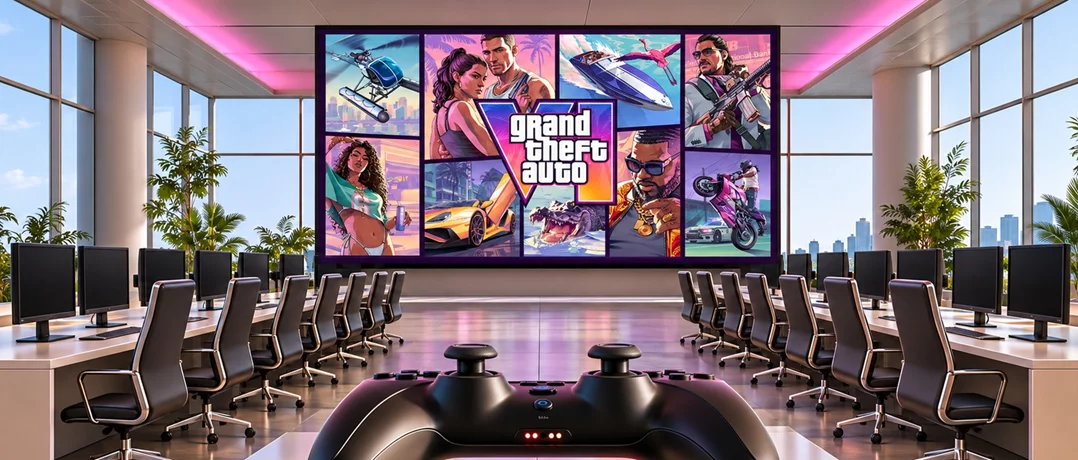
On the morning of November 19, millions of people followed a remarkably similar routine. They woke up, hit the gym, grabbed breakfast and climbed into their pickup trucks before heading into town to buy groceries. They even had plans to pick up their girlfriend from prison. All from the comfort of their own homes.
They were experiencing life as Jason, one of the two protagonists of Grand Theft Auto VI (GTA VI), the long-awaited installment of one of the world's most successful video game franchises, which allows players to freely explore vast fictional cities and pursue a life of crime.
Yet as millions went about their fictional lives, the game's release was having unexpected consequences in the real world.
The GTA flu
For many players, spending the day in Vice City, the game's fictional version of Miami, meant taking time off from their real-world obligations. In Britain, more than twice as many employees booked November 19 off to play GTA VI as to go on their honeymoon. British HR software provider BrightHR, drawing on data from 1.2 million employees across 70,000 businesses, estimated that 83,000 days of annual leave had been reserved nationwide to play the game throughout November and December. One particularly dedicated fan booked an entire fortnight.
But not everyone had requested time off in advance. On release day, BrightHR recorded a 56% increase in sickness-related absences compared with the previous Thursday, a phenomenon dubbed the “GTA flu.”
The disruption extended to Britain's classrooms. Provisional attendance figures from school management software provider Arbor indicated that around 35,000 additional secondary school pupils were absent compared with earlier in the week. Some schools offered prizes to encourage attendance, while one school in Birmingham even announced plans to deploy a minibus to collect absent pupils.
Empty roads, busy kitchens
Ironically, the release of a video game synonymous with driving coincided with a decline in parking activity across Europe. Mobility company Arrive recorded a 3% drop in parking sessions through its EasyPark application, reversing the usual increase in demand ahead of the weekend.
Across the Atlantic, the phenomenon was reflected in corporate expenditure. Financial technology company Ramp, drawing on transaction data from more than 85,000 American businesses, recorded a 7% decline in employee travel and entertainment purchases, making November 19 the weakest Thursday for spending in those categories in ten weeks.
Other businesses, however, capitalized on the occasion. In Miami itself, Uber Eats orders between midnight and 5 a.m. increased by more than 30%. DoorDash recorded a 450% surge in orders for gaming controllers and accessories during the hours surrounding the release.
Companies had anticipated this shift in consumer behavior. McDonald's introduced food ordering through Discord, a communication platform popular among gamers, while Uber Eats deliberately promoted meals that could be eaten with one hand.
Yet the hospitality industry faced challenges of its own. Data from workforce scheduling platform Harri, covering 280,000 restaurant shifts, revealed a 92% increase in missed shifts compared with the previous week, although sales at the restaurants monitored declined by less than 2%.
The day the internet broke records
Even before players could set foot in Vice City, GTA VI was breaking records elsewhere. At approximately 212 gigabytes, equivalent to nearly 80 hours of high-definition video streaming, the game was made available for download nine days before its official release to spread demand.
Within the first 48 hours of pre-downloading, American telecommunications giant Comcast recorded two of the ten busiest days in its network history. November 18 subsequently became its busiest day ever, with peak internet traffic rising 31% above normal levels. At one point, GTA VI alone accounted for nearly a quarter of the company's network traffic.
The phenomenon extended well beyond the United States. International internet exchange operator DE-CIX recorded unprecedented traffic across its global network, with internet traffic around the game's launch running 25% higher than during a typical week at the beginning of 2026.
Distributing a game of this size to millions of people without overwhelming internet infrastructure required extensive preparations. Amazon's content delivery network, CloudFront, utilized more than 1,550 server locations embedded within internet providers' networks, allowing players to download the game from locations closer to their homes.
Even with these preparations, gaming download traffic peaked at four times its normal daily maximum.
The battle for human attention
Perhaps the most revealing measure of GTA VI's success is the amount of time people devoted to it. According to Sony, between November 19 and 22, more than 39 million PlayStation 5 players collectively spent 683 million hours playing the game, equivalent to nearly 78,000 years. Each player averaged 17.4 hours over four days, with these figures excluding Xbox users altogether.
Market research firm Circana found that 61% of active PlayStation 5 users in the United States and 56% of active users of Xbox Series consoles worldwide played GTA VI on release day, averaging more than eight hours with the game running.
Millions more were watching others play. According to livestreaming analytics platform Streams Charts, GTA VI attracted nearly eight million simultaneous viewers and accumulated more than 214 million viewing hours within two days, surpassing the combined opening-week figures of Elden Ring, Hogwarts Legacy and Cyberpunk 2077, three of the most highly anticipated video game releases of the past decade.
Total viewing time on Twitch, one of the world's largest livestreaming platforms, increased by 61%, largely driven by GTA VI's popularity. Meanwhile, some of the most established titles in online gaming experienced significant declines in viewership. Fortnite's viewing time on YouTube fell by 60%, while Counter-Strike and World of Warcraft, two franchises that have maintained dedicated global audiences for more than two decades, each recorded declines of approximately 31% on Twitch.
Even entertainment platforms seemingly unrelated to gaming felt the impact. Adult entertainment website Pornhub reported that its American traffic fell 15.5% below normal levels just one hour after GTA VI's release.
GTA VI's extraordinary success, however, did not come at the expense of the entire entertainment industry. Despite concerns in Hollywood, The Hunger Games: Sunrise on the Reaping, released just a day after GTA VI, generated an estimated $225 million worldwide during its opening weekend, demonstrating that even one of the biggest entertainment releases in history could coexist with a major cinematic event.
With a record $3.79 billion in first-day retail sales, GTA VI secured its place in entertainment history. Yet its significance extends well beyond its commercial success. Few entertainment products possess the ability to alter the behavior of millions of people simultaneously, compelling businesses and institutions with seemingly no connection to the gaming industry to anticipate and adapt to their release.
For a few days in November, the rhythms of everyday life across the world were influenced by a city that doesn't even exist.
-
-

-
Nami El KhazenJournalistFocusing on geopolitics and international affairs.
-
