

From bugle calls to badges and service, Scouts du Liban continues to shape youth, identity, and citizenship across generations.
Always ready: Service and citizenship in Scouts du Liban
Always ready: Service and citizenship in Scouts du Liban
By Katharine Sorensen | February 22, 2026

Reading time: 6 min
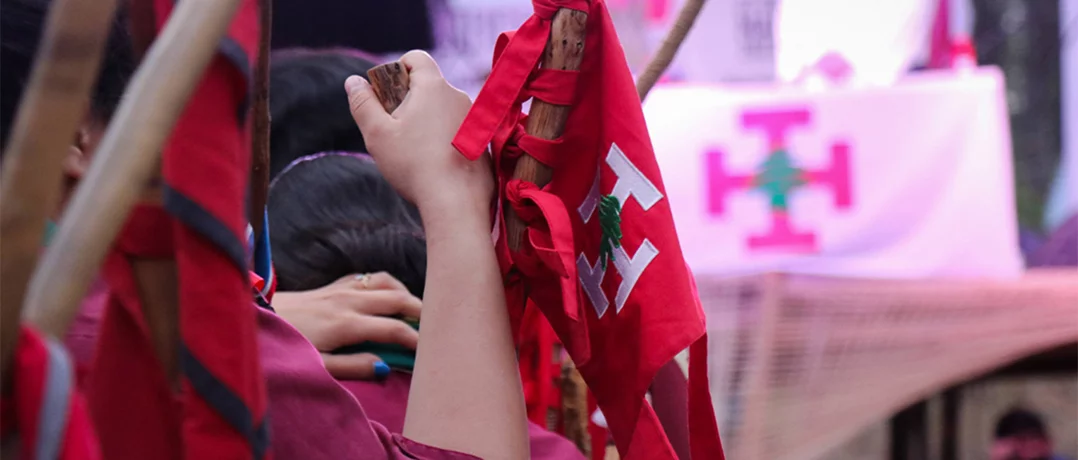
It’s 2:30pm on a Saturday in Beirut, and a uniformed figure raises a hollowed gourd to her lips. She blows a sharp call that echoes across the field, carrying farther than you expect. No, this is not a medieval reenactment. And neither is it some quaint, remote folk festival.
This is Scouts du Liban.
Morse code follows. “Dah! Dit dit dit dit dit dit!” To the untrained ear, the rapid series of dits and dahs might sound like nonsensical gibberish. To the scout, however, the message is unmistakable. “Attention! Fall in!”
There’s a flurry of activity, as scouts ages 8 to 21 criss-cross and zig-zag across the field in a seemingly haphazard pattern. It’s chaos at first, and you wonder at the sanity of the participants. Then suddenly, the running ceases, and three perfect semi-circles emerge.
Not bad. And somehow all the scouts’ scarves have remained on their neck. Bravo.
Beyond the field
Step back from the field for a moment, and the broader context sharpens.
Globally, scouting is often associated with suburban American troop meetings or British imperial ceremonies, rooted in a movement founded by Lord Baden Powell in the early twentieth century and later exported across the colonial territories. In much of the West, scouting today competes with sports leagues, summer camps, and myriad extracurricular activities that have come to dominate the youth’s life.
In Lebanon, however, scouting has evolved into an institution far more embedded into the country’s social fabric. As a member of the World Organization of the Scout Movement, Lebanon’s scouting sector is unusually dense for a country of its size. With 41 officially recognized organizations operating under the Lebanese Federation of Scouts, the movement commands a presence in nearly every district of the country and serves as a popular, national youth institution.
Structure, inclusion, and reach
One such organization is the Scouts du Liban (SDL). Founded in 1936 by the Scouts de France, SDL has grown steadily and now counts 15,202 members in 105 groups across the country. Though it began as an explicitly Catholic movement, it has evolved into a Christian-rooted but religiously open organization spanning multiple faiths. Like most scouting movements, it is structured by age, from cub scouts and wolf girls (8–12), to scouts and girl scouts (12–17), and rovers and pioneers (17–21).
Its approach to inclusion has shifted as well: girls, once part of the parallel Guides du Liban (GDL), were formally integrated in 2001, and today 41 “common groups” allow SDL and GDL to operate side by side. Membership costs $10 per year, supported by an internal aid system in which stronger groups contribute 10 percent of their funds to assist others. As General Commissioner Michel Khairallah put it, “Money is not our priority. We only ask that they pay whatever you can, wherever you can.”
Symbols and ceremony
If structure explains how scouting works, ritual reveals why it endures.
One of the most striking elements of a scout is his or her uniform. Stare at one for too long and you become slightly dizzy at the kaleidoscope of colours and symbols that crowd the dark blue fabric.
One scout at the Saint Vincent de Paul Bourj Hammoud branch, Georges, had 23 badges stitched onto his right shoulder. There was one for “water expert,” another for “interpreter,” and one for “cook,” and “friend of God.” It took Georges 4-5 years to collect all the badges, and he has no intention of slowing down. The badges, he explained, span a variety of disciplines and are divided into categories of “Expression” (think sculptor or singer), “Discovery” (explorer, reporter), “Sport,” “Life in Nature,” “Technique” (mechanic, electrician), and “Christian life.”
These badges, however, are not mere checklists for scouts to race through.
They are earned, not collected, and represent a continuous process.
But the personal insignia tell only part of the story.
Above these individual badges lay the troop’s “district badge.” As a member of one of the eight Mount Lebanon districts, Georges’ badge featured a shield with a lion, castle, goat, and mountain, four symbols that echo the history and landscape of the Mount Lebanon region. But travel east to the Beqaa, and the badge’s imagery shifts: there, a sun, vine, and plough speak to the valley’s agricultural roots. Head north and you’d find the cedar alongside an olive branch and a water spring. In Beirut, the symbols turn maritime and mythic—a dragon, scales of justice, and Phoenician ship—while in the South, the badge boasts a ship, castle, and dove. Together, these emblems situate each troop within a specific geography and history, embedding regional character directly into the uniform.
The symbolism continues as you move right to the scout’s collar and locate the scarf.
The scarf, simple at first glance, functions as a visible expression of how Scouts du Liban balances uniformity with local identity. The scarves are worn the same, tied the same, and hold the same significance. Yet the colours vary, depending on the troop.
At Saint Vincent de Paul Bourj Hammoud, the scarf comes in grey and red, grey for la matière grise, a nod to intelligence, and red for the heart. 15 minutes north at Antranik Antelias, however, the scarves colours are red and blue, two colours taken from the Armenian flag. While united under the same Scouts du Liban umbrella, the two troops have their own unique peculiarities, traditions, and identities. There is both continuity, and individuality. Just like the scarves.
And that tall, narrow banner at the back? That’s the fanion, also known as the patrol flag. Each patrol, usually seven or eight scouts within a larger troop, designs its own, choosing an animal and a phrase to match.
Think back to the semicircle formed after the gourd-bugle call. Once the line settles, each patrol sends its chant across the field: “Lion, long live the king!” “Panther, swift!” “Dolphin, king of the sea!”
You would be amazed at the conviction with which a scout will roar about jungle hierarchy.

Formation
As many scouts join in their early adolescent years, the initial motivations tend to be straightforward. Ask an eight-year-old why they joined and the answer is refreshingly simple: friends, adventure, camping, or, to cub scout Ivan, a chance to “learn how to tie your laces.” An important skill indeed, young man.
Ask a rover why they stayed, and the tone shifts.
"Scouting is not just an activity,” a rover at Saint Vincent de Paul explained.
It’s a path you create.
That progression, from play to purpose, is by design. The entire scouting system is structured to guide its members through life. Its aim is to inspire self-discovery and to build what Khairallah calls a “basket of values” by which you can define yourself and navigate subsequent stages of adulthood.
For Joelle Feghly, an alumni member at the Sagesse Group in Achrafieh and former district commissioner of Mount Liban, that formation is lasting. Scouting, she said, is more “complete” than any other extracurricular group. Its activities cultivate spiritual, physical, and personal development and instill principles of teamwork, humility, and creativity. “It’s who I am now,” Feghly said. “I can’t imagine life without it.”
Service and citizenship
If there is a thesis to scouting, it’s captured inside a familiar phrase: Toujours prête à servir de notre mieux. Always ready to serve, to the best of our ability.
Each age group emphasizes a different part of the creed. Cubs focus on “de notre mieux,” doing their best. Scouts internalize “toujours prête,” being prepared. And rovers carry “à servir,” service itself.
Service lies at the heart of the scouting philosophy. Return to the motto - always ready - and a deeper meaning unfolds. Yes, a scout is “always ready” to pitch a tent in the dark or navigate by compass, but they must also be “always ready” to serve. This service can be internal, i.e. help out with logistics at a scouting camp, or external, such as painting a local road or bringing food to families in need during the holiday season.
Service, for many scouts, is also inherently tied to citizenship. “Scouting is about becoming good citizens,” Sevag, executive council member at Entranik, said. “And you exercise your citizenship through community service.”
Institutional neutrality
Exercising citizenship, however, is not to be confused with exercising political allegiance.
Scouts du Liban has repeatedly resisted political affiliation. For Khairallah, that stance is foundational to the organization’s identity and traces directly back to the civil war. During that period, both left- and right-wing factions attempted to claim or align with the movement, Khairallah explained. When SDL refused, members left, and its expansion stalled. Decades later well into the twenty-first century, the same conviction holds.
“You can exercise your political rights,” Khairallah said.
But you have no right to influence us or put a certain image or association upon us.
A lasting framework
Although filled with symbols and ceremony, Scouts du Liban endures not through spectacle but through structure, relying on small, repeated rituals that gradually shape character. Year after year, the repetition does its work, shaping Lebanese youth into disciplined, engaged citizens – ones who are always ready to serve.
-
-
-
Katharine SorensenReporterSpecializing in global affairs, technology and economics, with a focus on on-the-ground investigative reporting.
-
