Anissa Helou reflects on a lifetime documenting Lebanon's culinary heritage, explaining how her latest cookbook preserves the country's regional food traditions, family recipes, and cultural history for future generations.


Anissa Helou reflects on a lifetime documenting Lebanon's culinary heritage, explaining how her latest cookbook preserves the country's regional food traditions, family recipes, and cultural history for future generations.

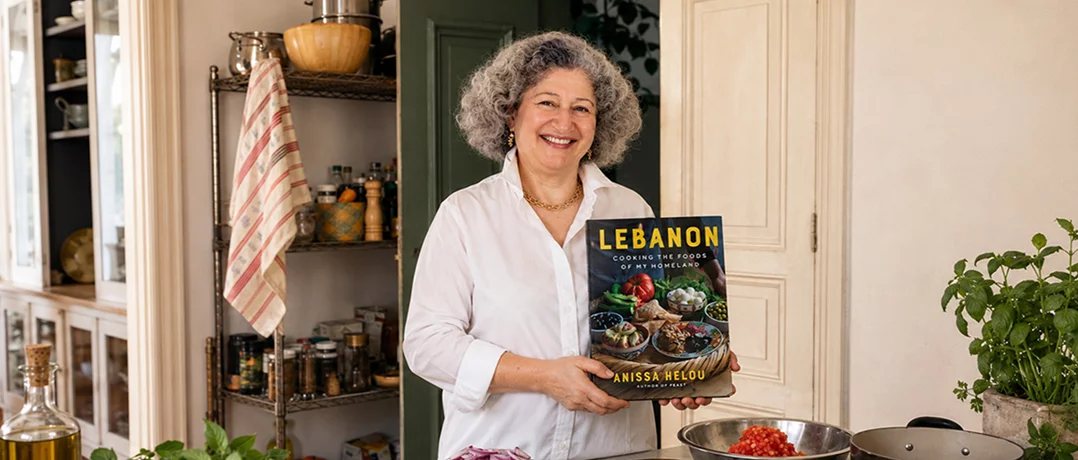
Anissa Helou has spent over three decades chronicling the food of Lebanon, Syria and the wider Middle East, turning family recipes and years of field research into eleven cookbooks that read as much like cultural history as kitchen manuals. Her latest, Lebanon: Cooking the Foods of My Homeland, is her most ambitious yet, a region-by-region portrait of how the country's different communities cook, published at a moment when war, economic collapse and displacement have put much of that culinary heritage at risk.
The Beiruter sat down with Helou to talk about how she got into food writing, what sets her new book apart, and why she sees her work as a race to preserve traditions before they disappear.
Helou, who is half Lebanese and half Syrian, left Beirut in 1973, before the civil war reshaped the country she grew up in. "I left Lebanon when I was 21," she told me, "back in 1973, so even before the war." London was not, at first, meant to be a culinary detour. She trained on the Sotheby's Works of Art course and spent close to twenty years in the art world, dealing in antiques and collections.
She had been planning a book about collecting when her literary agent introduced her to a Lebanese friend, and the conversation turned to cookbooks. "I thought maybe I should write a book about my mother's recipes," she said. A publisher happened to be looking for exactly that, a Lebanese cookbook, and Helou's first book was born, built largely from her mother's own handwritten pages.
"It was basically my mother's book," Helou said, "because she wrote all the recipes and everything." Her mother, a home cook rather than a trained food writer, had recorded them in Arabic and left much of the detail to be filled in. Helou and her mother tested the recipes together, and Helou layered in historical research of her own, an introduction tracing Lebanon's history and the influence of the various peoples who had occupied it over centuries.
That first book set the pattern for everything that followed: precise, workable recipes wrapped in cultural and historical context. "My whole purpose writing about food is to preserve the traditions, the recipes, the culinary lore," she explained. She resists the word "historian" as too grand a title, but the approach is unmistakably that of someone documenting a culture as much as a cuisine. "It's also very important to put the recipes in their social and historical context," she said, "and even have family stories, anecdotes and all this, so that you give life to the dishes."
Now in her fifth decade of food writing, Helou has just published her latest book, Lebanon: Cooking the Foods of My Homeland, her ninth title, and one she describes as her most ambitious exploration of the country's regional diversity. The book runs 368 pages and includes 165 recipes, paired with a mix of on-location photography shot across Lebanon and studio food photography.
It was published in the United States in March, with a UK edition to follow. "It's coming out next month in the UK," Helou told The Beiruter. The book had its official Beirut launch in late June, at a ceremony hosted by Lebanon's Tourism Ministry. Helou expects the reception to differ somewhat between the two English-language markets. "The difference between New York and London is that you have a lot more Middle Easterners in London," she said, "and Lebanese cuisine in particular is much better known in London."
Where her earlier work centered on her mother's Maronite recipes from the mountains, this book widens the lens considerably, mapping how Lebanon's various communities and confessions cook differently from one another. "This last book is very interesting because it's all about the people of Lebanon and the different regions," Helou said, "how the Druze cook in the Chouf Mountains, or the Sunnis of Beirut, they are all different.” She traces variations on shared dishes from region to region, and documents plenty that exist nowhere else, dishes tied so tightly to a single valley or coastline that they simply do not travel.
Helou is careful to distinguish the book from others already on shelves. "There are a lot of books on Lebanese cuisine," she said, "most of them basically recipe books more than historical and social context information." Hers, she argues, goes further, digging into regional dishes that rarely make it into more general collections. She recalled a friend messaging her after reading it, excited but a little embarrassed that he didn't recognize roughly a third of the dishes inside, among them lesser-known preparations like schnoob and berhoules that most books skip in favor of what she calls "the usual suspects. “It stands alone, in a way, because it's more deeply researched,” she said.
Helou told The Beiruter that the dish closest to her heart, the first one she ever cooked, was loubieh bizeit, made with her sisters. It appears in the new book photographed exactly the way her family has always eaten it, piled onto bread, the tomato-soaked bread rolled and eaten on the side. But she is quick to name others that are meaningful to her too, including the specific southern styles of kibbeh, kibbeh siyadeh among them, that rarely appear in cookbooks focused on Beirut or the mountains.
For all the obscure regional dishes the book uncovers, Helou points out that some things stay constant. Tabbouleh, fattoush, and kibbeh are dishes she considers essentially universal across the country. But even those, she noted, come with endless small variations depending on whose kitchen they're made in. It's a running joke among Lebanese families, she said: every village, and practically every grandmother, insists her version is the correct one. Ask around enough households and someone will always tell you their grandmother does it differently.
Helou once ran a cooking school out of her converted loft in London and had, before the pandemic, been planning to open one in Sicily. Those plans didn't survive COVID, and she's since let go of the idea entirely. These days her work is split between writing, consulting for restaurants, recently including a young Lebanese entrepreneur in Boston developing a saj concept, and appearances at food festivals and demonstrations.
She still returns to Lebanon, though less often than she once did. Her mother's death just over a year ago changed the rhythm of those visits. "When my mother was alive, I used to come every two or three months," she said. "Now I come twice a year." The visits, she admits, are more social than productive. "I'm too busy socializing here to write," she said, though she's quick to add that the country never stops feeding her curiosity, always turning up something new to chase down.
Lebanon's dishes may endure, but the places tied to them, the bakeries, the markets, the kitchens themselves, are increasingly at risk given the country's ongoing crises. Her books, this latest one especially, are as much an act of documentation as of cooking instruction, a record in words and photographs for someone who may grow up abroad and never make it back, so that when they finally open the book, they can still reconstruct their mother's or grandmother's cooking from it.
It is a fitting resonance of a line once said about her, which Helou says captures the work entirely: some books feed you, others take you home.

