

Arab League foreign ministers condemned Iran’s missile and drone attacks on several Arab states, reaffirming their right to collective self-defense and calling for international action to protect regional security and maritime stability.
Arab league rallies against Iran’s regional strikes
Arab league rallies against Iran’s regional strikes
By The Beiruter | March 09, 2026

Reading time: 3 min
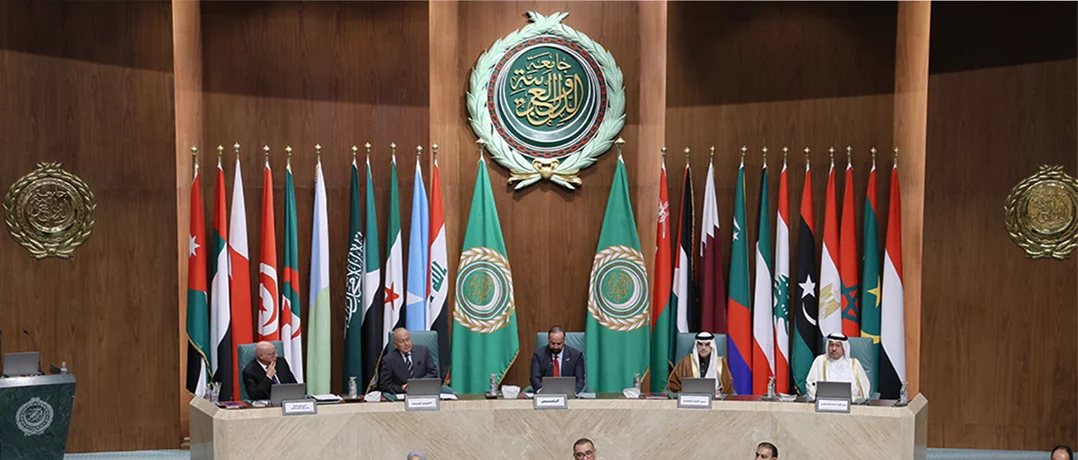
Amid escalating Iranian aggression in the Middle East, the Arab League convened an extraordinary ministerial meeting via video conference, to address what member states described as deliberate and unprovoked attacks on their territories.
The meeting, chaired by the United Arab Emirates (UAE), reaffirmed the inherent right of targeted Arab nations to defend themselves individually or collectively under international law, specifically referencing Article 51 of the 1945 United Nations (UN) Charter.
Arab League condemnation and legal justification
The extraordinary session of Arab foreign ministers expressed strong condemnation of the recent Iranian strikes, labeling them as “cowardly,” “illegal,” and conducted without prior provocation. These attacks, carried out via ballistic missiles and drones, targeted Jordan, the UAE, Bahrain, Saudi Arabia (KSA), Oman, Qatar, Kuwait, and Iraq, posing severe threats to regional peace, stability, and international security.
Ministers highlighted Iran’s deliberate targeting of civilian infrastructure, including airports, ports, energy facilities, residential areas, and diplomatic premises. The assaults not only endangered civilian lives but also caused significant material damage, constituting clear violations of international law and the 1949 Geneva Conventions and its subsequent protocols. The Arab League stressed that any assault on a member state constitutes a direct attack on all members, as outlined in the 1945 Arab League Charter and the 1950 Joint Defense and Economic Cooperation Treaty.
The League further reaffirmed the right of the affected nations to pursue all necessary measures to protect their sovereignty, security, and citizens, including military responses. It also emphasized the importance of resorting to international mechanisms, including the UN Security Council (UNSC) and UN General Assembly (UNGA), to condemn the attacks and hold Iran accountable.
Furthermore, the Arab League strongly condemned Iranian measures aimed at disrupting freedom of navigation, including threats to close the Strait of Hormuz or impede maritime traffic in Bab al-Mandab and other international waters. Such actions, the League stressed, jeopardize global economic stability, energy supply chains, and international peace. Member states reiterated the necessity for Iran to comply fully with international humanitarian and maritime law, ensuring civilian protection and unhindered commercial passage.
From here, Arab ministers collectively praised the bravery and efficiency of national defense and security forces, whose rapid response mitigated further loss of life and property.
Regional cooperation and international support
The Arab League’s declaration coincided with heightened diplomatic activity. Qatari Emir Sheikh Tamim bin Hamad received a call from French President Emmanuel Macron, who affirmed France’s full support for Qatar in light of Iranian aggression. Both leaders stressed the importance of maintaining stable energy supplies, ensuring freedom of navigation through strategic maritime passages, and reinforcing ongoing defense cooperation. Macron also reiterated France’s commitment to air defense assistance currently deployed in the region.
Similarly, Macron engaged in discussions with Kuwaiti Emir Sheikh Mishal al-Ahmad and Egyptian President Abdel Fattah el-Sisi, highlighting the need to secure maritime transportation, particularly in the Red Sea, and maintain energy stability. Parallel discussions involved the Qatari Foreign Minister Sheikh Mohammed bin Abdulrahman with French and Greek defense officials, focusing on enhancing coordination and mutual defense measures in the current volatile environment.
Moreover, the Arab League urged the UN Security Council to adopt a binding resolution condemning Iranian attacks and enforcing an immediate cessation of hostilities, holding Tehran fully accountable for its illegal actions. The League called on all Arab diplomatic missions worldwide to convey the decisions and concerns of member states, reinforcing coordinated international advocacy to protect regional security.
Lebanon in Arab security concerns
The League also reaffirmed its unwavering support for Lebanon’s unity, sovereignty, and the exclusive control of armed forces by legitimate state institutions over all its territory, urging adherence to UNSC Resolution 1701 and the 1989 Taif Agreement.
In this context, the League backed the decision of the Lebanese Council of Ministers on 2 March 2026, to immediately prohibit all security and military activities of Hezbollah and deem them illegal is welcomed. From here, it extended its support to the Lebanese government’s measures to safeguard security, stability, and sovereignty, while urging influential international actors to pressure Israel to cease its attacks and fully implement relevant international resolutions.
In conclusion, the extraordinary Arab League session underscored a unified regional stance against Iranian provocations and a resolute commitment to uphold sovereignty, protect civilian populations, and ensure regional stability. By asserting their legal right to self-defense and appealing to international law and institutions, Arab states signaled both preparedness to act militarily if necessary and determination to mobilize global diplomatic mechanisms. This comprehensive approach reflected a strategic balance between immediate defensive measures and long-term efforts to safeguard peace, security, and freedom of navigation in a region critical to global energy and commerce.
-
-

-
The Beiruter
-
