

Maria Magro's Between Two Shores uses watercolor to explore how architecture functions as both a witness to history and a repository of memory, linking personal experience to the layered histories of places such as Beirut, Jerusalem, and Baalbek.
Architecture, memory, and the places we carry

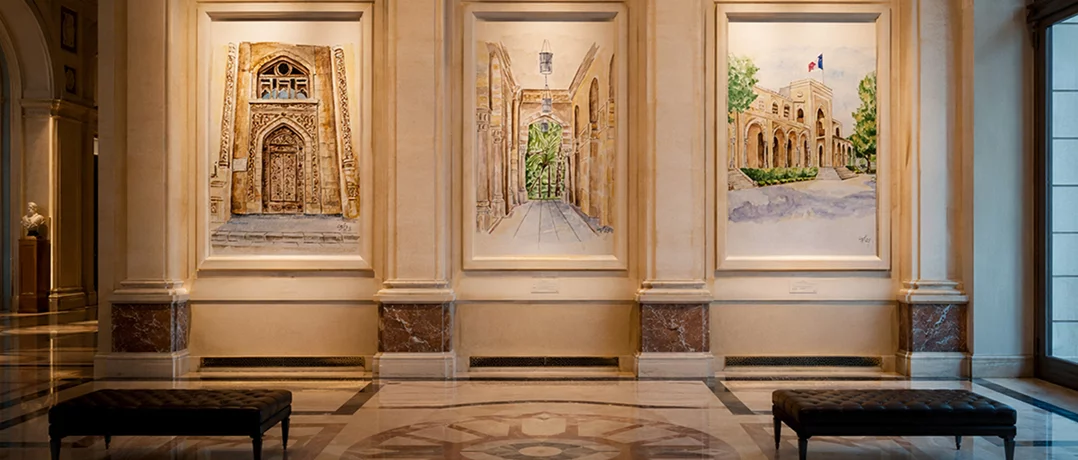
Architecture is often treated as a record of history. It is the legacy people leave behind and the landscape through which later generations encounter the past. Yet buildings do more than preserve history. They also accumulate memories, becoming repositories of personal experiences, relationships, and moments that long outlast those who lived among them.
In Entre deux rives, voyage en mémoire ("Between Two Shores, A Journey Through Memory"), currently on display at the USEK Museum, Portuguese artist Maria Magro explores exactly that relationship between architecture and remembrance. Drawing on decades of diplomatic postings that took Magro from Ankara and Jerusalem to Washington and Beirut, the exhibition traces "an intimate cartography" of the residences and cities she encountered throughout her travels.
In doing so, the collection asks a deceptively simple question: Why does architecture so often become the vessel through which we remember people, places, and entire chapters of our lives?
Architecture as a repository of memory
The relationship between architecture and memory has long fascinated writers and artists. In his 1958 work The Poetics of Space, French philosopher Gaston Bachelard argued that houses become containers of lived experience, with memories often attached to rooms, staircases, windows, and corners.
Magro's exhibition can be read through this lens. Rather than presenting sweeping cityscapes, many of her paintings focus on fragments. An ornate Jerusalem doorway, a stone arcade, a carved fountain, a section of Baalbek's columns. In Magro’s paintings, architecture is not merely a backdrop to history but one of the ways history is remembered and carried forward.
Why Lebanon lends itself to memory
Few places offer a richer setting for such an exploration than Lebanon.
Roman temples stand alongside Ottoman-era houses, medieval monasteries overlook modern highways, and French Mandate architecture remains woven into the fabric of contemporary cities. Across a relatively small geographic area, centuries of civilizations remain visible in the landscape.
The exhibition reflects this architectural density. In one watercolor, Magro focuses on the intricate stone carvings of the Temple of Bacchus at Baalbek. Elsewhere, she turns her attention to pointed arches, courtyards, and decorative details characteristic of Lebanon's nineteenth-century architecture.
For many Lebanese communities, buildings carry meanings that extend far beyond their physical form. They become markers of family histories, religious traditions, local identities, and collective memories. In a country where successive civilizations have left visible traces upon the landscape, architecture frequently serves as a record of overlapping histories.
Yet for Magro, Lebanon's appeal extends beyond architecture alone. The country's natural environment proved equally influential.
"It is only natural that I continued this artistic journey in Lebanon," she told The Beiruter.
Lebanon will always remain a special country for me because of its natural beauty: the blue of the sea, the greenery of its mountains, and its light.
Between France and the Levant
The exhibition's title refers to more than geography.
The collection traces a route through cities that have long occupied a crossroads between European and Middle Eastern histories, moving through spaces where architectural traditions and cultural influences have intersected for centuries.
Few sites better illustrate that intersection than Beirut's Résidence des Pins.
Built in 1915 by businessman Michel Trad, the residence later became the official home of the French High Commissioner during the Mandate period. It was from its grounds on September 1, 1920, that General Henri Gouraud proclaimed the creation of Greater Lebanon, making it one of the most historically significant sites in the country's modern history.
As a result, the residence occupies a distinctive place within both Lebanese and French historical memory. It is simultaneously a family home, a diplomatic institution, an architectural landmark, and a site associated with the birth of the modern Lebanese state.
For Magro, the residence was more than a historical landmark.
During her husband's tenure as French ambassador to Lebanon, the residence became part of her immediate surroundings and artistic landscape. She described the Résidence des Pins as both beautiful and historically significant, noting that it carries "a personal history with France."
Architecture occupies a unique position between public history and private memory, serving simultaneously as a witness to historical events and a repository of everyday experience.
Watercolor and the art of impermanence
If architecture provides the exhibition's subject matter, the medium watercolor shapes how those places are remembered.
Magro's artistic journey began more than three decades ago in Ankara, where she first taught herself oil painting. Later, while living in Washington, she discovered watercolor under the guidance of an American watercolorist–a technique she has continued to develop ever since.
Its transparency, fluidity, and luminosity immediately appealed to her. Unlike oil paint, watercolor dries quickly and lends itself naturally to sketching on location, allowing artists to respond directly to changing light, landscapes, and architectural details.
"It enabled me to capture the light, the shadows, and the subtle details that were close to my heart throughout my travels," she said.
In Lebanon, I found an environment that perfectly resonates with my artistic sensibility.
The result is a body of work concerned less with documentation than with recollection.
At a moment when travel is increasingly captured through digital photographs, Entre deux rives offers a slower form of remembrance. Through architecture, memory finds a physical form. Through watercolor, those memories remain suspended between past and present and between two shores.
-
-

-
The Beiruter
-
