

Argentina’s World Cup celebration reignites the Falkland Islands dispute, prompting debate regarding FIFA regulations, political expression, and historical rivalries.
Argentina’s Falklands banner sparks FIFA debate

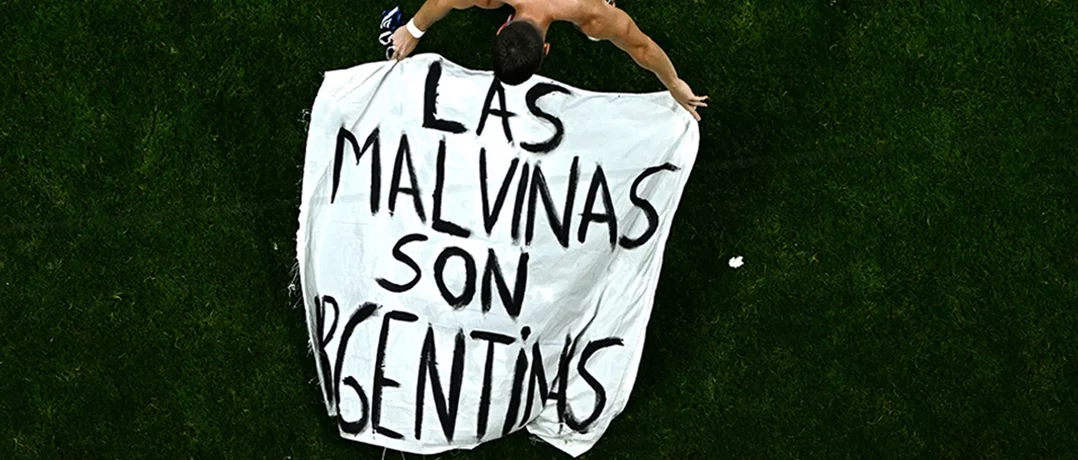
Argentina’s victory over England in the 2026 FIFA World Cup semi-final was expected to be remembered for its late comeback and qualification for a second consecutive World Cup final. Instead, the post-match celebrations shifted part of the international spotlight away from football after several Argentine players displayed a banner reading “Las Malvinas son Argentinas” (“The Falklands are Argentine”).
The move immediately reignited one of the world’s longest-running sovereignty disputes while raising questions about FIFA’s regulations governing political expression at international tournaments. Although FIFA has yet to announce disciplinary proceedings, the incident has nevertheless revived the recurring debate over whether football can, or should, remain separate from deeply rooted historical and political conflicts.
The banner and its immediate impact
Following the final whistle in Atlanta, Argentina’s players celebrated with supporters inside the stadium. During the celebrations, defenders Lisandro Martínez and Giovani Lo Celso were photographed holding a banner asserting Argentina’s claim over the Falkland Islands, known in Argentina as Las Malvinas.
The images rapidly spread and drew attention away from the final match result itself. The message reflected Argentina’s long-standing official position regarding sovereignty over the islands, but its display during an official FIFA competition immediately raised concerns about compliance with tournament regulations prohibiting political messaging.
The semi-final had already been regarded as one of the tournament’s most politically sensitive fixtures due to the historical relationship between England and Argentina, prompting enhanced security measures around the match.
The banner display quickly received support from several Argentine political figures. Vice-President Victoria Villarruel stated that the match “was not just another game” and reiterated Argentina’s sovereignty claim in public statements following the victory.
The Malvinas are Argentina! They forbade them to take them to the field and forgot that we carry them in our blood and heart.
Before the semi-final, she had characterized the encounter with England as an opportunity to stop “the invaders” and “claim what is ours;” remarks that drew attention because of the historical sensitivities surrounding the fixture.
By contrast, Argentina head coach Lionel Scaloni sought to distance his team from political controversy in the lead-up to the match. He stressed that the semi-final should be viewed solely as a football contest, acknowledging the tragedy of the 1982 conflict while arguing that sport should not become a vehicle for political disputes. Scaloni highlighted that the war remains a painful chapter in history that deserves remembrance but should not overshadow the spirit of international competition.
FIFA’s regulations on political displays
FIFA has consistently maintained that football should remain politically neutral during its competitions. Its Stadium Code of Conduct prohibits banners, flags, clothing, or other materials considered political, offensive, or discriminatory from being displayed inside official venues.
Whether Argentina’s banner constitutes a breach ultimately rests with FIFA’s disciplinary bodies. The organization has not publicly confirmed whether it has opened an investigation, nor has it announced any sanctions. However, the incident bears similarities to previous cases involving political messaging during FIFA competitions.
In 2014, the Argentine Football Association received a £20,000 fine after national team players displayed the identical slogan before a friendly match against Slovenia. FIFA concluded that the display violated regulations concerning political demonstrations and team misconduct. This has fueled speculation that disciplinary action could once again be considered if FIFA determines the latest display violated its rules.
The historical context behind the dispute
The Falkland Islands remain one of the most enduring territorial disputes between Argentina and the United Kingdom (UK).
Britain has administered the islands continuously since 1833, while Argentina argues that it inherited sovereignty from Spain following its independence in 1816 and maintains that British control began through what it considers an unlawful colonial occupation.
The disagreement escalated dramatically in April 1982 when Argentine forces landed on the islands, triggering a 74-day armed conflict. Britain responded by deploying a naval task force to retake the territory. The war concluded in June 1982 with British forces regaining control. The conflict resulted in the deaths of 255 British military personnel, approximately 649 Argentine servicemen, and 3 civilian islanders.
Beyond the military outcome, the war profoundly influenced both countries’ domestic politics. In Britain, the victory strengthened Prime Minister (PM) Margaret Thatcher’s political standing. In Argentina, the defeat accelerated the collapse of the ruling military junta and paved the way for the country’s return to democratic governance.
Nevertheless, despite decades of diplomatic negotiations and periodic discussions at the United Nations (UN), the sovereignty dispute remains unresolved.
Argentina continues to regard the islands as an integral part of its national territory, referring to them as the Islas Malvinas. Successive Argentine governments have consistently reaffirmed their commitment to pursuing sovereignty through peaceful diplomatic means.
The UK, meanwhile, maintains that the Falkland Islands are a British Overseas Territory and argues that the wishes of the islanders are the determining factor in the sovereignty question. In a 2013 referendum, an overwhelming majority of Falkland Islanders voted to remain under British sovereignty. Britain relies on the latter’s outcome as evidence of the islanders’ right to self-determination, while Argentina rejects the referendum’s legal significance, arguing that the population was established after Britain’s occupation.
Sport and politics: An ongoing challenge
The semi-final between Argentina and England is the latest example of the complex relationship between international sport and political identity.
Major sporting events frequently provide athletes, supporters, and public figures with highly visible platforms capable of amplifying political messages. FIFA has repeatedly sought to limit such expressions, arguing that neutrality protects the universality of the game.
Nevertheless, historical disputes, national identity, and collective memory often remain intertwined with international sporting competitions. Similar debates have emerged in previous tournaments involving territorial disputes, geopolitical conflicts, and symbolic displays by both players and supporters.
The challenge for FIFA and similar organizations thus lies in balancing freedom of expression with the principle that sporting events should not become arenas for political confrontation.
-
-

-
The Beiruter
-
