For children shaped by conflict, art becomes a vital language for expressing trauma, processing emotions, and beginning to heal.




For children shaped by conflict, art becomes a vital language for expressing trauma, processing emotions, and beginning to heal.

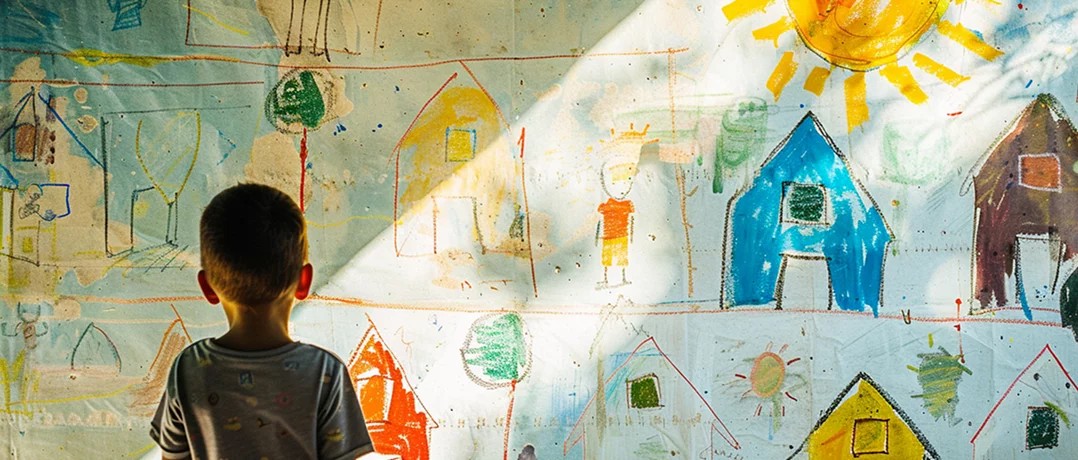
For children living through war, displacement, or chronic instability, art can say more than months of conversation. The Beiruter spoke with Randa Wehbe, a psychologist and psychotherapist who works with children in contexts of conflict, to reveal that art is often the most honest language available to a child whose inner world has been shattered by experiences too large to name.
"Children often cannot fully express traumatic experiences in words because their emotional vocabulary and sense of safety are still developing," Wehbe explains. In ordinary circumstances, this is simply a feature of childhood. In war, it becomes something more urgent. When a child has witnessed destruction, lost family members, or lived under constant threat, asking them to talk about it directly can feel, and genuinely be, overwhelming.
The problem is neurological. Trauma lives in the body before it lives in language. The part of the brain that processes fear and survival operates faster and more powerfully than the parts responsible for verbal reasoning. For a child in distress, finding words for terror is a bit like being asked to write a poem while the building is burning.
Art sidesteps this bottleneck. Drawing and painting allow children to communicate with distance, to express emotion indirectly, through image and symbol, without having to confront it head-on. As Wehbe puts it, “a child may draw explosions, broken homes, or separated families instead of saying “I feel unsafe.” Art allows them to communicate indirectly, with distance, which helps them feel more in control of the experience.”
Over time, certain patterns tend to emerge in the artwork of children exposed to conflict. Wehbe describes a range of recurring themes that, read carefully and over time, offer a window into a child's emotional world.
"Dark colors, heavy lines, or chaotic drawings" can signal emotional distress or anxiety, she says. Scenes with "weapons, fire, or destruction" reflect exposure to violence. "Small or isolated figures" point to feelings of helplessness or insecurity, while missing family members suggest "loss or fear of losing attachment figures." Then there are children who return to the same image again and again, what Wehbe calls "repetitive drawings of the same event," which may indicate emotional "stuckness" or trauma replay.
Not all signals are dark. Some children produce idealized scenes, perfect families, sunny homes, hearts. These matter too. Wehbe describes them as expressing "a wish for safety and control," a hunger for the ordinary life that has been taken away.
She is careful, however, to stress that no single drawing should be treated as a verdict. "These themes do not diagnose trauma by themselves," she says, "but they can give insight into the child's emotional world and sense of safety." Interpretation requires patience, context, and time.
Beyond expression, there is something in the act of creation itself that supports psychological recovery. "Art can be very therapeutic for children exposed to trauma," Wehbe says. "It supports emotional regulation and healing in several ways."
The first is externalization. "Feelings that are overwhelming inside the body become visible on paper," she explains, "which makes them easier to tolerate." When something formless and terrifying acquires shape and color on a page, it becomes, for the first time, something the child can look at from the outside.
The second is agency. "Choosing colors, shapes, and stories restores a sense of agency" in a situation where the child often feels entirely powerless. Trauma, by its nature, is an experience of helplessness. Drawing reverses that, even in a small way.
Third, the creative process itself works on the nervous system. "The nervous system becomes calmer through repetitive, sensory, and creative activities," Wehbe says. Over time, she notes, this can "reduce anxiety, improve focus, and provide a safe outlet for fear or aggression."
None of this happens in a vacuum. Wehbe is emphatic that the adults surrounding a child, parents, teachers, therapists, are central to whether art becomes genuinely therapeutic or remains just an activity.
"Adults should take a supportive, non-intrusive role," she says. "The goal is not to analyze or interpret too quickly, but to create safety and openness." When a child shares a drawing, the instinct to conclude something, to name what it means, should be resisted. Instead, Wehbe advises adults to "invite the child to explain their drawing instead of assuming meaning", using open-ended questions like "Tell me about your drawing" or "What is happening here?" Direct interpretations, "this means you are traumatized", should be avoided entirely.
Calm, she says, is the most powerful tool an adult brings to the room. "The adult's calm presence helps the child feel safe enough to express difficult emotions." And that safety is not incidental to the healing process, it is the process. "The therapeutic value is often not only in the art itself," Wehbe says, "but in the relationship and containment offered by the adult."
In the end, that may be the deepest truth about art therapy for children in crisis: it works not because crayons are magical, but because being seen, even through a drawing of a burning house, is one of the most healing experiences a human being can have.

