

Ashekmann: Turning Lebanon’s walls into a living archive
Ashekmann: Turning Lebanon’s walls into a living archive
By Lynn El Khalil | February 10, 2026

Reading time: 6 min
Walls as power, walls as memory
In Lebanon, walls are never silent. They carry the weight of wars that never fully ended, negotiations that solved nothing, ceasefires that only paused the damage, election cycles that repeated the same betrayals that became routine. They absorb grief, anger, hope, and exhaustion. They are repainted, erased, overwritten, and reclaimed, but never neutral. Unlike official archives, walls do not sanitize history. They do not pretend to be objective. They remember who had power at a given moment and who dared to push back.
This is the emotional and political terrain that shaped Ashekmann. Not as an abstract artistic influence, but as a lived environment soaked in noise, loss, and contradiction. For Ashekmann, graffiti is not decoration, rebellion, or self-expression for its own sake. It is survival. It is a continuation of a long Lebanese tradition where walls are used to speak when institutions fail, where paint replaces platforms, and where public space becomes the last remaining place to tell the truth out loud.
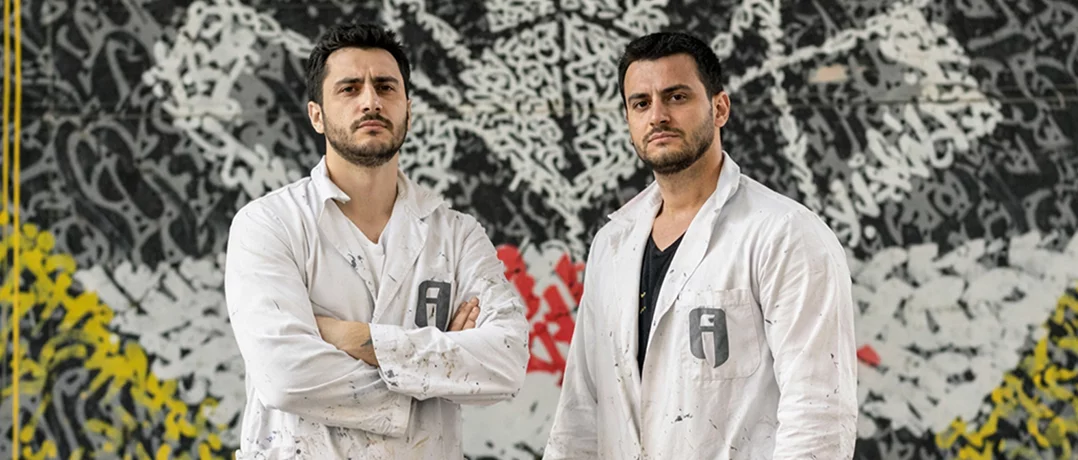
Mohamed and Omar, identical twins born in the early 1980s, grew up without distance from violence. “We experienced the civil war, the 80s, the 90s, the 2000s,” Mohamed says. “Every decade there was something.”
Their childhood memories are structured around survival. “When we were young, our inspiration, our collective memory, was the ruins of the shelter. We literally learned how to count numbers by counting bombs. One, two, three.” Fear was not abstract. It was counted, measured, memorized.
On their way to school, another lesson became clear. “We used to see walls with slogans, political graffiti, stencils from militias,” Mohamed recalls. “And we felt that whoever is writing on the wall definitely has power.” Walls marked territory, loyalty, and threat. They taught the twins that visibility equals authority.
From weapons to paint
That understanding eventually crystallized into a strategy. “We realized power doesn’t only come from someone holding a gun or a missile,” Mohamed says. “It can also come from art. From paint.”
Ashekmann was born from that shift. Not to replace power, but to confront it using the same surface it had always relied on. Their work does not romanticize graffiti as chaos. It treats it as a counter-authority, capable of exposing the systems that dominate Lebanese life.
From the beginning, Ashekmann resisted being reduced to one medium. “We don’t like to call ourselves just graffiti artists,” Mohamed insists. “We’re a creative collective.”
Graffiti was the foundation, but it quickly expanded into Arabic rap music, guerrilla marketing, streetwear, design studios, figurines, installations, and large-scale political campaigns. Each extension served the same goal: protecting the message by multiplying the ways it could travel.
Even the name Ashekmann is deliberate. In Arabic, it refers to a car’s exhaust. In Japanese slang, it means the same thing. “It takes all the exhaust from the car and pushes it outside,” Mohamed explains. “That’s exactly what we wanted to do. Take all the pressure, all the political and social shit inside us, and release it.”
Ashekmann sees itself as a mirror. “We’re chameleons,” Mohamed says. “If you put us in Switzerland, we’d be writing about chocolate and luxury watches. In Lebanon, we write about politics.”
Their work is not an imported ideology. It is an environmental response. Corruption, sectarianism, war, collapse, and displacement are not themes. They are conditions.
Mainstream media, Mohamed argues, cannot reflect this honestly. “The one who gives you money is the one who gives you orders,” he says. Financial control shapes narratives. Ashekmann wanted a platform where no sponsor could rewrite the message.
Writing in arabic, speaking to the city
Language is central to Ashekmann’s practice. Their graffiti is unapologetically Arabic, not ornamental or nostalgic, but confrontational.
“Our inspiration wasn’t the gangs of LA or New York,” Mohamed says. “It was Beirut.”
After university, the twins studied under master calligrapher Ali Asi. They could have borrowed Latin graffiti lettering. They refused. “We wanted to craft something completely new,” Mohamed explains. “Arabic calligraphy, Arabic graffiti. A new form of art.”
This choice reclaimed Arabic from being associated only with tradition or authority and repositioned it as a language of dissent.
In their early years, Ashekmann worked fast. “We were vandals,” Mohamed says. “Throw-ups. Five to ten seconds.” They painted between four and six in the morning, when the city slept.
Visibility mattered. “If the location is hidden, you don’t get respect. If it’s public, you do.”
As their reputation grew, walls became buildings. Buildings became landmarks. With scale came permits, cranes, and scaffolding. Trust followed. “People started giving us buildings for free,” Mohamed says. “They give us the façade and tell us, do whatever you want.”
This led to a long-term ambition: turning Beirut into an open-air museum. Free, public, and unfiltered. “You just walk,” Mohamed says. “The city becomes the gallery.”
Operation Zahet: cleansing a rotten system
During the October 17 uprising, Ashekmann launched Operation Zahet, one of their most conceptually layered interventions. Zahet, roughly translating to “buzz off” or “enough,” was not painted on a wall. It was turned into a consumer product.
The collective designed an actual bar of soap called “Zahet.” Full packaging. Labels. A professional ad. Influencers shared it organically, mistaking it for a real brand. “They thought it was Ariel or Persil,” Mohamed says.
The symbolism was precise. Soap cleans. Zahet was a call to cleanse the political system. Not to reform it. Not to negotiate with it. But to remove what no longer belongs. The campaign appropriated the visual language of consumer capitalism to deliver a direct political critique.
Then came placement. “We put the billboards around politicians’ houses,” Mohamed explains. “We know where they live.” The message was no longer abstract. It became spatial and personal. What would normally require hundreds of thousands of dollars in advertising space was achieved through insight, timing, and cultural literacy. “It might cost half a million dollars to cover the city,” Mohamed says. “We did it differently.”
Zahet was not just an act of protest. It was a carefully constructed intervention designed to disrupt political visibility and challenge how power presents itself in public space.
Operation Salam:writing peace where war once spoke
If Zahet was confrontation, Operation Salam was reconstruction . In Tripoli, along Syria Street between Jabal Mohsen and Bab al-Tabbaneh, two neighborhoods historically divided by violence, Ashekmann painted the word “Salam” in Kufic script across 1.4 kilometers of wall.
The message could only be read from above. That was intentional. Salam required distance, perspective, and patience. Fighters from both sides helped paint it. “It was a message of unity,” Mohamed says. “Art doesn’t always need to be negative. It can be constructive.”
Salam was also about reframing Lebanon’s global image. “If you ask Western media what Lebanon is, they’ll tell you war,” Mohamed says. “That’s not the case.” By inscribing peace onto one of the country’s most infamous fault lines, Ashekmann placed Lebanon on the map for something other than conflict.
Grendizer: the people’s champion
Among Ashekmann’s most beloved works is Grendizer, a mural depicting the iconic Japanese anime character known across the Arab world. For many Lebanese who grew up in the 1980s and 1990s, Grendizer was more than entertainment. He was protection.
“We believe Grendizer is the people’s champion,” Mohamed says.
“We believe in him more than we believe in any politician.”
The symbolism is layered. Grendizer is a defender from the outside, a figure who arrives when institutions fail. In a country where political leaders consistently disappoint, the mural elevates a fictional hero as a more trustworthy guardian than any real authority. Painted in Arabic calligraphy, the piece bridges pop culture, nostalgia, and political critique.
Grendizer is not escapism. It is indictment.
Community as collaborator, not audience
Ashekmann’s work often activates communities rather than addressing them. In Bourj Hammoud, when plans emerged to burn garbage near residential areas, the collective painted a massive mural of a World War II gas mask.
No one commissioned it. “The kids from the neighborhood started helping us,” Mohamed recalls. Shop owners brought water. Media attention followed. “We put a spotlight on the place,” he says. “Even if we contributed one percent, that one percent matters.”
The wall became a megaphone for a neighborhood that was otherwise ignored.
Ashekmann is often accused of negativity. Mohamed rejects that framing. “I wouldn’t call it positive,” he says. “Constructive storytelling is better.”
Living in a collapsing system leaves little room for optimism as branding. “I can’t be positive if I live in a negative environment,” he adds. “But I can be honest.”
How Ashekmann funds its freedom
Independence is structural, not rhetorical. “We didn’t want anyone to pay us and tell us what to say,” Mohamed explains.
To protect their message, Ashekmann built a self-funded ecosystem. They operate design studios, Arabic streetwear lines, figurines, and guerrilla marketing services. “We are entrepreneurs,” Mohamed says. “We are self-made. Self-paid.”
Streetwear sales support murals. Design contracts finance campaigns like Zahet and Salam. “We wanted to create a vicious circle,” Mohamed explains. “We pay ourselves so no one controls the message.”
They walk away from money when it threatens that control. “If it’s not in line with our strategy,” Mohamed says, “exit.”
Legally, graffiti in Lebanon is illegal. Practically, it exists in a negotiated gray zone. “Lebanon is a heaven for graffiti artists,” Mohamed says, “but you need to know where and when.”
Ashekmann avoids religious sites and parliament. They collaborate with local crews abroad. Their work has appeared on walls and in galleries from London to New York, from Berlin to the Gulf. Beirut remains the core.
The wall as archive
Every Ashekmann project begins with insight. “An idea without insight is like bubble gum,” Mohamed says. “It looks nice, but it has no mileage.”
Their insights come from the middle east, collapse, corruption, and struggle. The wall is only the starting point. Interviews, videos, and conversations extend the life of each piece. “Our art doesn’t stop with the paint,” Mohamed says. “What we’re doing now is part of the mission.”
At one point, Mohamed imagines a future stripped of context, memory, and excuses. “Imagine 100 or 200 years from now, there’s an apocalypse,” he says. “Everything is destroyed.” No governments. No media outlets. No official narratives left to explain what happened. “Our stories on walls will tell the history of the city,” he continues. “The history of humanity. Unfiltered.”
That vision is not science fiction. It is a quiet admission of how fragile memory is in Lebanon, and how easily stories are erased, rewritten, or buried. Ashekmann’s ambition is not recognition, approval, or institutional validation. It is permanence. Evidence. A refusal to disappear quietly.
In a country that constantly rewrites itself to avoid accountability, Ashekmann insists on leaving marks that cannot be easily smoothed over. On walls. In neighborhoods. In public sight. Where power once spoke alone, uninterrupted and unquestioned. And where now, finally, it is being answered.
