



Six years after the Beirut Port explosion, first responders, medical workers and rescue teams recount the chaos, courage and coordination behind Lebanon’s largest emergency response, preserving the human stories behind one of the country’s darkest days.
August 4 through the eyes of first responders
August 4 through the eyes of first responders
By Lynn El Khalil | August 04, 2026

Reading time: 9 min
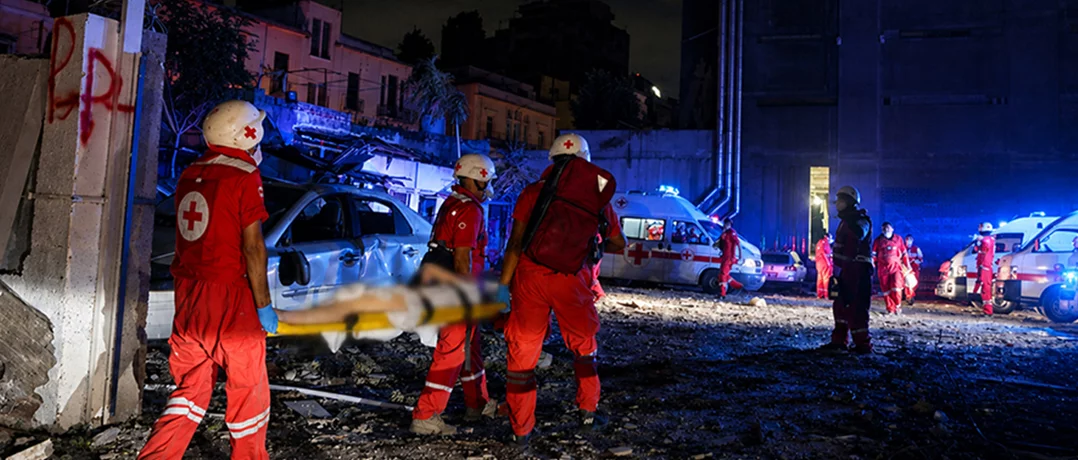
Every Lebanese remembers August 4 differently. At 6:07 p.m., it was still an ordinary summer evening. Within minutes, everything had changed. Some remember the sound, others remember the silence that followed. Many remember the frantic phone calls, the shattered glass, the smoke rising above Beirut, or the desperate search for loved ones.
Six years later, those memories remain painfully clear, proof that some days never truly become part of the past. More than 220 people lost their lives, over 7,000 were injured, and hundreds of thousands saw their homes and neighbourhoods transformed in a matter of seconds. While Beirut has rebuilt much of what was destroyed, the memories remain untouched by time. Remembering August 4 is not about remaining trapped in tragedy. It is about preserving the stories of those who lived it and the lessons it continues to carry. While many remember where they were when the explosion happened, others remember where they had to go.
They remember the streets they drove through, the buildings they searched, the patients they treated, and the lives they fought to save. Their memories offer another way of remembering August 4, one defined not only by loss, but by service in the face of unimaginable devastation.
The first calls
Every disaster has a moment before it becomes history, when those responding know something terrible has happened but have no idea how much worse it is about to become. In exclusive interviews with The Beiruter, Alexy Nehme, Director of Emergency Medical Services at the Lebanese Red Cross, and Walid Hashash, Head of the Service and Operations Unit at the Lebanese Civil Defense, reflected on the first moments after the Beirut Port explosion, when confusion quickly gave way to one of the largest emergency responses in Lebanon's history.
For Nehme, the evening had already begun. He was driving home along the Beirut-Jbeil highway when his phone rang. Reports reaching the Red Cross operations room placed the explosion in different parts of Beirut, while friends from across the city called to report shattered windows and damaged homes, each convinced the blast had happened nearby.
Realising the gravity of the situation, he immediately turned his car around and, before even reaching Beirut, had already dispatched four ambulances toward the suspected site while coordinating with crews responding to a growing number of emergency calls. At the same time, Hashash and his Civil Defense team were responding to reports of a fire at the port, unaware that they were heading toward one of the largest non-nuclear explosions in history.
We weren't expecting something of this magnitude. We deal with fires and explosions, but nothing like this.
A city in ruins
As Nehme approached Beirut, roads that only minutes earlier had been filled with commuters were blocked by debris, overturned vehicles, and people desperately searching for loved ones. Emergency calls overwhelmed the Red Cross operations room, revealing that this was not a single incident but a disaster stretching across entire neighbourhoods. Having responded to wars and major bombings throughout his career, Nehme believed he had already witnessed Lebanon's worst tragedies.
I thought the 2005 explosions were the worst we'd ever see. I was wrong.
For Hashash, the devastation became clear the moment Civil Defense reached the port. Fires burned across the docks, buildings had been torn apart, and rescue teams immediately began searching for survivors beneath the rubble while trying to contain the flames.
Finding order in chaos
As the scale of the explosion became apparent, the Lebanese Red Cross mobilised between 163 and 175 ambulances from across the country, while Civil Defense crews battled fires, searched collapsed buildings, and later deployed divers to recover victims and submerged vehicles from the sea. With conventional water supplies proving insufficient, firefighters pumped seawater directly from the Mediterranean to contain the blaze. Despite extensive training, both organisations found themselves responding to a disaster unlike anything they had prepared for. Civilians rushed the injured to hospitals in private cars, motorcycles, and pickup trucks before ambulances could reach them, forcing emergency crews to adapt constantly while trying to restore order to overwhelming chaos. Textbook procedures quickly gave way to instinct, teamwork, and experience, as every decision carried life-or-death consequences.
The explosion did not spare those trying to save others. Several Lebanese Red Cross centres, including the Achrafieh station, sustained heavy damage, while many volunteers spent hours treating casualties in the very neighbourhoods where their own families lived, unsure whether their loved ones had survived. At the same time, Civil Defense crews continued searching collapsed buildings long after the fires had been brought under control, knowing that every hour reduced the chances of finding someone alive. For both Nehme and Hashash, August 4 was more than a test of emergency preparedness. It was a reminder that, in the face of unimaginable devastation, first responders are often forced to carry the same fear and uncertainty as the people they are trying to save, even as they continue moving toward danger when everyone else is running away.
Too many victims, too little time
The Red Cross encountered hundreds of casualties within hours. Burns, amputations, and deep lacerations caused by shattered glass became some of the most common injuries. Around 250 casualties were treated almost immediately, before the total climbed to between 500 and 600 patients across the surrounding neighbourhoods. Yet one of the greatest challenges was not the injuries themselves, it was the sheer disorder.
Although Red Cross teams train extensively for mass casualty incidents, Nehme explained that the reality on August 4 was impossible to fully control. Civilians transported victims in pickup trucks, on motorcycles, and inside private cars. Ambulances arrived only to find injured people already being loaded into any available vehicle.
There was no way to apply the textbook exactly as we had learned it.
Instead, responders concentrated on reducing the chaos as much as possible while continuing to save lives. For Civil Defense, the work did not end once the fires were under control, the search for the missing would continue for days.
Inside a hospital under pressure
While ambulances fought their way through blocked streets and Civil Defense teams searched collapsed buildings, another battle was unfolding inside the American University of Beirut Medical Center. In an exclusive interview with The Beiruter, Dr. Salah Zeineldine, who was serving as an intensive care physician at AUBMC on August 4, recalled how the hospital transformed within minutes from a routine working day into the centre of one of the largest mass casualty responses in Lebanon's history. Like everyone else in Beirut, Dr. Zeineldine did not immediately know what had happened, but the force of the explosion made one thing clear: hundreds of casualties would soon be arriving. Without waiting for confirmation, AUBMC activated its disaster response plan as doctors, nurses, technicians, and support staff rushed to their assigned roles, while colleagues who had already left work returned to the hospital. Within fifteen to twenty minutes, the first wave of patients began arriving.
By 7 p.m., the emergency department had reached capacity. Hallways became treatment areas, outpatient clinics were converted into emergency spaces, and by the end of the night AUBMC had treated around 610 patients, forcing staff to cancel elective surgeries and dedicate every available resource to life-saving care. As casualties continued to arrive, the hospital coordinated with the Ministry of Public Health and the Lebanese Army to redirect less critical patients elsewhere, allowing trauma teams to focus on the most severe injuries.
Staff would not stop working until nearly 3 a.m. "It was continuous crazy work," Dr. Zeineldine recalled. "Full of casualties, blood, and death." Although the hospital itself suffered damage, it remained fully operational. Broken windows complicated operations during the height of the COVID-19 pandemic, while unidentified patients were assigned temporary codes rather than names to speed up treatment and ensure that no time was lost when every second mattered.
The hospitals receiving the injured were themselves struggling to recover from the force of the explosion. Several medical centres closest to the port sustained extensive damage, destroyed equipment, and operating rooms rendered unusable, forcing some facilities to evacuate patients even as new casualties continued arriving.
At Saint George Hospital University Medical Center, the blast claimed the lives of four nurses and three patients, forcing the hospital to evacuate as it struggled to continue caring for the wounded. Karantina Hospital and Lebanese Hospital Geitaoui also suffered severe damage, leaving much of Beirut's healthcare system stretched at the very moment it was needed most. Doctors and nurses in some hospitals found themselves treating the injured while working in damaged buildings, turning parking lots, entrances, and even sidewalks into makeshift treatment areas as the city's healthcare system faced an unprecedented strain.
Although the core disaster protocols at AUBMC, the Lebanese Red Cross, and the Lebanese Civil Defense remain largely unchanged, August 4 reshaped how each institution prepares for future emergencies. In the years that followed, all three organisations reviewed their response, strengthening coordination, communication, ambulance deployment, and patient management so that the lessons learned that night continue to guide disaster response across Lebanon today.
The stories that must be told
Six years have passed, yet August 4 continues to live in the memories of those who responded that night. For Alexy Nehme, it is the memory of coordinating ambulances through streets buried beneath debris while emergency calls came faster than they could be answered. For Walid Hashash, it is the image of firefighters and rescue teams searching collapsed buildings, battling flames, and refusing to stop looking for survivors.
For Dr. Salah Zeineldine, it is a hospital transformed within minutes into the centre of one of the largest mass casualty incidents in Lebanon's history, where doctors, nurses, and staff worked through the night to save as many lives as they could. Their recollections are not filled with dramatic declarations or heroic language. Instead, they speak of protocols, split-second decisions, teamwork, and the determination to keep going despite exhaustion, uncertainty, and loss. It is perhaps in that quiet professionalism that the true weight of their work becomes clear. As the years pass, continuing to tell the story of August 4 becomes more important, not less.
Memory fades, generations change, and headlines move on, but the experiences of those who lived through that evening remain part of Lebanon's collective history. Remembering is not about remaining trapped in grief, it is about ensuring that the lives lost are never reduced to numbers, and that the people who carried the city through its darkest hours are never forgotten. The courage shown by first responders, healthcare workers, and volunteers cannot be measured by the number of ambulances dispatched, fires extinguished, or patients treated. It lives on in every life that was saved, every family that was reunited, and every person who made it home because someone else chose to answer the call.
Their stories deserve to be remembered alongside those of the victims, not only as a tribute to their service, but as a reminder of the resilience, compassion, and humanity that emerged from one of Lebanon's darkest days.
