



Iranian billboards urging Hezbollah to invade Nahariya highlight how inflammatory rhetoric masks deeper pressures over the group’s weapons and future.
Axis of Resistance’s intransigence persists

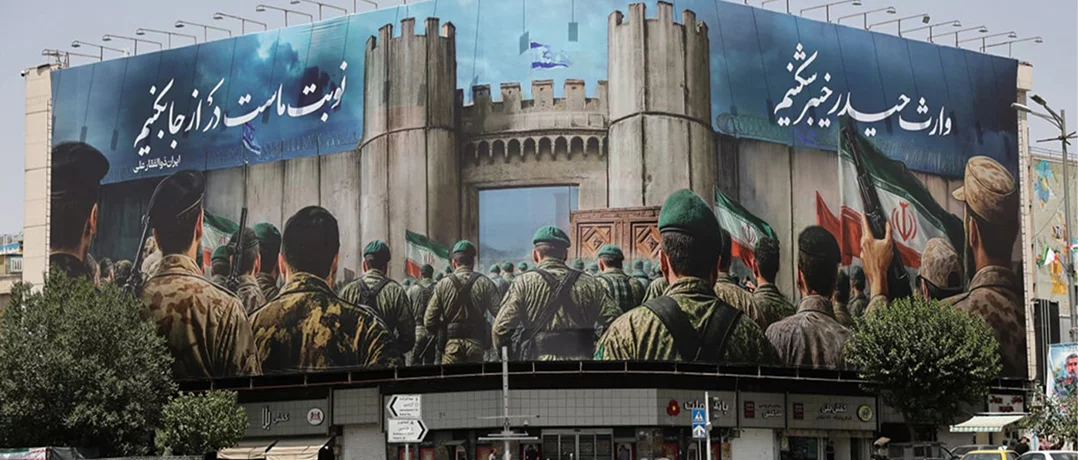
Recent reports of billboards appearing in Iran calling on Hezbollah to invade the Israeli city of Nahariya have underscored the persistence of inflammatory rhetoric in an already fragile regional environment.
Although symbolic, such messages reflect deeper dynamics shaping the Axis of Resistance’s posture after the 2023-2024 war with Israel. At the heart of the issue lies Hezbollah’s uncompromising stance on retaining its weapons, a position that has evolved from a domestic controversy into an existential dilemma for the party and a growing challenge for the Lebanese state.
Symbolism and regional messaging
The Iranian billboards urging action against a civilian city in northern Israel are widely seen as political signaling rather than an operational call. They serve to reinforce the narrative of “resistance” promoted by Iran and its allies, while reminding both adversaries and supporters that confrontation remains part of the ideological landscape.
Similar messages have surfaced in speeches by Hezbollah’s leadership, including past warnings by the late Secretary-General Hassan Nasrallah that “an invasion of the Galilee remains on the table if the confrontation escalates,” in his June 2024 speech. Together, these statements illustrate how rhetoric is used to project strength even as material constraints tighten.
Why Hezbollah will not relinquish its weapons
Hezbollah’s refusal to discuss disarmament is not merely tactical.
As articulated by senior figures such as Mohammad Raad, the group views its weapons as inseparable from its identity. Arms are not simply tools of defense; they are the foundation of Hezbollah’s political legitimacy, ideological narrative, and regional role. Surrendering them would require redefining the movement entirely and abandoning the very rationale on which it was built.
Unlike other armed movements that eventually transitioned into political actors with domestic agendas, Hezbollah has never anchored its legitimacy in a clearly defined national social or economic project. Its engagement in Lebanese politics has consistently revolved around regional conflicts and the concept of armed resistance.
As a result, disarmament would not represent a strategic adjustment but an existential rupture.
Diminishing external and internal support
Hezbollah’s calculations rely heavily on factors beyond its control. For years, it benefited from weak Lebanese state institutions, persistent instability in Syria, and sustained Iranian backing. Today, each of these pillars is under strain.
Lebanese institutions, although still fragile, are gradually regaining credibility among broader segments of society, undermining Hezbollah’s long-standing narrative that the state is inherently incapable of protecting the country. In Syria, the consolidation of authority in Damascus and the declining intensity of open-ended regional conflicts reduce Hezbollah’s room for maneuver. Meanwhile, Iran itself faces severe economic pressures and internal political recalibration following significant military setbacks. These constraints have limited Tehran’s ability to prioritize the needs of its allies, including Hezbollah (despite its continuous vocal support for the group, which analysts perceive as a necessity to ensure the group’s survival until Iran reaches the negotiating table with the US; after which it would bargain with this “card”).
From here, Hezbollah’s intransigence over its weapons reflects a struggle for survival rather than confidence. While symbolic gestures and heated rhetoric continue to project defiance, the structural conditions sustaining the group are eroding. As Hezbollah clings to its arms, it risks deepening Lebanon’s institutional decay as well as prolonging national paralysis and security. In this sense, the weapons that define the movement may also be the very factor preventing both Hezbollah and Lebanon from escaping a cycle of decline, instability and prosperity.
-
-

-
The Beiruter
-
