



Located near Baalbek's iconic Roman temples, Saint George's Orthodox Church carries a history that spans generations. Through the Saliba family's stories and efforts to preserve it, the church offers a glimpse into a lesser-known chapter of the city's religious heritage.
Baalbek's Orthodox Church: A forgotten chapter in the city's history
Baalbek's Orthodox Church: A forgotten chapter in the city's history
By Yara Saliba | November 22, 2026

Reading time: 5 min
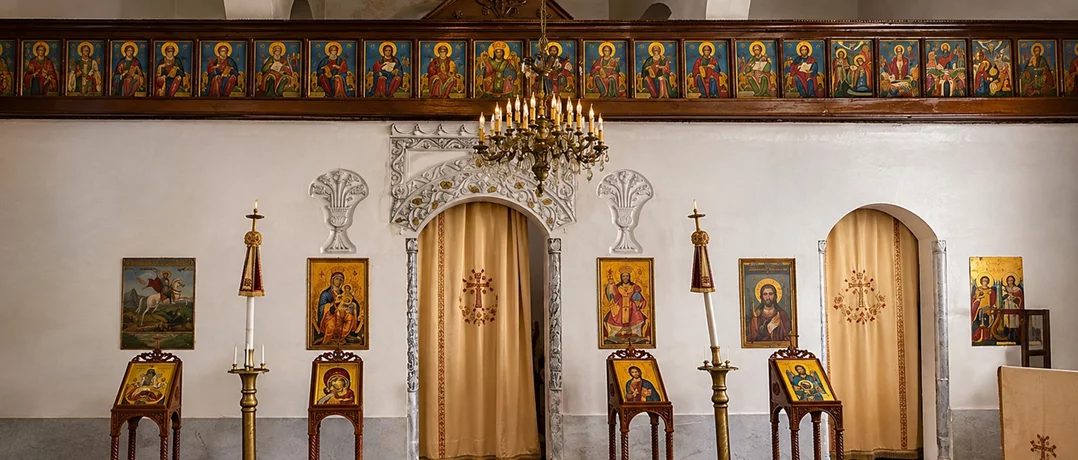
Baalbek is one of Lebanon's most renowned cities, celebrated for its rich history, cultural heritage and remarkable Roman ruins. Over the centuries, the city has been home to diverse communities and religious groups. At the beginning of the 20th century, Christians from different confessions formed a significant part of its population, with Catholics representing the majority, followed by Orthodox Christians and then Maronites, alongside a Muslim community.
However, successive conflicts and wars pushed many Christian families to leave Baalbek in search of safer areas. Today, the city's religious heritage is still visible through its many mosques and churches, including three historic churches representing its main Christian confessions: Saydet al-Maounat for the Maronites, Saint Barbara's Church for the Catholics and Saint George's Church for the Orthodox community.
Just a short distance from the iconic Roman temples stands the smallest one of the three, Saint George's Orthodox Church. Behind its modest walls lies a fascinating story of faith, family and a legacy that has endured through generations. The Saliba family, which has looked after the church for generations, is deeply connected to its history and preservation.
A church rooted in history
“Saint George's Church was built around 1850, when the Orthodox community had a significant presence in Baalbek,” said Amale Saliba, the oldest living member of the Saliba family, during her interview with The Beiruter, as she recounted the story of the church and her family's longstanding connection to it.
According to Amale, the church's establishment was closely linked to Mattadios Saliba, the first Archimandrite responsible for the Baalbek and Zahle area. Recognizing the need for a priest to serve the local Orthodox community, he appointed his nephew, Mikhail Saliba, as the parish priest.
The Saliba family, which was financially well-established at the time, helped the church serve the people of Baalbek. Father Mikhail later married and had children who were born in the United States. But, an outbreak of typhus claimed the lives of most of his children, leaving only one surviving son, Tanios Saliba who returned back to Lebanon. Father Mikhail was eventually buried outside the church, and his tomb is present there until today.
A church protected by faith
The church underwent reconstruction in 1912, followed by renovation work in 1972 with a grand reopening ceremony. bringing it to the state it is in today. On the other hand, it cannot be demolished and rebuilt from the ground up, as it stands above Roman ruins on land belonging to Lebanon's Ministry of Tourism. Despite its modest size, the church holds several historical treasures, including religious icons dating back to the 19th century. Dedicated to Saint George, it is also associated with numerous accounts of miracles experienced by people in Baalbek over the years, strengthening the saint's place in the city's religious traditions.
Saint George's Church did not escape the difficulties of the Lebanese Civil War. According to Amale Saliba, it was robbed twice during the conflict. The first incident took place in 1975, when thieves stole the church's heavy black iron door. Amale explained that her late husband, Joseph, refused to take action against the person responsible, saying: “We don't want to do anything. Saint George will bring back what belongs to him.”
Two weeks later, the man who had stolen the door reportedly returned it to the family. He recounted that he had left it near the place where he kept his sheep and cattle, but that all his animals had died within a week. The man eventually became convinced that stealing the church door had brought him misfortune. “He thought the door was cursed and realised that what he had done was a mistake,” she recalled.
The church was targeted again during a second robbery, when thieves took its crystal chandeliers, old icons and gold religious objects. This time, Joseph and his brothers, accompanied by the priest, went to retrieve the stolen belongings and eventually brought them back to the church.
The keepers of Saint George's church
The story of Saint George's Church is closely intertwined with that of the Saliba family, whose generations have looked after the building and ensured that it stays open. For Amale, the responsibility was passed down through the family, beginning with Tanios, the son of Father Mikhail, who inherited the church's key. Tanios later passed the key to his four sons: Nicolas, Joseph, Georges and Moussa. Although another priest was eventually appointed by the Orthodox ecclesiastical authorities, the Saliba family continued to hold the key and oversee the church's upkeep.
Tanios Saliba, was the first tourist guide at the Baalbek Roman temples. Speaking six languages: Arabic, French, English, Spanish, Italian and German, he welcomed numerous prominent visitors, including kings and presidents from all around the world and introduced them to the city's archaeological treasures. His eldest son, Nicolas, followed in his footsteps, becoming a tourist guide at the temples and speaking five languages. This tradition continued with Nicolas's son, Charbel, who now works as a guide and speaks seven languages.
Joseph Saliba also left his mark on the city's cultural life. He was among the founders and the first president of the Cultural Assembly in Baalbek, an organization established to promote the city's heritage. “We organized cultural activities, helped families in need and welcomed prominent figures, including Fairuz and a Russian Orthodox Patriarch who travelled from Russia specifically to visit Saint George's Church,” Amale shared. The organization continues its activities today, with her serving as its president.
Moussa Saliba, the youngest of the four brothers, pursued a different path, becoming an antiques expert and dealer specializing in religious icons and coins. He also worked with Lebanon's Ministry of Tourism. The family's involvement in Baalbek extended to the hospitality sector, with the Salibas owning several restaurants in Baalbek and Zahle.
“Our family owned several antique shops in Baalbek and the surrounding area as well,” Amale explained. Even though the shops have closed, the family continues to hold a collection of antiques and historical pieces in their home, which itself stands above the remains of an ancient Roman theatre.
The Saliba family is now the only Orthodox family still residing in Baalbek and they continue to keep the community's presence alive through Saint George's Church. Its doors are still open, carrying the memories of the people who once gathered there to pray. This church reminds the city of a community that was once an important part of its history.
-
-
-
Yara SalibaJunior Writer/Translator
-
