

Reflecting on Bachir Gemayel’s vision of a sovereign Lebanon, the country’s unfinished state-building journey highlights the need for stronger institutions and accountability.
Bachir Gemayel’s vision of a sovereign Lebanon
Bachir Gemayel’s vision of a sovereign Lebanon
By Philip Honein | September 14, 2026

Reading time: 5 min
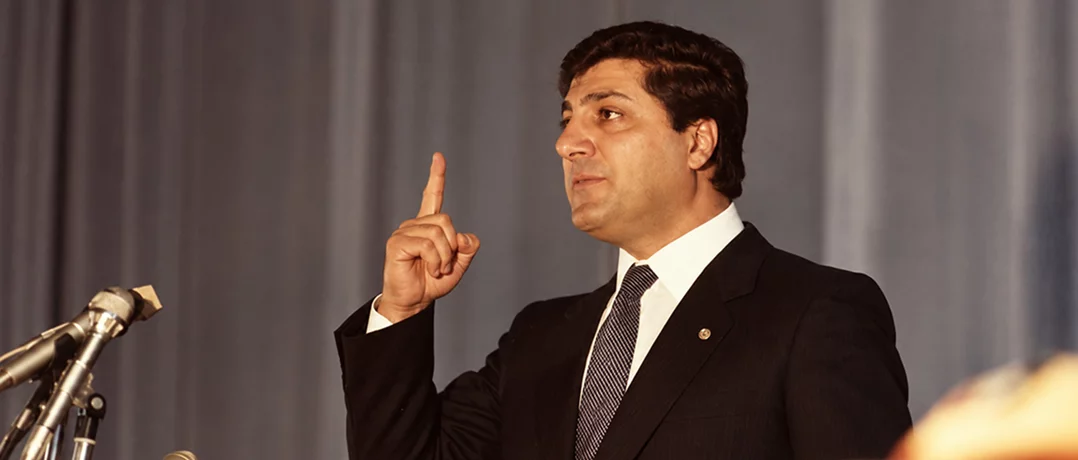
On September 14, I do not want to write about Bachir Gemayel the way we do every year, nor do I want to add another photograph to the collection. I want to ask a simpler, and more difficult, question: after all this bloodshed, what have we built?
Lebanon has witnessed enough slogans to build ten countries: sovereignty, resistance, liberation, independence, and reform. Yet electricity remains absent, the judiciary besieged, the public administration weak, and the economy continues to drive its own people away. Herein lies the tragedy: a cause begins as something noble, only to become a profession. A party is founded to serve an idea, but eventually the idea comes to serve the party. The slogan remains, while the influence of those who speak in its name continues to grow.
Thus, after the war, the warlords emerged from the trenches and entered the halls of power. In 1991, a general amnesty law was passed covering most of the crimes committed during the civil war, allowing countless chapters to be closed without accountability. They then returned to govern us once again. This is the root of the problem: when institutions fail to protect you, you need a leader; when the law fails to secure your rights, you need wasta (personal connections); and when the state disappears, the party and the influential figure take its place.
So why would those who benefit from a weak state ever build a strong one? In Lebanon, the state is not weak because no one knows how to build it. It is weak because many know exactly what they would lose if it were ever built.
Even more dangerous is that this system has conditioned us to accept its failures. Power outages have become normal, the loss of people's bank deposits has come to be seen as fate, and obtaining one's rights has become an achievement. Over time, we stopped asking why the state does not function, and instead began asking how we could manage our lives without it.
The most dangerous aspect of this system is that it no longer fears the people's anger. It is betting on their exhaustion and on their willingness to adapt to failure rather than reject it. And for those who refuse, the airport is there, and the sea remains open before them.
That is precisely why I do not wish to invoke Bachir as a saint, nor do I ask the Lebanese to forget their disagreements with him. We may disagree over his history or his political choices, but can we disagree over the need for one state, one law, and institutions stronger than any leader, party, or sect? In the inaugural address he prepared after his election, he spoke clearly about the Constitution, the rule of law, Lebanon's independence, its territorial integrity, and the restoration of the role of state institutions.
This is where we should meet. For the state should not be judged by the name of the person who advocates it, but by whether we truly want it to stand above everyone.
Nor has this idea ever belonged exclusively to one sect. Only days ago, Lebanon marked the anniversary of the disappearance of Imam Musa al-Sadr. Al-Sadr and Bachir were not on the same political path, but neither were they complete opposites. In 1977, al-Sadr addressed Bachir respectfully, describing him as "the courageous young man," and stressed that alternative institutions should make way for the state's legitimate institutions. Every year we raise al-Sadr's portraits, while allowing his idea to fade. The two men disagreed, but the question remained the same: should the sect be part of a strong state, or become a substitute for it?
For this reason, every leader who presents himself as the protector of his sect and replaces the state guarantees his own influence for as long as his community remains fearful and dependent upon him.
Nor did the problem remain confined to domestic politics. At many turning points in our modern history, Lebanese political forces sought support from foreign powers to strengthen their own influence, when any external support should instead have been directed toward strengthening the state rather than its leaders. Loyalties became divided among the capitals of the region and the world, while Lebanon remained the last recipient of loyalty. Perhaps today we are approaching the end of this absurdity and beginning to understand what men gave their lives for: that Lebanon should be the reference point, not the battlefield.
In this regard, former Member of Parliament and Minister Edward Hunayn wrote: "It can never be right for the interest of any man, whoever he may be; or the interest of any office, however exalted; or enmity and friendship, however bitter the enmity or however warm the friendship, to occupy a place above that which we have reserved for Lebanon, this enduring and eternal nation." These words capture precisely what we lack today: no man stands above Lebanon, and no office or personal interest is more important than it.
Yet there are those who aspire to the presidency, the premiership, or the speakership of Parliament before demonstrating what they have changed in the positions they have already held and through the influence they have already possessed. The problem is not ambition itself, but when the state becomes merely a ladder to power instead of power serving as a means to build the state. Whoever seeks to govern Lebanon should begin by reforming the square meter over which he already exercises authority.
As for the state we speak of, it must be present in people's daily lives. We need the spirit of the "Division 16" campaign in every ministry, every public administration, every street, and every alley: a law that commands respect, violations that carry consequences, and enforcement free from personal connections or sectarian protection. Not a police state, but a state in which everyone knows that the rules apply equally to all, and that persistent violations entail serious consequences.
Forty-four years later, the question is no longer what Bachir would have done had he lived. The real question is: who fears the establishment of the state today, and what would they lose if it were built?
Lebanon has paid enough in blood. What we lack is neither another diagnosis nor another martyr. We simply need to decide that Lebanon matters more than our leaders, that citizens' rights should require no intermediary, and that the state should need no one's permission to be a state.
Lebanon does not need a savior. It needs a state that no longer requires one.
A strong state is not an impossible dream. But it will never be born as long as the guardians of its weakness remain its very custodians.
-
-
-
Philip HoneinSenior executive, engaged observer and nonprofit leader
-
