



A monumental rosary in Deir El Ahmar is transforming Lebanon’s hills into a unique spiritual pilgrimage destination.
Bead by bead: Lebanon's giant rosary

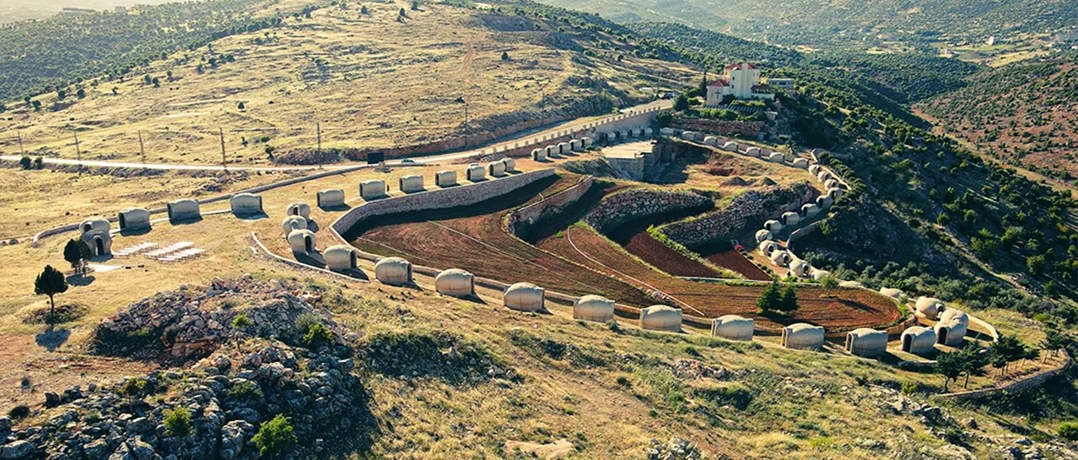
High in the hills of Deir El Ahmar, a project of extraordinary ambition is reshaping the landscape. Lebanon is building one of the largest rosaries ever constructed, and the result is already becoming a destination unlike any other in the country.
The structure is monumental in the truest sense, designed to be walked, experienced, and prayed through, stretching across the terrain in a way that makes the familiar act of holding a rosary into something you inhabit with your whole body. Visitors move along the beads as pilgrims move through sacred ground: slowly, deliberately, with a sense that the space itself is asking something of them.
Faith in scale and spirit
The entire team and creators behind the Giant Rosary of Deir El Ahmar have chosen to remain anonymous, a choice maid by profound faith and a shared belief that the work should speak for itself. One of the priests involved tells The Beiruter, “since the late 20th century, some monks intensified their efforts, aiming to purchase land in the area to establish a center for their mission. Although a decision to purchase the land was made in 2003, various factors prevented the acquisition at that time. Nonetheless, the legal and administrative follow-up continued, and the dream reemerged.”
The modern vision for the rosary began with a young Lebanese man, who visited Medjugorje in 2006, and experienced, as the priest explains, a “a spiritual encounter. He prefers to keep his experience private but he got the idea there, to create a platform linking Bechwet and Deir el Ahmar like a bridge. Positioned on the hill overlooking the Bekaa, it would bring great salvation to humanity. It would be part of the path of Mary.”
Although the young man preferred to remain unnamed, his vision inspired the project, which the Lebanese Maronite Order began in 2008. The rosary itself is monumental: it stretches approximately 620 meters and consists of fifty-nine beads, culminating in a Cross of the Resurrection designed as a large monument. Inside the cross is a small educational space to teach visitors how to pray the rosary, which, the priest emphasizes, “is not for the Virgin; it’s for Jesus. Each bead represents a scene from the Gospels, the mysteries of Joy, Light, Sorrow, and Glory. The rosary is the Gospel, made tangible on Earth.”
The five main components, the Cross of the Resurrection, the giant rosary, the House, the adjacent building, and the forthcoming monastery, form an integrated spiritual whole with a single goal: encounter with God. The rosary encompasses representations of the Stations of the Cross, icons of the Gospels, and the Acts of the Apostles, continuing toward Berqa, Ghossib el-Qouz, and Nabha, sites of local Christian martyrdom and history. The rosary’s 59 beads have been constructed, each equipped for prayer and reflection. The priest notes that “length isn’t important; placement is. The rosary overlooks the Bekaa and carries a message of Christianity toward non-Christians, with the Virgin playing a central role.”
The endeavor is supported by both the Lebanese Maronite Order and a dedicated association, relying largely on donations. He estimates that “the concrete alone cost over 13 million dollars,” highlighting the scale of both ambition and commitment. Beyond the construction, the spiritual dimension is paramount. Each day, summer and winter, worshippers gather in nature, celebrating the Eucharist in a unique open-air church set among the beads. “It’s perhaps one of a kind in the world,” he says, describing a space where believers and non-believers, Christians and Muslims, pray together respectfully, guided by faith rather than ceremony.
The priest, who has closely witnessed the project, emphasizes that the hilltop site, especially the region of Bechwet, has long held a Marian significance. “The Virgin has had a presence here for a long time,” he explains. He traces the origins of the devotion to communities from Bsharri and Aakkoura, who, two to three centuries ago, brought with them the veneration of Our Lady of Bechwett. The devotion, he notes, “traces back to Sayyidet Naya.
Our Lady of Bechouet is one of the most spiritually significant Marian sites in the country and the region. For generations, the shrine has drawn believers seeking healing, protection, and intercession, with many attributing personal miracles and answered prayers to the Virgin’s presence there. Beyond individual testimonies, Saydet Bechwet has come to symbolize a collective refuge, particularly during times of war and uncertainty. Thousands of worshippers from across the world have visited the sanctuary where they march from the village of Bechouet to the old church where the blue and white statue of the Virgin Mary stands.
The priest contextualizes the Virgin’s appearances across the region: “The Virgin has a project for Christianity here, not just rooting and strengthening faith locally. Many who came were not merely defending themselves, they were protecting neighboring areas along the western chain. There have been many appearances of the Virgin throughout history, and even more so during the 1975 war when the area was attacked.” Eyewitnesses report sightings of the Virgin in the sky under specific conditions, particularly during battles, reinforcing the sense of divine guardianship over the valley.
In the priest’s words, the giant rosary is “gradually progressing, a blend of devotion, education, and human connection, rooted in centuries of Marian tradition, and reaching toward a vision of spiritual unity for the region.”
A pilgrimage site in the making
Word of the rosary has spread well beyond Deir El Ahmar, drawing pilgrims and curious visitors from across Lebanon and beyond. It joins a tradition of hillside sacred landmarks, that give Lebanon's mountainous geography a profound spiritual character. The country has long known how to make its heights holy.
As St John Paul II profoundly said, “The Rosary is a storehouse of countless blessings. To pray the Rosary is to hand over our burdens to the merciful hearts of Christ and His Mother.”
-
-

-
The Beiruter
-
