

Peter Dickinson discusses Zelenskyy’s Syria visit as part of Ukraine’s broader Middle East strategy, highlighting security cooperation, geopolitical diversification, and Kyiv’s effort to reposition itself as a regional partner and security provider.
Behind Zelensky’s visit to Syria

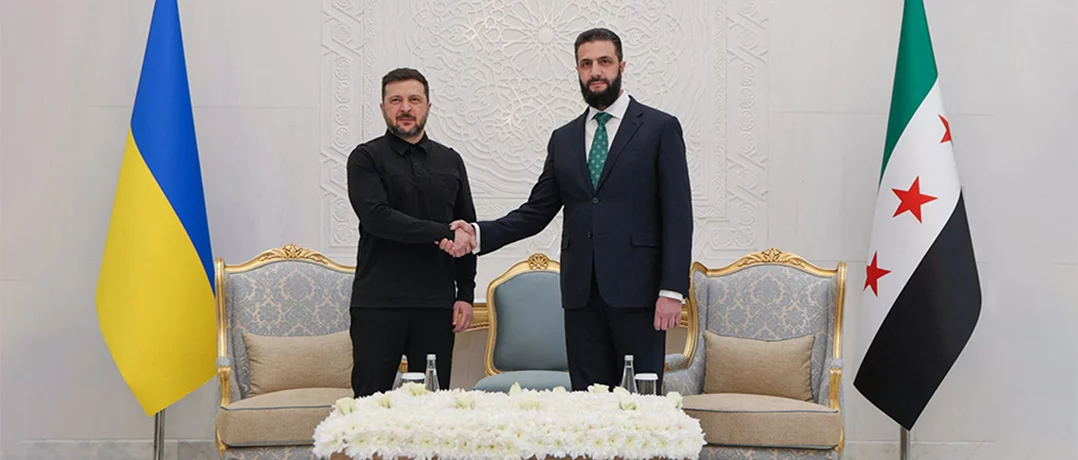
The recent visit of Ukrainian President Volodymyr Zelenskyy to Damascus marks a notable shift in Ukraine’s foreign policy posture, reflecting a broader effort to expand its geopolitical reach beyond its traditional Western allies.
Meeting with Syria’s interim president Ahmad al-Sharaa, Zelenskyy’s trip comes at a moment of heightened regional instability. While the visit may appear, at first glance, to be symbolic, it in fact carries strategic, military, and economic dimensions that reveal Ukraine’s evolving ambitions as both a security provider and diplomatic actor in the Middle East.
In this context, The Beiruter reached out to Peter Dickinson, the publisher of Business Ukraine magazine, in order to better understand the significance and meaning behind the aforementioned visit.
A broader Middle Eastern strategy
According to Dickinson, Zelenskyy’s visit to Syria must be understood within the context of Ukraine’s expanding diplomatic outreach across the Middle East. In recent weeks, the Ukrainian president has toured key regional states, including Saudi Arabia (KSA), United Arab Emirates (UAE), Qatar, and Jordan. These visits are not isolated engagements, but part of a coordinated strategy aimed at building new alliances amid shifting global power dynamics.
This visit to Syria needs to be viewed in the context of Zelenskyy’s broader policy… he’s now trying to develop stronger ties with all the countries in the Middle East.
As noted by Dickinson, Ukraine is actively seeking to diversify its diplomatic base. Long reliant on support from Europe and the United States (US), Kyiv is now attempting to reduce its vulnerability to political fluctuations in Western capitals. This recalibration is particularly relevant given the unpredictability of American foreign policy and the ongoing strain of Ukraine’s war with Russia.
Exporting security expertise
At the core of Zelenskyy’s regional outreach lies Ukraine’s desire to reposition itself as a provider of security rather than merely a recipient of aid. After more than 4 years of war, Dickinson stated, Ukraine has developed specialized expertise in countering drone and missile threats; particularly those associated with Iranian and Russian tactics.
Ukraine has very unique expertise in defending against these drone attacks because of the last four years of Russian attacks.
This experience has become a valuable diplomatic asset. By offering training, technology, and operational knowledge to Middle Eastern states, including Damascus, Dickinson believed that Ukraine is leveraging its battlefield experience to forge strategic partnerships. In Syria’s case, this cooperation is especially relevant. The country’s air defense capabilities remain limited, particularly in the face of increasingly sophisticated drone warfare.
Ukraine’s proposal to assist Syria in countering such threats is therefore mutually beneficial, said Dickinson. For Kyiv, it opens the door to new partnerships, potential financial support, and even access to military resources such as air defense missiles. For Damascus, it offers a pathway to rebuilding a devastated military and security apparatus (in part due to the massive Israeli attacks following the Assad regime’s fall on 8 December 2024) in a rapidly evolving threat environment.
Syria’s calculated engagement
For Syria, the engagement with Ukraine represents a pragmatic step in diversifying its own foreign relations following the fall of Bashar al-Assad. The new leadership under Ahmad al-Sharaa appears intent on avoiding overdependence on any single external actor, particularly Russia, whose support was closely tied to the previous regime.
Although Russia maintains a military presence in Syria, including key naval and air bases, the new government is likely to approach this relationship with caution. As Dickinson suggested, Damascus may tolerate a limited Russian role for strategic reasons, but it is unlikely to view Moscow as a long-term security partner.
This creates space for new actors, including Ukraine, to establish a foothold. Beyond military cooperation, Dickinson added, Syria is also interested in economic recovery, particularly in securing stable food supplies. Ukraine, as a major global grain exporter, is well positioned to contribute to regional food security; an issue that remains critical amid ongoing economic hardship.
Syria is obviously not as wealthy as the Gulf states… but it does have a potentially strategic role to play.
The Turkish dimension
An often-overlooked aspect of Zelenskyy’s visit, Dickinson noted, is the role of Recep Tayyip Erdoğan and Türkiye. Zelenskyy’s arrival in Damascus followed meetings in Istanbul, and reports indicate that he traveled to Syria aboard a Turkish aircraft. This underscores Ankara’s involvement in facilitating Ukraine’s regional engagement.
Dickinson stated that Turkey’s interests in Syria are multifaceted, encompassing security concerns, energy transit routes, and broader regional influence. By supporting Ukraine’s outreach to Damascus, Ankara may be seeking to strengthen its own role as a mediator and strategic hub linking Europe, the Middle East, and potentially Ukraine.
Additionally, Dickinson noted that discussions surrounding gas infrastructure and energy cooperation highlight the economic dimension of this triangular relationship. Ukraine’s integration into regional energy networks could further enhance its strategic relevance beyond the battlefield.
Balancing regional sensitivities
Zelenskyy’s engagement with Syria also unfolds against a complex regional backdrop, particularly concerning Israel. Dickinson said that Israel has traditionally maintained a cautious stance toward Ukraine, prioritizing its own strategic relationship with Russia.
From an Israeli perspective, any enhancement of Syrian military capabilities raises concerns. However, the nature of Ukraine’s proposed support, focused primarily on counter-drone defense, may mitigate these fears. Such systems are designed to intercept low-cost aerial threats rather than challenge advanced airpower, which remains Israel’s primary military advantage.
Moreover, Dickinson highlighted that Israel’s limited involvement in supporting Ukraine reduces its leverage over Kyiv’s regional initiatives. As a result, while Israeli concerns may shape the broader context, they are unlikely to significantly constrain Ukraine-Syria cooperation.
Hence, Zelenskyy’s visit to Syria is far more than a diplomatic gesture; it is a reflection of Ukraine’s strategic transformation in the face of prolonged conflict and shifting global alliances. By positioning itself as a provider of security expertise and a partner in economic recovery, Ukraine is actively redefining its role on the international stage.
For Syria, the engagement offers an opportunity to rebuild state institutions while diversifying external partnerships in a post-Assad era. As for the wider region, it signals the emergence of new dynamics in which non-traditional actors like Ukraine play an increasingly prominent role.
-
-

-
The Beiruter
-
