



Interview with international affairs expert Mohammad Chebaro highlights Saudi FM Beijing visit as key signal of strengthening Saudi-China strategic partnership and coordination.
Beijing visit reinforces Saudi-China alliance

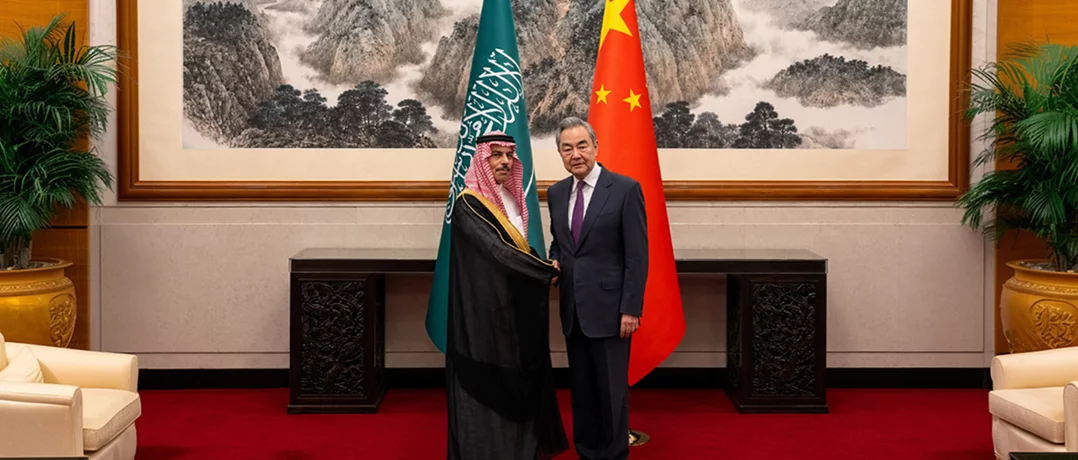
The Kingdom of Saudi Arabia (KSA) and China have reaffirmed the strength of their rapidly expanding strategic partnership following the official visit of Saudi Foreign Minister (FM) Prince Faisal bin Farhan to Beijing.
The visit comes at a particularly significant moment. It coincides with the tenth anniversary of the Saudi-Chinese Comprehensive Strategic Partnership and takes place amid major geopolitical shifts in the Middle East following the recent Iran-Israel-United States (U.S.) armed conflict and renewed diplomatic efforts to stabilize the region.
A strategic visit in a volatile regional context
In an exclusive interview with The Beiruter, international affairs expert Mohammad Chebaro views the timing of the visit as part of a broader pattern of Saudi diplomatic engagement aimed at reinforcing stability rather than signaling any abrupt shift in foreign policy direction.
He explains that in periods of regional uncertainty, states such as Saudi Arabia naturally expand their outreach to major global actors. This approach reflects Riyadh’s long-standing objective of securing peace, stability, and prosperity through diversified diplomatic channels. China, in this context, is seen as an increasingly important partner due to its growing geopolitical weight and its ability to influence key regional actors.
A key element of this engagement is China’s relationship with Iran. Chebaro notes that Beijing’s political and strategic leverage gives it a unique role in regional diplomacy, particularly at a time when Iran remains a central source of instability and tension in the Gulf and wider Middle East.
Saudi Arabia between China and the United States
Chebaro stresses that deepening Saudi-Chinese relations should not be interpreted as a departure from the Kingdom’s strategic partnership with the United States (U.S.). Instead, it reflects a pragmatic diversification of foreign policy in response to a rapidly evolving global order.
Saudi Arabia, like many regional states, is seeking to maximize its post-conflict positioning and secure national interests through flexible diplomacy. Within this framework, Chebaro believes that China complements rather than replaces Washington, offering additional channels for political engagement and economic cooperation.
He also highlights China’s role in mediating the 2023 Saudi-Iran rapprochement as evidence of its growing diplomatic influence. This precedent strengthens Beijing’s credibility as a stakeholder capable of contributing to regional de-escalation, though Chebaro cautions that changing realities in Iran and the region may limit the effectiveness of repeating such efforts in the same form.
Expanding economic and strategic cooperation
Beyond geopolitics, Chebaro underlines the strong economic convergence between Saudi Arabia’s Vision 2030 and China’s Belt and Road Initiative (BRI). Both frameworks highlight diversification, infrastructure development, and long-term economic transformation, making them naturally complementary.
He notes that China has become a key partner for Saudi Arabia across multiple sectors, including energy, industry, technology, and infrastructure. At the same time, China’s continued reliance on Gulf energy supplies further deepens the interdependence between the two sides. Since Vision 2030 was launched in 2016, Chinese investment has increasingly focused on sectors identified by Riyadh as essential for economic diversification, including renewable energy, smart cities, transportation infrastructure, advanced manufacturing, digital technologies, artificial intelligence (AI), and logistics.
Indeed, economic cooperation remains the cornerstone of Saudi-Chinese relations. Over the past decade, bilateral trade has more than doubled, rising from approximately $42 billion in 2016 to more than $107 billion in 2024. China has become Saudi Arabia’s largest trading partner, while Riyadh remains Beijing’s leading commercial partner in the Middle East.
Ultimately, Chebaro expects cooperation to expand into advanced manufacturing, logistics, digital technologies, and large-scale infrastructure projects. In his assessment, the relationship is not defined by rivalry but by strategic complementarity, reflecting a broader global shift toward multipolar partnerships and interconnected economic priorities.
A decade of strategic partnership
Prince Faisal’s visit marks another milestone in a relationship that has evolved dramatically over the past 3 decades. Although Saudi Arabia and China established formal diplomatic relations only in 1990, bilateral ties have expanded at an extraordinary pace, culminating in the establishment of a Comprehensive Strategic Partnership during Chinese President Xi Jinping’s visit to Riyadh in 2016.
Meeting at Beijing’s Great Hall of the People, Prince Faisal and VP Han Zheng stressed their shared commitment to strengthening cooperation, particularly in the fields of trade, investment, and economic development. They also reaffirmed their intention to maintain close coordination on regional and global issues, reflecting the increasingly political dimension of the bilateral relationship.
Prince Faisal highlighted the unprecedented progress achieved in Saudi-Chinese relations, attributing this success to mutual trust and a shared strategic vision that has enabled both countries to pursue long-term cooperation across multiple sectors.
Looking ahead
Prince Faisal bin Farhan’s visit to Beijing illustrates the continued maturation of Saudi-Chinese relations. What began 3 decades ago as a modest diplomatic relationship has evolved into one of the Middle East’s most significant strategic partnerships.
Economic cooperation remains the foundation of bilateral ties, but today’s relationship extends far beyond energy trade. The integration of China’s BRI with Saudi Arabia’s Vision 2030 has created a framework for collaboration across infrastructure, technology, renewable energy, investment, education, and innovation.
At a time of considerable geopolitical uncertainty, both Riyadh and Beijing appear committed to maintaining stable, pragmatic, and mutually beneficial relations. As Saudi Arabia pursues economic transformation and China seeks reliable partnerships across the Middle East, their strategic alignment is likely to deepen further, positioning the partnership as an increasingly influential factor in shaping the region’s economic and diplomatic landscape for years to come.
-
-

-
The Beiruter
-
