



How the 1958 U.S. intervention in Beirut preserved Lebanon’s government and reshaped American military involvement across the Middle East for decades.
Beirut 1958: The landing that changed the Middle East
Beirut 1958: The landing that changed the Middle East
By The Beiruter | July 04, 2026

Reading time: 5 min
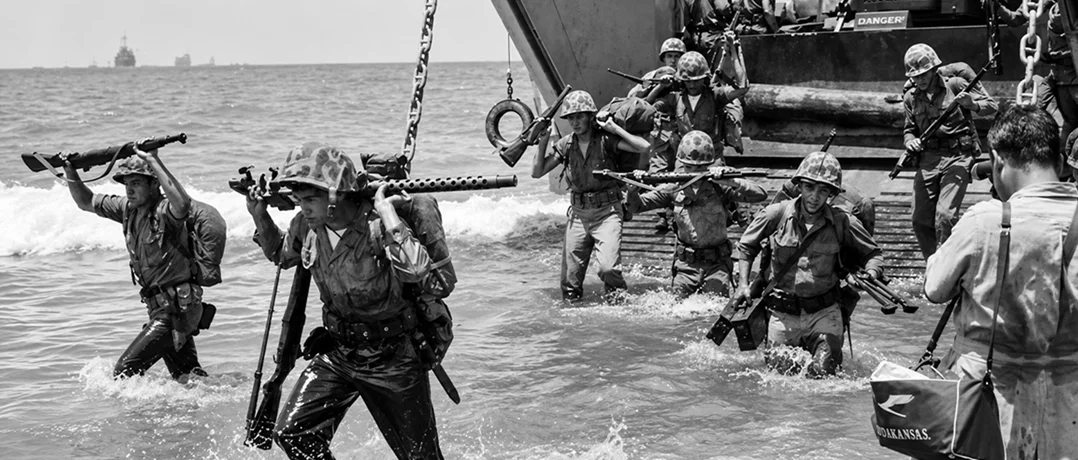
The United States (U.S.) military landing on the shores of Beirut on 15 July 1958 marked a defining moment in both Lebanese and American history. At approximately 3:00 p.m., around 1,700 U.S. Marines landed on Beirut’s beaches under Operation Blue Bat, supported by an imposing naval force of nearly 70 warships, including 3 aircraft carriers.
The operation represented the first American combat intervention in Lebanon and the Middle East while also laying the foundations for decades of U.S. military involvement across the region. Indeed, the events of 1958 not only reshaped Lebanon’s domestic political landscape but also established a precedent for future U.S. military engagement in the Middle East, making Beirut the starting point of what would become America’s long and often controversial regional presence.
The origins of the 1958 crisis
The 1958 Lebanese crisis emerged from a combination of domestic political tensions and rapidly evolving regional dynamics, although interpretations of its causes have long remained contested.
From the perspective of President Camille Chamoun and his supporters, the crisis stemmed primarily from foreign interference aimed at toppling Lebanon's legitimate constitutional government. Chamoun accused Egyptian President Gamal Abdel Nasser and the newly established United Arab Republic (UAR), formed through the union of Egypt and Syria (1958-1961), of encouraging and supporting armed opposition inside Lebanon. Nasser sought to export his revolutionary pan-Arab project by undermining governments that refused to align themselves with Cairo. In this regard, Lebanon was the target of a coordinated campaign of political agitation, propaganda, and subversion, fueled in particular by Cairo’s influential Voice of the Arabs radio broadcasts, which openly denounced the Lebanese government and encouraged opposition to its pro-Western orientation.
Regionally, there is little doubt that the Middle East was undergoing a profound transformation. Nasser had become the dominant political figure in the Arab world following the 1952 Egyptian Revolution and the 1956 Suez Crisis. His message of Arab nationalism, anti-colonialism, and regional unity resonated across many Arab societies, inspiring popular movements that challenged existing governments in the Middle East. However, for countries such as Lebanon, with its pluralistic political system, distinct identity, and delicate sectarian balance, the rise of pan-Arabism also generated deep concerns that national sovereignty could be sacrificed in pursuit of broader regional hegemony and ambitions.
The establishment of the UAR in February 1958 further elevated Nasser’s stature, while significantly intensifying the aforementioned concerns in Washington and several Arab capitals. Chamoun and his supporters regarded such a prospect as a direct threat to Lebanon’s independence, stability, and unique political model. Washington likewise feared that the spread of revolutionary Arab nationalism would destabilize pro-Western governments across the region and potentially strengthen Soviet influence during the Cold War. Indeed, the Cold War (1945-1991) increasingly influenced Western interpretations of Middle Eastern politics, viewing Arab nationalism through the prism of Soviet expansion.
The decisive trigger came on 14 July 1958, when Iraq’s Hashemite monarchy was overthrown in a violent military coup that resulted in the deaths of King Faisal II, Crown Prince Abd al-Ilah, and Prime Minister (PM) Nuri al-Said. The sudden collapse of one of the West’s closest Arab allies generated fears in Washington that Lebanon, Jordan, the Kingdom of Saudi Arabia (KSA), and other pro-Western governments could soon become the next targets. Therefore, for both Beirut and Washington, preserving Lebanon's internationally recognized government became an urgent strategic priority.
Operation Blue Bat: How American intervention preserved Lebanon’s constitutional government
Faced with the dramatic developments in Iraq and following Chamoun’s request for military assistance, U.S. President Dwight D. Eisenhower ordered the launch of Operation Blue Bat under the framework of the 1957 Eisenhower Doctrine, which committed the U.S. to assisting Middle Eastern countries facing external aggression or threats to their independence linked to international communism.
On 15 July 1958, approximately 1,700 Marines landed on Beirut’s beaches, in what would eventually amount to include nearly 15,000 personnel. The deployment was backed by overwhelming naval and air power, while the 82nd Airborne Division remained on standby.
The success of the intervention lay less in combat than in deterrence. The overwhelming American military presence stabilized the security environment, discouraged further escalation by anti-government forces, and demonstrated Washington’s determination to defend Lebanon’s constitutional authorities. Rather than aggressively intervening in Lebanon’s internal conflict, the Marines adopted a restrained posture focused primarily on stabilizing the security situation. Working closely with the Lebanese Armed Forces (LAF), American commanders avoided becoming directly involved in Lebanon’s internal fighting while ensuring that the internationally recognized government remained intact.
Political negotiations gradually replaced military confrontation. Under growing international and domestic pressure, LAF Commander Fouad Chehab emerged as a broadly acceptable presidential candidate. In this context, Chamoun completed his constitutional term before peacefully transferring power, thereby preserving constitutional continuity while defusing the crisis.
The legacy of 1958
Although the 1958 intervention was relatively brief and resulted in limited casualties, its historical significance has proven immense.
First, the operation preserved Lebanon’s internationally recognized government at one of the most dangerous moments in its modern history. By responding decisively to Chamoun’s request for assistance, the United States helped prevent the collapse of the Lebanese state. Indeed, the intervention prevented Lebanon from being drawn into the political orbit of the UAR at a moment when pan-Arab enthusiasm was at its peak. Had Chamoun’s government collapsed in the aftermath of the Iraqi revolution, Lebanon could have faced overwhelming pressure to join Egypt and Syria in a wider Arab union, fundamentally altering its independent political identity and constitutional system.
Second, the operation marked the beginning of direct American military intervention in both Lebanon and the broader Middle East. While the U.S. had maintained strategic interests in the region since World War II (1939-1945), Beirut represented the first occasion on which American combat forces were deployed to influence political developments in an Arab country. Later American interventions, including the return of U.S. Marines to Beirut in 1982, the Gulf Wars, and the post-2001 military campaigns across Iraq, Syria, and Afghanistan, reflected an increasingly interventionist American approach that many historians trace back to the precedent established in Lebanon.
Third, the crisis demonstrated how regional political movements could be interpreted through and become intertwined with Cold War geopolitics. The Eisenhower administration largely portrayed the Lebanese crisis as part of a global struggle against Soviet expansion. From Washington’s perspective, allowing another pro-Western government to fall after the Iraqi revolution would have fundamentally altered the regional balance of power.
Finally, the intervention illustrated that decisive military action could create the conditions necessary for successful diplomacy. The presence of overwhelming American force deterred further escalation and bought time for political negotiations that culminated in the election of Fouad Chehab. Thus, military intervention enabled a constitutional transition that preserved state institutions and avoided a broader regional conflict.
Hence, more than 6 decades later, the 1958 intervention marked the beginning of a new chapter in Middle Eastern geopolitics; one whose consequences continue to shape regional and international affairs today. As the Middle East once again undergoes profound political and security transformations, could the region witness another decisive moment capable of reshaping the balance of power in a way that reinforces Lebanon’s sovereignty, safeguards its constitutional order, and contributes to its long-term stability?
-
-

-
The Beiruter
-
