



How architecture transformed Beirut from a provincial Ottoman port into a Mediterranean capital and why preserving those layers still matters today.
Beirut between Ottoman arches and French facades

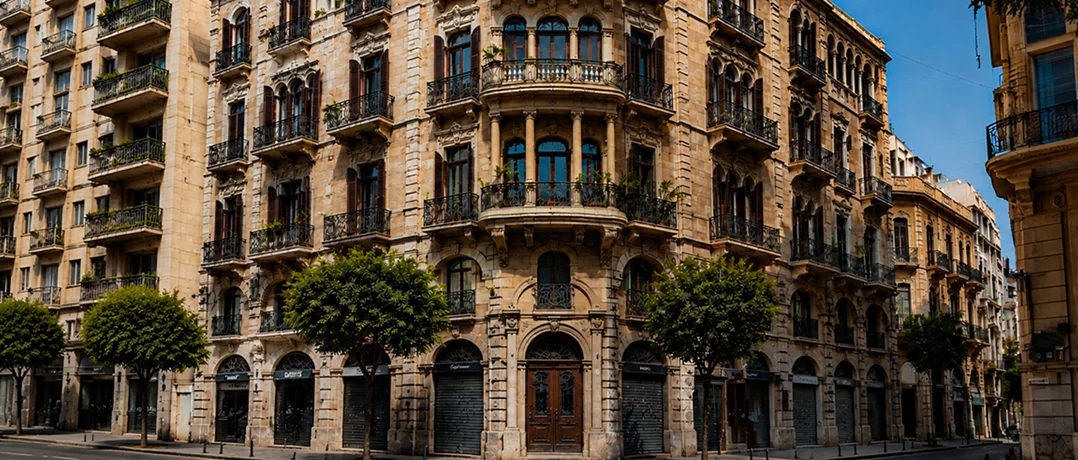
One of the quiet miracles of Beirut is that you can walk through centuries in a single afternoon.
A few steps in Achrafieh or Zokak el-Blat can take you from an Ottoman-era house with triple arches to a French Mandate façade with wrought-iron balconies and symmetrical windows. The transition is not abrupt. It is layered. And if you pay attention, you begin to see how political power reshapes stone.
Under Ottoman rule, Beirut was a provincial port city gradually expanding in the 19th century. The house was designed around collective family life. Its central hall and interconnected rooms encouraged daily interaction among multiple generations living under one roof. Privacy existed, but community was the organizing principle. The architecture reinforced social structures based on kinship, neighborhood ties, and mutual dependence. Courtyards served not only as environmental solutions but also as social spaces where stories, traditions, and family histories were passed from one generation to the next.
The triple-arched window became iconic. It was both functional and symbolic, a frame that connected interior life with the street while maintaining dignity and proportion. These houses did not dominate the skyline. They belonged to it.
Then came the French Mandate in 1920.
Political authority shifted, and with it, urban ambition. Beirut was no longer simply a regional port. It was imagined as a Mediterranean capital aligned with Europe. The French Mandate introduced a different vision of urban life. Wider boulevards, administrative districts, and apartment buildings reflected a more modern and centralized society. Public space became increasingly organized around institutions rather than neighborhoods. The city expanded beyond traditional family networks, encouraging new forms of social interaction linked to commerce, education, and public administration.
In Downtown Beirut, areas like Place de l'Étoile embodied this transformation. Radial streets, clock towers, and façades inspired by French urbanism reshaped the city’s center. Balconies became more decorative. Symmetry replaced organic irregularity.
Buildings began to signal state presence rather than purely domestic life.
And yet, Beirut did not fully abandon its Ottoman roots. Instead, it blended.
Mandate-era buildings often retained local stone. Triple arches appeared beside European ornamentation. The result was not an imitation of Paris, it was adaptation. Beirut absorbed foreign influence but filtered it through Levantine materiality.
Walking through Gemmayze today, I sometimes pause at buildings where Ottoman and Mandate layers coexist within meters of each other. The street becomes a dialogue between eras. One house whispers of inward family courtyards. The next declares outward-facing civic ambition.
Architecture, in this sense, does more than reflect political systems; it shapes the way people live together.
This transformation influenced how Beirutis understood citizenship and belonging. While Ottoman architecture emphasized the household and the immediate community, Mandate-era planning encouraged engagement with a broader civic sphere. Public squares, government buildings, schools, and cultural venues became places where different social groups could encounter one another and participate in an emerging urban identity.
In many ways, the coexistence of these architectural traditions mirrors Beirut's social character. The city has always balanced intimacy with openness, local identities with cosmopolitan aspirations. Its buildings reveal an ongoing dialogue between private and public life, between inherited traditions and new political realities.
Perhaps this is why the loss of historic architecture feels so significant. When an old house disappears, we lose more than a façade or a decorative detail. We lose a physical record of how people once lived together, how communities interacted, and how different generations understood their relationship with the city and with one another.
It tells us that cities are not neutral landscapes. They are shaped by authority, aspiration, and identity.
When historic houses are demolished for high-rise towers, the visible dialogue between eras disappears. The skyline becomes less layered, more abrupt. Political history flattens into contemporary speculation.
Preserving Ottoman and Mandate architecture is not about choosing one identity over another. It is about recognizing that Beirut has always been plural culturally, religiously, architecturally.
Today, we stand at another crossroads.
The question is not whether Beirut will change, it always has. The question is whether we will allow its political layers to remain visible, readable, and accessible.
Because when architecture preserves memory, history becomes something you can touch.
And Beirut, more than most cities, deserves to keep its layers intact.
