



Beirut Chants is a free festival uniting Lebanese and international musicians, celebrating music and community annually.
Beirut Chants celebrate Saint-Saëns and Ziad Rahbani in 2025 program
Beirut Chants celebrate Saint-Saëns and Ziad Rahbani in 2025 program
By Patricia Khoder | November 29, 2025

Reading time: 4 min
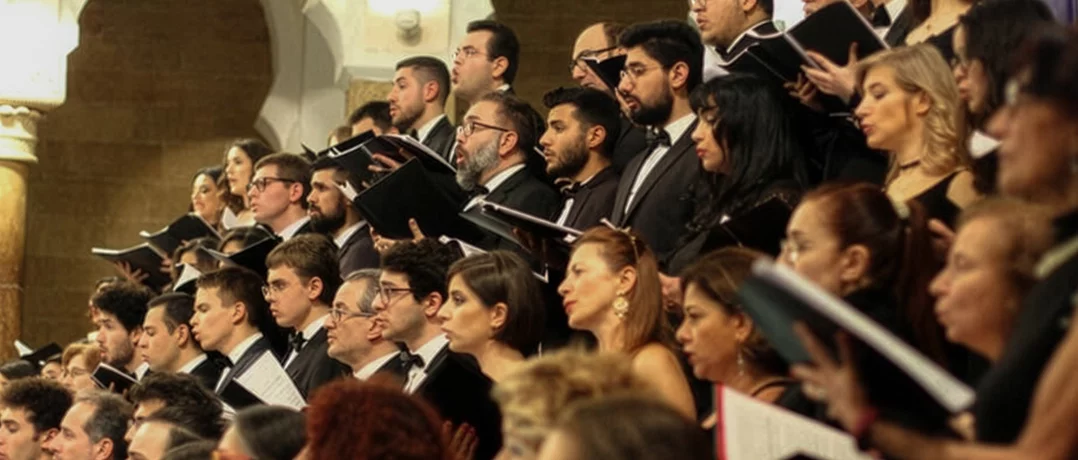
For 18 years, beginning at the end of November, Beirut Chants has been the essential Christmas rendezvous in the Lebanese capital. The free festival, held unfailingly until Dec. 23 one day before Christmas Eve has introduced Beirutis and Lebanese alike to the churches of their city. This year is no exception. Every evening for a little less than a month, a church in Beirut opens its doors to welcome music lovers, whether they enjoy religious chants, opera, classical music or oriental music. Singers, choirs and musicians come from across Lebanon, from Europe and sometimes even from the United States, Australia and Asia.
This 18th edition will notably mark, on opening night, the 190th anniversary of Camille Saint-Saëns’ birth. Two additional evenings will pay tribute to Ziad El-Rahbani and Oum Koulthoum. These concerts will be led respectively by Makram Aboul Hosn and Firas Andari.
Father Toufic Maatouk, the festival’s artistic director, emphasizes the guiding spirit behind Beirut Chants. “To respond to the festival’s programming, one must respond to the very mission of the festival,” he says.
It is a festival with a strong local presence, one that serves above all as a showcase for Lebanese artists. At the same time, it is a festival that has a mission a vocation to be an international festival.
He adds that the festival’s strength lies above all in the richness of Lebanon’s musical scene. “We have a wide presence of Lebanese singers and musicians, Lebanese choirs, orchestras and local ensembles,” he says. “But alongside this Lebanese mosaic, there is an international presence that reflects Beirut’s identity as an open and cosmopolitan city, a place where East meets West. In our program, we feature 30% foreign artists and 70% Lebanese talents.”
Maatouk says the festival was born from the people, from local artists and from the vision of its founder, Micheline Abi Samra, along with the dedication of its team. Because Beirut Chants does not have substantial financial means, the festival continuously seeks new talent whose participation it can support. As a conductor who performs on major international stages from New York to Vienna, Maatouk attends global competitions where he discovers emerging talents who can be invited to Beirut. Among them are American pianist Eric Lu and Korean pianist Seong-Jin Cho.
For Maatouk and the entire team, Beirut Chants represents not only artistic vitality but a vitality that expresses the soul of Lebanon. “It is a plural, creative and resilient soul,” he says. “We try to give artists the possibility to express themselves without limits.” He adds,
For me, Beirut Chants is important. I am a musician, and it is thanks to the festival that I was able to grow.
Indeed, Beirut Chants mirrors the image of an open and diverse Lebanon, where choirs, singers, musicians and spectators from all communities gather to joyfully celebrate the holiday season and participate in the lighting of a large Christmas tree this year, the one in Martyrs’ Square.
Over the years, the festival has introduced many Lebanese to all the churches in their capital, including those that do not usually host concerts or recitals.
“It is a ritual, and a high level of artists are giving space to all communities, confessions, ages and classes, everyone becoming part of one project that unites people,” says founder Micheline Abi Samra. “This is my mission, this is why I started it, and this is why I will continue, because I believe in the Lebanese people, in my country, and Beirut deserves this.”
The festival has also managed to remain free thanks to its many sponsors and the dedication of those who run it.
“This festival allows us to choose a repertoire that is out of the ordinary and non-commercial,” says classical Arabic vocalist Firas Andari, who will perform at Beirut Chants for the third time this year. “Its audience is very different from those who attend regular concert halls.”
Composer and double bassist Makram Aboul Hosn has participated in the festival for ten years. “This year will be my first time as a lead,” he says.
“I love Beirut Chants because its organizers treat foreign and Lebanese musicians the same way, respecting all artists. And although it is a Christmas festival, it brings together all Lebanese people, both among the audience and the musicians.”
Among the foreign talents performing this year is Joseph Tawadros, the Egyptian Australian oud virtuoso who has performed his own works with the Australian Chamber Orchestra, the BBC Symphony, the Ukraine National Orchestra and the Camerata Salzburg. He is the first and only Australian composer to have his work performed by the Academy of Ancient Music in the United Kingdom.
Also appearing are brothers Yossif and Philippe Ivanov. Yossif, acclaimed as “a player of impressive authority and presence,” quickly gained recognition after winning First Prize at the Montreal International Competition at age 16 and later Second Prize and the Public Prize at the Queen Elisabeth Competition in Brussels. He has performed at the Berliner Philharmonie, Munich’s Herkulessaal, Carnegie Hall, Wigmore Hall, the Mozarteum Salzburg, the Musikverein Vienna, the Louvre and the Cité de la Musique in Paris. He performs on a 1710 Carlo Tononi violin lent by the Queen Elisabeth College of Music.
Philippe Ivanov, who made his orchestral debut at age 9, has been a soloist with the Royal Flemish Philharmonic, Brussels Philharmonic, the Sofia Soloists Chamber Orchestra, the Bulgarian “New Symphony” Orchestra, and the Bulgarian National Radio Symphony Orchestra. He won the 2002 Belgian Radio-Television “Tenuto” competition and later the “Premio Silvio Bengalli” International Piano Competition in Italy, as well as the Chopin Prize at the 2010 Summer Academy at the Mozarteum Salzburg.
-
-
-
Patricia KhoderJournalistFocusing on culture and entertainment.
-
