Scale Beirut ’26 brought Lebanese startups, investors, and innovators to New York Tech Week, showcasing the growing global ambitions of Lebanon’s entrepreneurial ecosystem.


Scale Beirut ’26 brought Lebanese startups, investors, and innovators to New York Tech Week, showcasing the growing global ambitions of Lebanon’s entrepreneurial ecosystem.

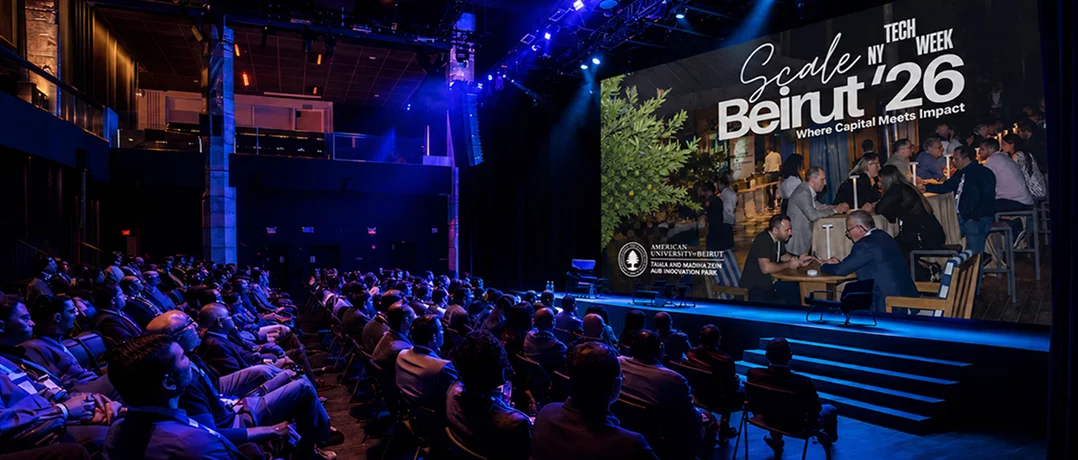
Only days after Beirut recorded one of its strongest performances ever in StartupBlink's Global Startup Ecosystem Index, Lebanese entrepreneurship made another statement this time not through rankings, but through presence.
For the first time, the American University of Beirut's Talal and Madiha Zein Innovation Park (Zein AUB iPark) brought a curated group of Lebanese startups, founders, investors, and technology leaders to New York Tech Week 2026 through Scale Beirut '26, an event designed to introduce Lebanese innovation to a global audience.
The timing could hardly have been more symbolic.
While Beirut recently climbed 36 places in the global startup rankings and entered the Middle East's top 10 startup ecosystems, Scale Beirut demonstrated what those numbers represent in practice: companies building products, attracting capital, creating jobs, and increasingly expanding into international markets.
Hosted in Midtown Manhattan and organized in partnership with Impersonas, the event brought together founders, investors, corporate executives, and ecosystem builders around a simple proposition: Lebanese entrepreneurs continue to build globally relevant companies despite years of economic and political instability.
The event showcased startups emerging from the Zein AUB iPark ecosystem, which has become one of Lebanon's most active startup support platforms.
According to figures presented by the organizers, the innovation park has reviewed more than 1,000 startup applications, supported over 200 ventures, incubated and accelerated more than 80 companies, and helped portfolio startups raise more than $25 million in capital. Those startups have collectively generated more than $12 million in revenue and created more than 640 jobs. The accelerator itself accepts only around 5 percent of applicants.
For a country whose entrepreneurial ecosystem has often been defined by resilience, those figures suggest increasing maturity.
The startups featured at Scale Beirut reflected the diversity of sectors emerging from Lebanon's innovation landscape.
Among them were Impersonas, which develops AI-powered digital humans; Synova Life Sciences, focused on regenerative medicine and stem-cell innovation; Chimera Cybersecurity, which develops AI-powered security solutions; Celitech, a connectivity platform for travel providers and enterprises; Predictive Healthcare, which focuses on surgical-site infection monitoring; Podeo, a podcast economy platform; and PIPP, a behavioral-design platform that helps users transform personal goals into structured journeys.
Rather than relying on traditional conference pitches, organizers designed the evening around direct founder-investor interactions, startup stations, live demonstrations, and what they described as a "live investor grilling" format intended to test founders' thinking, conviction, and decision-making in real time.
Perhaps the strongest signal came not from the stage, but from the audience.
According to event data, Scale Beirut attracted 186 registered attendees representing 11 countries. More than 80 percent of participants were based in the United States, while more than 20 investors, venture capitalists, and capital allocators attended alongside more than 50 founders and CEOs. Executive-level participants accounted for 58 percent of attendees.
The guest list included representatives from venture capital firms and investment organizations such as Andreessen Horowitz (a16z), Nyca Partners, Moonshots Capital, MetaProp, Aegis Ventures, Apax Partners, Zeytoun Ventures, Planeteer Capital, and STS Capital Partners.
Participants came from the United States, Lebanon, Canada, the UAE, France, Switzerland, Australia, Armenia, Jordan, Nigeria, and China, highlighting the increasingly international nature of Lebanon's entrepreneurial and diaspora networks.
The event's programming reflected that ambition. Panels and discussions featured Lebanese Minister of displaced and minister of state for technology and artificial intelligence Dr. Kamal Shehadi, entrepreneur and YC alumnus Michel Haddad, Aboard and Postlight founder Rich Ziade, and Legacy founder and YC alumnus Khaled Kteily, among others.
Startup rankings provide an important benchmark, but ecosystems ultimately grow through relationships, investment flows, talent networks, and market access.
That is precisely what events such as Scale Beirut seek to accelerate.
For years, Lebanon's startup ecosystem has relied heavily on the diaspora to connect local innovation with international opportunities. The New York gathering represented a modern extension of that strategy, linking Lebanese founders not only to fellow expatriates, but also to global investors, operators, and technology leaders.
In that sense, Scale Beirut can be viewed as an extension of the momentum reflected in StartupBlink's latest report.
The rankings demonstrated momentum. New York demonstrated ambition.
If Beirut's startup ecosystem is entering a new phase, its success will likely depend not only on how many startups are created at home, but also on how effectively they connect with the global markets, capital, and partnerships needed to scale.

