



Exclusive interview to The Beiruter with François-Xavier Bellamy, Vice President of the European Parliament, on Lebanon’s sovereignty crisis, Hezbollah, France’s role, and the future of the Lebanese state.
Bellamy to The Beiruter: France and Lebanon’s enduring partnership
Bellamy to The Beiruter: France and Lebanon’s enduring partnership
By Josiane Hajj Moussa | May 28, 2026

Reading time: 8 min
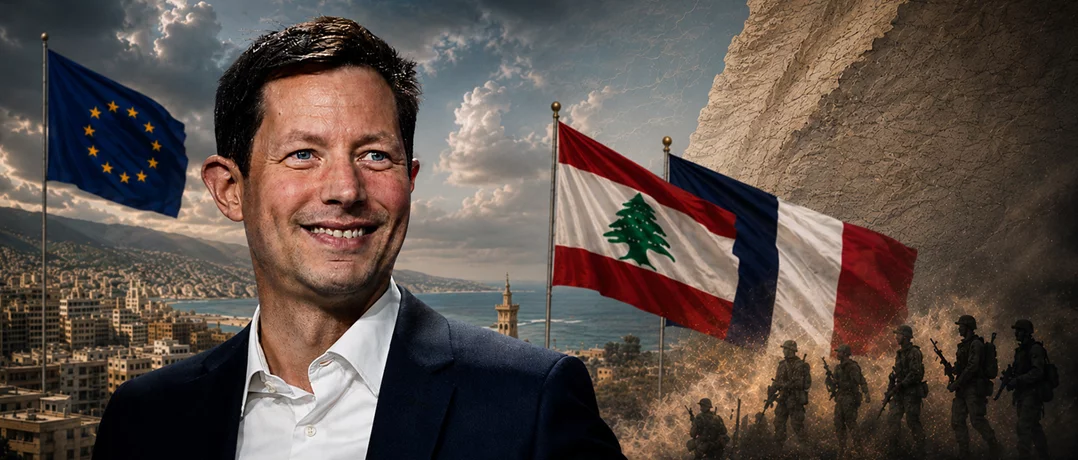
Few bilateral relationships carry as much historical weight as the one between France and Lebanon. France’s ties to Lebanon date back to the 16th century, when the French monarchy intervened to protect Christians within the Ottoman Empire. In 1920, Paris formally proclaimed the State of Greater Lebanon, helping shape the borders, institutions, and cultural identity of the modern Lebanese state. Today, roughly 210,000 Lebanese live in France, while nearly a third of Lebanon’s population still speaks French.
A century-long strategic and cultural relationship
A century later, France remains one of Lebanon’s most active international advocates. In October 2024, French President Emmanuel Macron pledged €100 million in aid as Paris hosted a conference that mobilized more than $1 billion in international assistance for Lebanon. French development financing in Lebanon has reached a cumulative €1.195 billion since 1999. In early 2026, France also announced plans for a dedicated conference in Paris aimed at mobilizing support for the Lebanese Armed Forces (LAF) as the Lebanese state seeks to consolidate weapons under exclusive state authority.
The relationship between France and Lebanon is not merely diplomatic. It remains political, cultural, economic, educational, and deeply historical.
France has consistently positioned itself as one of Lebanon’s closest international partners, maintaining strong humanitarian, political, and institutional support throughout successive crises, wars, economic collapses, and political transitions. Today, as Lebanon continues to grapple with economic collapse, political paralysis, displacement, and escalating regional tensions, Paris and the broader European Union (EU) remain among the country’s principal international backers through financial aid, humanitarian assistance, diplomatic engagement, and institutional support.
Against this backdrop, François-Xavier Bellamy, Vice President of the European Parliament and Vice President of the French Republicans party, spoke to The Beiruter about France’s approach toward Lebanon, Hezbollah’s role within the Lebanese state, the future of the LAF, UNIFIL, and the growing challenges facing Lebanese youth amid war and economic collapse.
Bellamy criticizes Europe’s “normalization” of Hezbollah
Bellamy sharply criticized what he described as Europe’s long-standing “normalization” of Hezbollah’s role in Lebanon, arguing that European countries had too often treated the group as an ordinary political party despite its armed wing and influence over Lebanese institutions.
A political party that possesses a militia is not an ordinary political party. In any democracy, in any of our countries, such a situation would obviously be considered intolerable.
Bellamy argued that attempts to separate Hezbollah’s political and military branches amounted to “an abstraction,” insisting that Lebanese themselves, particularly those who risked or lost their lives opposing Hezbollah’s grip over state institutions, fully understood the nature of the group’s influence.
He specifically referenced Lebanese Shiite intellectual and activist Lokman Slim, saying many Lebanese had “paid with their lives” for attempting to expose Hezbollah’s hold over Lebanon’s democracy, sovereignty, institutions, freedom, and security.
According to Bellamy, Europe and parts of Lebanon had for years adopted what he described as a “fatalistic” approach toward Hezbollah, based on the belief that the group’s weapons were an unchangeable reality that had to be accommodated politically.
Lebanon-Israel talks and France’s role and support
Bellamy also welcomed direct Lebanese-Israeli negotiations, describing them as “a major sign of hope.”
The truth is that the current war is not between Lebanon and Israel. It is between Hezbollah and Israel, and therefore between Iran and Israel.
According to Bellamy, the fact that Lebanon and Israel were now speaking directly represented “a way of emerging from this collective hostage situation.”
While insisting that Israel must respect proportionality and Lebanese sovereignty, Bellamy argued Hezbollah remained “the primary violator” of Lebanese sovereignty.
“France’s role is to encourage this process and do everything possible to ensure it reaches a successful conclusion,” he said.
Bellamy on France’s Lebanon policy and the limits of the status quo
Bellamy acknowledged criticism directed at France’s historical approach toward Lebanon, particularly accusations that Paris had at times prioritized short-term stability over confronting Hezbollah’s growing influence inside the Lebanese state.
“I myself have often criticized positions defended in the name of my country,” he said. “Being French does not mean I believe France has done everything correctly in Lebanon.”
Still, Bellamy insisted France remained “a friendly and brotherly country” to Lebanon, arguing that the relationship between both nations extended far beyond temporary political disagreements. “France’s role today is to stand alongside the Lebanese people to protect the country’s stability,” he said.
But Bellamy rejected the idea that preserving stability meant maintaining the status quo.
The status quo is instability. The status quo is violence. The status quo is war.
He added, “The reality today is that Lebanese people have been impoverished and dispossessed. They have been deprived of prospects for the future. Their education, healthcare, and essential public services have been weakened.”
Bellamy recalled hearing bombs during a recent visit to southern Lebanon, arguing that those opposed to Hezbollah’s disarmament failed to recognize that the current situation itself was already producing victims.
“We are told that disarming Hezbollah would create victims, but it is the present situation that is creating victims,” he said, while adding that “since last March, 3,500 Lebanese have died. That is the reality of the blood price Lebanon is paying today for having become hostage to this armed militia.”
According to Bellamy, France should continue supporting Lebanon through what he repeatedly described as an urgent disarmament agenda tied to restoring full state authority.
The Lebanese Armed Forces and the struggle for institutional reform
Bellamy also strongly defended the LAF, rejecting narratives portraying the army as weak or incapable.
“A state is defined first and foremost by its monopoly over weapons,” he said. “The Lebanese Armed Forces must regain that monopoly.”
They are the force capable of protecting all Lebanese people and all communities in Lebanon. They are the only force that protects all of Lebanon.
While acknowledging that the army required further support, Bellamy insisted the institution itself remained strong. “I reject the narrative sometimes promoted, a narrative that only serves Hezbollah propaganda, claiming the Lebanese Army is incapable of acting,” he said.
Bellamy stressed that European efforts focused not only on military assistance but also on broader institutional reforms.
He described it as “completely unacceptable” that no convictions had yet been issued in the case of the 2020 Beirut port explosion, noting that the European Parliament had supported sanctions against individuals obstructing the investigation. “Today, thanks to the government’s actions, the investigation has reached its conclusion,” Bellamy said. “Now it must lead to judicial proceedings and clear convictions.”
He also highlighted the need for banking reform and accountability, including the return of funds to Lebanese depositors whose savings had effectively disappeared during the financial collapse. “There can be no institutions and no state without accountability,” he said.
Bellamy further revealed that the European Parliament had recently approved a judicial partnership convention between Lebanon and the European Union aimed at expanding legal and institutional cooperation.
Education, UNIFIL, and preserving Lebanon’s social foundations
Another major concern for Bellamy was Lebanon’s education sector, which he described as one of the country’s greatest strengths despite the ongoing financial collapse. “The level of education in Lebanon is extraordinary,” he said.
However, Bellamy warned that many Lebanese schools were now effectively on the verge of bankruptcy because of the state’s inability to provide adequate funding.
Working alongside L’Œuvre d’Orient, Bellamy said efforts were underway to secure financial support for schools so they could continue operating, paying teachers, and reopening next year. “This is essential so Lebanese families can remain in Lebanon and continue offering hope to their children,” he said.
On the future of UNIFIL in Lebanon, Bellamy acknowledged that the peacekeeping mission had at times appeared powerless during the conflict, partly because of what he described as an unclear mandate. “At times, it may have appeared powerless in the face of the conflict,” he said, “but that does not mean it was useless.”
Bellamy noted that civilians in southern Lebanon had told him how important UNIFIL had remained, particularly in helping deliver humanitarian aid to villages. He also paid tribute to two French soldiers killed while serving under UNIFIL, describing their deaths as “revolting.”
Lebanese youth and the temptation of emigration
Addressing Lebanon’s younger generation, Bellamy acknowledged the despair, economic hardship, and growing desire among many young Lebanese to emigrate.
“I completely understand why many of them feel anxious and perhaps discouraged. I completely understand why they may wonder whether their future lies elsewhere,” he said.
Still, Bellamy insisted Lebanon’s future ultimately depended on its youth.
During visits to schools in southern Lebanon and Tripoli, Bellamy said he had been struck by the “extraordinary maturity, wisdom, energy, intelligence, and eloquence” of Lebanese students, including children as young as eight or ten years old.
He recalled students spontaneously singing their school anthem while bombs and drones could still be heard nearby. “At that moment, I thought to myself that I might have more hope for the future of these young Lebanese than, at times, for the future of my own country,” he said.
Bellamy finally concluded that
I understand the temptation to leave and the feeling of discouragement, but I truly believe hope remains possible if Lebanese youth are ready to devote this strength to the future of their country.
-
-

-
Josiane Hajj MoussaReporter
-
