

As ceasefire negotiations remain volatile and both displacement and fighting persist, many Lebanese fear rebuilding may prove impossible after a second devastating war in less than two years.
Between reconstruction and despair

For the past eighteen months, Marwan has been rebuilding.
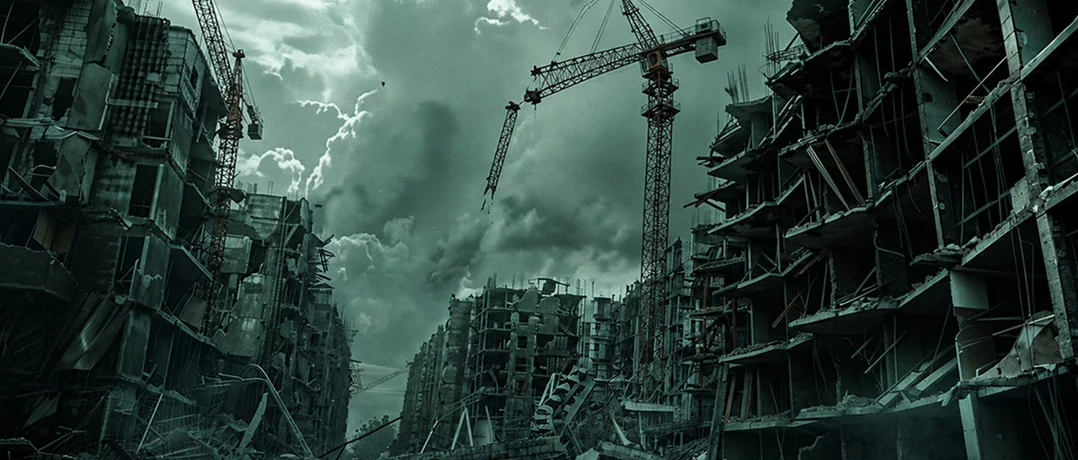
When the ceasefire between Israel and Hezbollah first took effect in November 2024, his house in Dahiyeh lay in ruins. Struck in the conflict's opening weeks, the kitchen was scorched from the blast, while his two children's room was coated in dust and littered with rubble.
That’s when Hezbollah’s money arrived. The repairs cost approximately $10,000. Hezbollah contributed $6,000, and Marwan paid the rest. He rebuilt, moved on, and assumed the worst was behind him.
It wasn’t.
Eighteen months later, a new round of fighting between Israel and Hezbollah brought Israeli strikes back to Dahiyeh. Marwan’s house was hit again. When he saw a video of his home destroyed for the second time, he cried.
Now Marwan fears the money will never come. That fear permeates the Shi’a community, he says, as people confront the reality that Iran, long a steady source of funding, is now consumed by its own war and economic pressures.
“We are weak now, we are so weak,” Marwan said. “Hezbollah against Israel is like one against a thousand.”
For Marwan, the imbalance is not simply a matter of military strength. It is a question of whether communities shattered by the fighting will ever have the means to recover.
“People are afraid, because the destruction now is worse than ever,” he said.
Everybody is tired, and we are looking for peace.
A ceasefire in name only
For many Lebanese, the question of reconstruction cannot be separated from the uncertainty surrounding the ceasefire itself. Tracking its developments has become a dizzying exercise — at best exhausting, and at worst nearly futile. Successive rounds of the U.S.-brokered negotiations between Israel and the Lebanese government have done little to stabilize conditions on the ground.
Last Monday offered a reminder of how fragile the truce remains. When Israel issued its first evacuation order for Dahiyeh since the ceasefire began, panic ensued. Residents rushed to leave ahead of the threatened strikes, while roads leading out of Beirut's southern suburbs were packed with traffic for hours.
The strikes never came. Concerned that escalation in Lebanon could jeopardize its own negotiations with Iran, the United States intervened and secured a limited arrangement under which Israel agreed to halt airstrikes on Beirut in exchange for an end to Hezbollah attacks on Israel.
Days later, Washington announced a broader ceasefire framework following a fourth round of talks with the Lebanese government. Under its terms, Hezbollah would halt attacks and withdraw operatives from the area between the Israeli border and the Litani River, while the Lebanese Armed Forces would gradually assume exclusive control over designated zones free of non-state armed groups. Key questions, however, remained unresolved, including the location of those zones and the timeline for an Israeli withdrawal from southern Lebanon.
Hezbollah, which was not directly involved in the negotiations, rejected the proposal, describing the ceasefire terms as a form of surrender that would ultimately achieve Israel's objectives. Since Thursday, the group has continued launching rockets and drone attacks against Israeli forces and communities near the border.
Despite the ceasefire announcement, Israeli officials warned displaced residents not to return to southern Lebanon. Defense Minister Israel Katz said hundreds of thousands of civilians would not yet be permitted to go back, citing ongoing operations against Hezbollah. Israeli strikes have continued across several towns and villages.
For many displaced families, the message is clear: it is not yet safe to return, let alone rebuild.
Nowhere to return
The impact of that uncertainty is perhaps most visible in the movement of the displaced. On the eve of the April 16 ceasefire, more than one million Lebanese were registered as displaced, 141,000 of which resided in one of the country’s then 690 shelters. Within 48 hours, that number had plummeted to 92,000, with 613 shelters remaining open.
But as residents returned to villages that were largely destroyed, and fears grew that Israeli military operations would continue, many of the displaced returned to the shelters. As of Sunday, 637 shelters were operating, housing 135,100 individuals, nearly matching pre-ceasefire levels.
Wissam, Vice-President of the Disaster Risk Reduction (DRR) unit in Tyre which helps coordinate the displacement response, noted that statistics tracking the movement of the displaced following the ceasefire have shown little movement.
There have been no changes since the ceasefire, because there is still no actual ceasefire.
The shelter system captures only a portion of the displacement crisis. According to DRR figures, 21,169 displaced individuals had been recorded in the Tyre as of June 4, but only 5,204 (24.6%) were residing in one of the region's 19 shelters. The remainder were being accommodated outside the formal shelter network, relying on relatives, friends, and host families for a place to stay.
One of those host families is Marwan’s. Despite having lost his own home in Dahiyeh, he has opened his house in his hometown of Ansariyeh, a coastal village south of Saida, to four displaced families.
“This is how you serve the community,” he said. “Not with war.”
The human cost
Individual acts of solidarity, while meaningful to those they reach, have done little to ease the strain on a system pushed well beyond its limits.
Last Monday night proved particularly tense for many shelters operating in Beirut. As residents from Dahiyeh feared to return, uncertain whether Israel would heed U.S. pressure and refrain from striking the suburb, some took up temporary refuge in their cars along Beirut's waterfront, while others turned to the city’s already overcrowded shelters.
Directors at one shelter in Hamra, a neighbourhood in West Beirut that houses a significant portion of the displaced, described hosting 40 people that night. As the shelter was already full, the new arrivals slept on the ground beneath the school's entrance or across the building's ground floor.
The strain extends beyond the shelter system, spilling over into Beirut's healthcare sector. When one shelter resident fell ill and required medical attention, staff said they were unable to find a single available bed after calling four hospitals across the city. Each, they learned, was already operating at capacity with the influx of wounded and displaced from the south.
The episode underscored a broader reality for many displaced families: even those who have found temporary refuge remain uncertain about what comes next.
While shelter residents currently have access to food, water, and basic necessities, many fear what will happen once the fighting eventually ends. At that point, the shelters are expected to close, and families will be asked to return home. Yet for many, the prospect of return offers little sense of certainty or closure.
Entire border communities such as Kfar Kila, Beit Lif, and parts of Bint Jbeil have been reduced to rubble during the fighting and subsequent demolition operations, as Israeli forces have continued destroying homes in some areas even after the ceasefire.
The physical destruction has been accompanied by a staggering loss of life. According to the Ministry of Social Affairs' latest statistics, 3,637 people have been killed in Lebanon since the start of the war, including more than 1,000 since the ceasefire took effect on April 16.
Among the dead are at least 128 paramedics and healthcare workers killed in Israeli attacks on ambulances and medical facilities over the past three months.
Six of those medical workers were family friends of Marwan's from Dahiyeh and Ansariyeh. He lost three cousins during the 2024 war. Since the latest round of fighting, however, the number of relatives, friends, and acquaintances he has lost has climbed into the tens.
“They were good people, educated people,” he said. “And they died for what?”
Marwan said the repeated cycles of destruction and rebuilding have left many feeling abandoned by all sides involved in the conflict.
“There is no trust. Not in Israel, not in Hezbollah, not in anyone,” he said.
What remains, he said, is exhaustion.
As ceasefire negotiations continue and families remain displaced, reconstruction feels increasingly difficult to imagine. For those who have already rebuilt once only to watch everything disappear again, the prospect of starting over is no longer a certainty.
“We don’t deserve what is happening to us,” Marwan said.
Who will give us support to rebuild?
-
-

-
Katharine SorensenReporterSpecializing in global affairs, technology and economics, with a focus on on-the-ground investigative reporting.
-
