"While darkness and peacelessness rule in many hearts, you, little children, be prayer and my extended hands of love... because Satan is strong and seduces hearts."
These words form part of the latest monthly message attributed to the Virgin Mary by the Medjugorje visionaries, released on July 25.
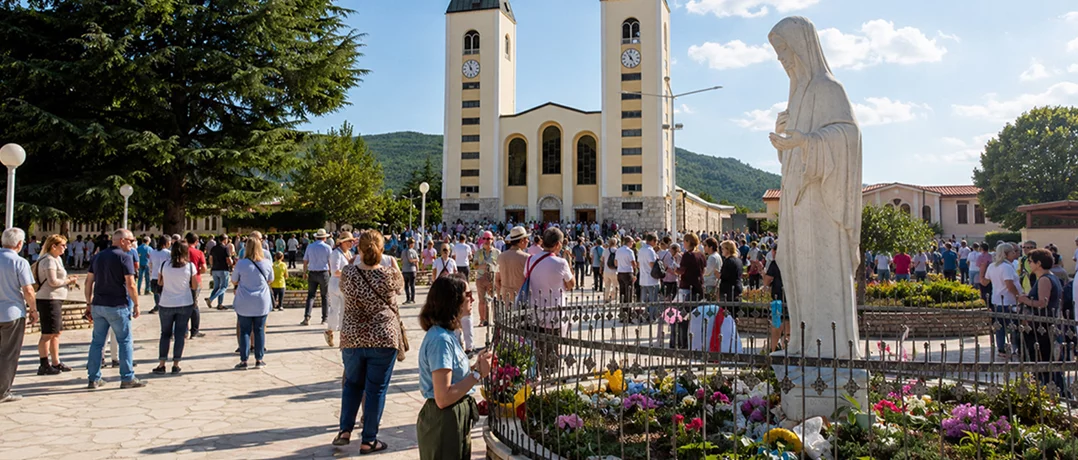
Just days later, the message took on an added poignancy when Medjugorje itself became the target of an act of vandalism. A statue of the Virgin Mary was defaced with black paint, offensive graffiti was sprayed across the sanctuary and part of the outdoor altar at St. James Church was set on fire.
Rather than responding with outrage, the parish called on the faithful to answer the attack with prayer, forgiveness and reconciliation, values that closely echoed the themes of the July message.
The incident once again drew international attention to the small village in Bosnia and Herzegovina that, for more than four decades, has been one of the world's most visited Catholic pilgrimage destinations. Every year, millions of pilgrims travel to Medjugorje in search of spiritual renewal, among them thousands of Lebanese who have forged a particularly deep connection with the shrine. But what is it about Medjugorje that continues to inspire such devotion, and why has it become a place of profound significance for so many Lebanese Christians?
The attack was not random
According to Fr. Joe Eid, the attack was neither spontaneous nor the work of someone unfamiliar with Medjugorje. The suspect had himself been a devoted follower of the reported apparitions, returning to the Bosnian pilgrimage site every year between 2016 and 2024. In 2019, he even organized a walking pilgrimage from Warsaw to Medjugorje, documenting the journey on social media under the title At the Feet of the Virgin, an initiative that attracted significant attention in Poland.
The turning point, Fr. Eid said, came toward the end of 2024, when the man became involved with what he described as an extremist Protestant group. He was careful to distinguish the group from Protestantism as a whole, stressing that theological differences between Catholics and Protestants should not be confused with extremism.
According to confessions obtained by authorities following the suspect's arrest, the group convinced him that the Medjugorje apparitions were demonic, that honoring the Virgin Mary amounted to idolatry, and that Christ was displeased with his devotion to her. “Believing he was making amends for what he had been led to see as a grave spiritual error, he allegedly carried out the attack”.
Security cameras captured the suspect setting fire to part of the outdoor altar at St. James Church, while the nearby Podbrdo apparition hill and Blue Cross prayer site were also vandalized. He was later recognized near the Croatian border, leading to his arrest by Bosnian authorities, where investigators say he confessed to the radicalization that led to the attack.
"This is Medjugorje"
Yet for Fr. Eid, “the story of Medjugorje was defined less by the vandalism itself than by what happened the following morning. Within hours, around 300 volunteers including Lebanese pilgrims and residents, came together to restore the damaged sites”.
"This is Medjugorje," he said.
They cleaned the graffiti from St. James Church, repaired the Blue Cross prayer site, and restored Podbrdo, the hill where the first reported apparitions took place.
For Fr. Eid, the effort was never simply about repairing statues or buildings.
"We do not worship statues," he said. "They are visible signs that point to our faith, honoring God's work in the life of the Virgin Mary and reminding us of Christ's sacrifice on the Cross."
Damaging a statue, he argued, does not weaken that faith.
Our faith is much deeper than wood or stone. Whoever attacks these symbols may intend to insult our beliefs, but they cannot destroy them.
For Fr. Eid, the response reflected the very spirit of Medjugorje. Rather than condemning the attacker, he believes the Virgin Mary would have met him with compassion. "The law must take its course," he said. "But we answer hatred with forgiveness, because only forgiveness frees us from evil."
"I am one of its fruits"
For Fr. Joe Eid, Medjugorje's significance is measured less by the reported apparitions than by the lives transformed through them.
The greatest miracle is not an apparition. It is when someone arrives broken and leaves as someone who loves, forgives, prays and wants to become a better person.
Introduced to Medjugorje's message through the Mass of Peace in Lebanon, he says the experience led him back to Christ, inspired his vocation and ultimately guided him to the priesthood.
"I am one of the fruits of Medjugorje."
Every day, more than 600 priests hear confessions in Medjugorje, welcoming pilgrims seeking repentance and reconciliation. Whether someone believes in the reported apparitions, he says, is ultimately secondary. What matters is the willingness to acknowledge one's weaknesses, seek forgiveness and return to God.
The shrine's greatest legacy is in its "fruits": people rediscovering themselves through prayer, examining their conscience, repairing relationships and finding renewed purpose. "There are spiritual healings, psychological healings and human healings," he said.
Lebanon's bond with Medjugorje
Lebanon was among the first countries to embrace Medjugorje's message, with organized pilgrimages beginning around 2000 and a strong Lebanese presence continuing ever since. Today, Lebanese priests regularly accompany pilgrims to the shrine, while close ties have developed between the Church in Lebanon and the parish of Medjugorje.
Yet the connection extends beyond pilgrimage.
According to Fr. Joe Eid, one of the most remarkable aspects of Medjugorje is the prominence of Saint Charbel. "After the Virgin Mary, Saint Charbel is the most beloved saint among pilgrims," he said. "His presence there is extraordinary."
He recalls foreign pilgrims rushing toward Lebanese visitors upon seeing the Lebanese flag, asking for their blessing simply because they come from the homeland of Saint Charbel.
They may not be able to visit Lebanon. but when they meet Lebanese pilgrims, they feel they are encountering something of Saint Charbel.
"You arrive carrying the burdens of Lebanon and then you see how deeply the world loves Saint Charbel. He makes us hold our heads high again."
From a Quiet Village to a Global Pilgrimage Site
Nestled among the hills of western Herzegovina, about 25 kilometers southwest of Mostar, Medjugorje was once a quiet farming village known for its vineyards, tobacco fields and close-knit Catholic community. That changed on June 24, 1981, when six local children reported seeing a woman holding a child on Podbrdo Hill. According to their testimonies, she identified herself as the Blessed Virgin Mary and, in the days that followed, delivered messages centered on peace, prayer, conversion, fasting and reconciliation.
Although Medjugorje has become one of the Catholic world's most prominent pilgrimage destinations, the Church has not formally recognized the reported apparitions as supernatural. As Fr. Eid explained, the Vatican traditionally waits until alleged apparitions have concluded before issuing a definitive judgment, allowing time to examine both the reported messages and their spiritual fruits.
In September 2024, however, the Dicastery for the Doctrine of the Faith issued a nihil obstat ("nothing stands in the way"), formally recognizing the abundant spiritual fruits associated with Medjugorje and permitting official pilgrimages and public devotion, while stopping short of authenticating the apparitions themselves.
Catholics remain free to believe or not believe in the reported apparitions, but the Vatican has encouraged the faithful to focus on the site's enduring message of prayer, conversion, peace and a deeper relationship with Christ.