Amid war and uncertainty, Lebanon’s layered history and shared traditions of Lent and Ramadan evoke a timeless story of resilience, memory, and renewal.




Amid war and uncertainty, Lebanon’s layered history and shared traditions of Lent and Ramadan evoke a timeless story of resilience, memory, and renewal.

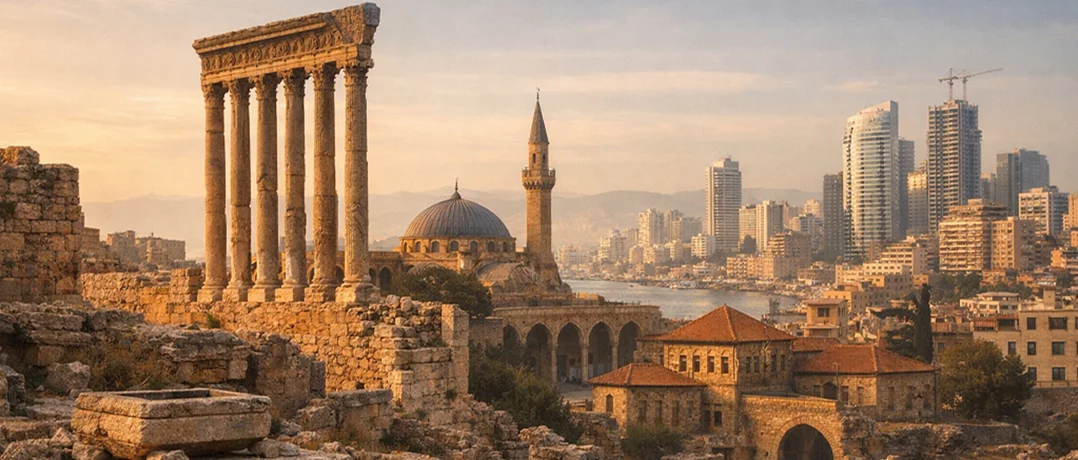
Lent and Ramadan, the periods before Fitr and Easter, have practically coincided this year. Spring is a time of resurrection and renewal, both of which have a deep meaning in Lebanon, a country already tightly-wrapped in history.
And at this time of year, I often read parts of The Hills of Adonis by Colin Thubron, perhaps because he captures Lebanon in spring so beautifully, but also because this year in particular, we once again feel the weight of fortune heavy on our collective shoulders. It is good to remember that we spring from a tradition so much more profound than that of those who seek to remove us.
Before Christ walked in Sidon; before he performed his miracle at Qana, the ancient Semites worshiped Astarte, the pagan goddess of the moon, fertility and spring and whose name is arguably the origin of the word Easter. Her lover, Adonis, was killed by a wild boar, sent by Astarte’s jealous husband, at a grotto near the River Ibrahim. However, the Gods showed pity and allowed Adonis to ascend from the underworld once a year, in spring, when the flooding river shifts red mud, said to be the renewed blood of Adonis, from the mountain slopes and into the Mediterranean.
Then there is Bacchus (or Dionysus to the Greeks), the Roman God of Wine to whom a huge temple in Baalbek in the Northern Bekaa Valley is dedicated. The Romans and Greeks might claim him as their own but he is very much ‘Lebanese’, being the son of Jupiter and Semele, the daughter of the Phoenician prince Kadmos.
The worship of Bacchus, by ancient fertility cults revolved around the idea of resurrection, expressed initially through the agricultural cycle of sowing, growing, harvesting and feasting. So wild were these parties, or Bacchanals, that Rome, mindful of what was happening on the eastern fringes of its empire, commissioned the Temple of Jupiter to overlook that of Bacchus, to remind the people of the Bekaa, just who was in charge.
The Bekaa is wild and mystical. It is Canaanite and Roman, Byzantine Mameluke, Ottoman and the French. The Israelis certainly did, when they invaded Lebanon 1982 and sent their tanks trundling up the road north through the vineyards of Qanafar and Amiq to do battle with the Syrian Army. The Bekaa with its patchwork of coloured soils has been witness to history. They have gone (for the moment) but the Bekaa endures.
As has Tripoli, Lebanon’s second city with its churches, mosques, khans and a magnificent crusader castle, built by Raymond of Saint-Gilles, the richest of the Crusaders and who died before it was completed, at the beginning of the 12th Century.
We all know that Byblos is the oldest inhabited city on earth, but it is also from where the ships of the Phoenician traders would load up with glass olive oil, purple dye and of course Bybline, the Grand Cru of the ancient world. The same can be said for the southern biblical cities of Sidon, near to where Astarte sat on her throne and Tyre, where the Romans held chariot races in a stadium you can still walk around today.
And then there is Beirut, the capital. Forget the restaurants, the malls and even the Pigeon Rock. Think of the layers of history, the earthquakes and wars and the people. In her song Ya Beirut, Majida El Roumi calls the Lebanese capital Il sitte I’Dunya, the lady of the world. But what kind of lady? Is she a respectable grande dame or is she an elderly ‘madam’ running a house of disrepute, once spectacularly beautiful, powerful and adored, now addled by age and too many favours, yet still imbued with dignity?
Elsewhere in the Lebanese songbook, Fairuz sings of a Beirut made from ‘the soul of its people; from wine, sweat and jasmine’. And yes, the city has survived, if not on account of wine and jasmine, then definitely with sweat, and not a little blood and tears too.
The blood and the tears have returned. Many of us won’t be coming for the holiday season. I wanted to be here for Easter, Eid el Kbeer. I wanted to walk up to the church on Easter Sunday and stand outside with the men, chatting, smoking, pushing worry beads. “Al maseeh qam!” Christ has risen! Lunch would have been long and loud; lamb washed down with whiskey or arak. It’s how we roll in the mountains.
But we will be back. As my late aunt once said to me standing in our garden and pointing to the ground. “Hawn akheretna”. Here is our end.