



After devoting more than two decades to protecting endangered sea turtles on Lebanon's southern coast, Mona Khalil leaves behind a community-based conservation movement that continues to safeguard both the coastline and the species she dedicated her life to protecting.
Beyond the Orange House: Mona Khalil's lasting legacy
Beyond the Orange House: Mona Khalil's lasting legacy
By The Beiruter | June 30, 2026

Reading time: 5 min
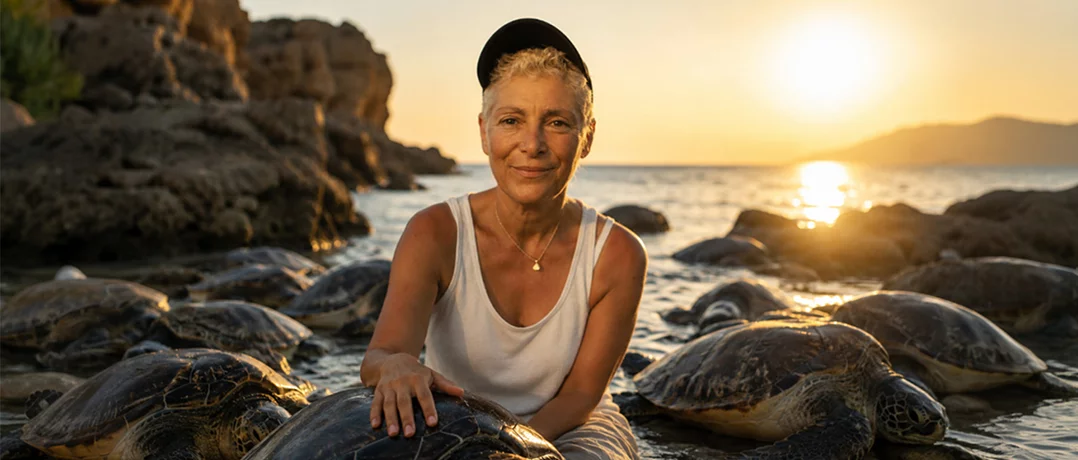
For more than two decades, Lebanese environmental activist Mona Khalil devoted her life to protecting endangered loggerhead and green sea turtles along the coast of Mansouri, near Tyre, where her family home became known as the Orange House and later a small conservation hub. The stretch of beach she defended was only about a mile long, yet it became one of Lebanon's best-known nesting sites for endangered sea turtles and a model for community-based conservation efforts along the country's coast.
Each nesting season, Khalil and the volunteers she trained monitored nesting sites, protected eggs from predators and human disturbance, and helped hatchlings reach the Mediterranean. Her death in June, after an Israeli strike hit her home, prompted mourning across Lebanon and among environmentalists abroad. But it has also renewed attention to the fragile coastline and community-led conservation model she spent decades building.
Although war has devastated much of southern Lebanon, damaging homes, fishing boats and local infrastructure, the network of volunteers, fishermen and municipal partners Khalil spent years cultivating continues her work, preserving not only endangered sea turtles but also the collaborative approach to conservation that she believed offered the best chance of protecting them for generations to come.
A life bound to the sea
Khalil’s work began after she returned to her family’s land in Mansouri in 1999 and saw a turtle nesting on the beach. That encounter became the foundation of the Orange House Project, which she helped establish as a conservation and ecotourism initiative dedicated to protecting sea turtles along Lebanon’s southern coast.
Born in Lagos, Nigeria, in 1949, Khalil spent years abroad, including in the Netherlands, before returning to Lebanon. She painted the house orange in tribute to the Netherlands, where she had lived during Lebanon's civil war, transforming the property into a guesthouse and conservation center. While visitors came to stay near the beach, the heart of the project was protecting nesting turtles.
For Assaad Serhal, founder and president of the Society for the Protection of Nature in Lebanon (SPNL) , what set Khalil apart was not simply that she cared about conservation. It was the depth of her bond with the species she had chosen to protect.
“It wasn’t conservation for conservation’s sake,” Serhal said, speaking to The Beiruter.
It was the bond with the sea turtles that inspired her work. Everything she did, she did for the sea turtles.
Khalil referred to the Orange House as "my paradise," he said, and devoted herself to protecting the turtles that returned each year to nest on the beach. She spent countless nights monitoring nests and ensuring hatchlings reached the sea before they could fall prey to stray dogs, foxes, seagulls and other predators.
Serhal recalled one morning when Khalil explained why that work had become her life's purpose, linking it to the loss of her only son in a sea accident.
“She said, ‘Assaad, this is my life. This is what I want to do,’” he said.
From one woman to an entire community
For much of her life, Khalil preferred to work alone.
When Serhal first met her after the 2006 war, he was struck by how fiercely protective she was of the world she had created at the Orange House.
"She had her own world, and she was happy with it," he said. "She didn't want anybody interfering with her world, with the sea turtles, or with studying or tagging them." The Orange House was a refuge she carefully guarded. Although researchers and environmental groups expressed interest in her work, she was initially reluctant to invite outsiders.
That began to change after the 2006 war, as reconstruction efforts brought Khalil into closer contact with the municipality of Mansouri and a broader network of conservationists working along Lebanon's southern coast. Through those conversations, she was introduced to the hima, a community-based conservation model that places local residents at the center of protecting natural resources.
At first, she was unconvinced. Serhal said Khalil believed she and her partner could continue caring for the turtles on their own and questioned the need to involve others. He argued that lasting conservation depended on local ownership, from municipalities to fishermen.
"What you're doing is really amazing," he recalled telling her. "Nobody else in Lebanon, or even in the region, is doing this alone."
In the years that followed, Khalil gradually expanded the project beyond the Orange House itself. Local fishermen became part of the conservation effort through training that replaced destructive practices such as dynamite fishing, while the protection of Mansouri's nesting beaches became increasingly rooted in the surrounding community.
The people carrying her legacy forward
Preparing others to continue that work became one of Khalil's final and most enduring contributions.
Over the last decade, she trained young people from the surrounding community, alongside her longtime partner, to monitor nesting beaches, rescue hatchlings and educate visitors about Lebanon's marine ecosystem.
"There is now a local community that really trusted her, and she trusted them," Serhal said.
They became deeply dedicated to the cause under her guidance. I think that will be her real legacy.
Despite the loss of their mentor, many of those young conservationists have continued monitoring turtle nesting sites through one of the region's most difficult periods.
Their task, however, has become considerably harder. The Orange House bears the scars of war, fishing boats and conservation equipment have been destroyed, and much of the surrounding community is rebuilding. Sustaining Khalil's work, Serhal said, will require restoring not only damaged equipment but also the partnerships she spent years building with local fishermen, municipal officials and residents.
"Something has to happen to bring back that system," he said. "We want to make sure the municipality stays committed to the public land where the turtles are coming."
For Serhal, preserving what Khalil built would be the most meaningful tribute to her life.
"Using the sea turtles, the publicity around them and Mona's legacy, what she accomplished, maybe all of that can be used for a greater cause," he said.
She paid her life for the turtles, for marine life, for the community and for the fishermen.
-
-

-
The Beiruter
-
