



Trump has launched a Board of Peace for Gaza’s reconstruction, raising questions about legitimacy and the UN’s role.
Board of Peace debuts with billions for Gaza
Board of Peace debuts with billions for Gaza
By The Beiruter | February 21, 2026

Reading time: 3 min
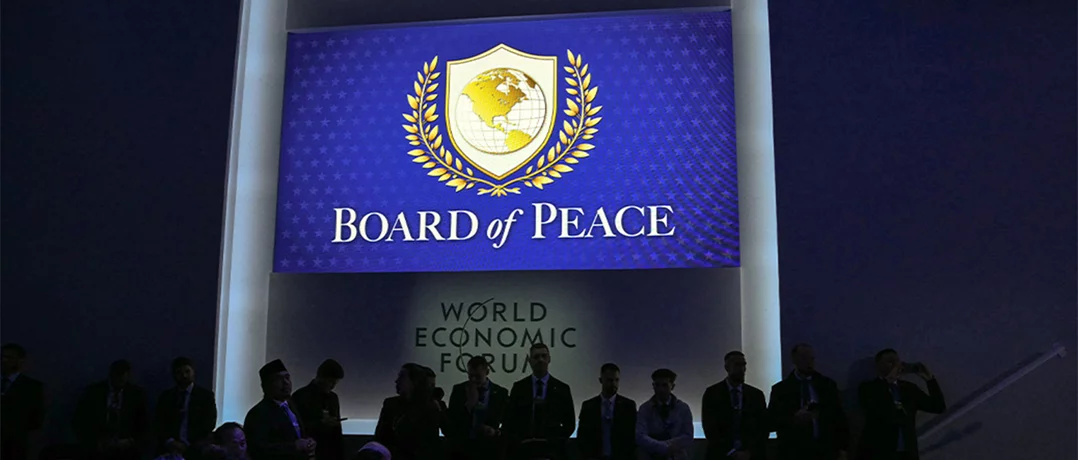
When US President Donald Trump convened the inaugural meeting of his newly formed Board of Peace in Washington, he presented it as a bold corrective to what he has long described as the failures of traditional global diplomacy. Conceived initially as part of his 20-point plan to end the war in Gaza, the Board has rapidly evolved into something more ambitious: a proposed standing international body tasked with overseeing Gaza’s reconstruction and potentially addressing other global conflicts.
Supporters frame it as an agile, results-oriented alternative to bureaucratic inertia. Critics see it as an attempt to sideline or overshadow the United Nations (UN) and a revival for colonial ambitions. What is clear is that the Board of Peace marks one of the most unusual experiments in modern multilateral governance; one built largely around Trump’s personal leadership and political brand.
Origins and structure
Trump first introduced the idea of a peace board in September 2025, tying it directly to efforts to halt the war between Israel and Hamas (following the 7 October 2023 Hamas attack). After a fragile ceasefire took place in October 2025, planning accelerated. The Board was formally launched on the sidelines of the World Economic Forum and convened for the first time at the renamed Donald J. Trump Institute of Peace in Washington.
Its charter outlines a 3-year term for member states, with an unusual clause: countries that contribute $1 billion may obtain permanent membership. Trump has appointed himself chairman with sweeping executive powers, including agenda-setting authority and veto rights over decisions. He also retains influence over membership selection and, notably, the choice of his successor.
The executive board includes high-profile figures such as former British Prime Minister (PM) Tony Blair and Trump’s son-in-law Jared Kushner. US Secretary of State Marco Rubio and longtime Trump envoy Steve Witkoff are also central players. Bulgarian diplomat Nickolay Mladenov serves as High Representative for Gaza.
While the original UN mandate referenced support for displaced Palestinians, the Board’s own charter avoids direct mention of the UN and even Gaza itself; a drafting choice that has fueled suspicions about its broader ambitions.
Membership: Who joined, and who didn’t
Approximately 2 dozen countries have formally joined the Board. Among them are several Arab states, including the Kingdom of Saudi Arabia (KSA), Qatar, Egypt, Jordan, and the United Arab Emirates (UAE). Other members span Eastern Europe and Asia, including Indonesia, Armenia, Azerbaijan, Kazakhstan, Pakistan and Vietnam.
Israel is a member, represented by PM Benjamin Netanyahu. Notably absent, however, is Palestine. Palestinian participation is limited to a lower-tier technocratic committee tasked with local governance coordination. For many observers, this imbalance has become one of the Board’s most controversial features.
Equally striking is who has stayed away. Key Western democratic allies, including the United Kingdom (UK), Canada, France and Germany, declined to join as full members. Several sent observers instead, alongside the European Union (EU). Major powers such as Russia and China have not signed on. Critics argue that the absence of permanent UN Security Council (UNSC) heavyweights undermines the Board’s claim to global legitimacy.
Financial commitments and reconstruction vision
At its inaugural meeting, Trump pledged $10 billion in US support toward Gaza’s reconstruction, part of what he described as a broader $70 billion long-term rebuilding effort. Member states collectively committed more than $6.5 billion in additional funding, with Gulf states among the largest contributors.
The World Bank Group, led by President Ajay Banga, is expected to act as trustee, managing and disbursing government-contributed funds under the Board’s direction.
Plans unveiled at the meeting included temporary housing developments near Rafah, large-scale infrastructure projects, and ambitious proposals for new economic corridors linking Gaza to regional markets. Israeli businessman Yakir Gabay outlined a vision featuring modern urban districts, high-tech industry and tourism along a rebuilt Mediterranean coast.
Yet the sums pledged so far represent only a fraction of estimated needs. World Bank assessments suggest that reconstruction could require tens of billions more.
Security and the International Stabilization Force
Central to the Board’s strategy is the deployment of an International Stabilization Force (ISF). US Major General Jasper Jeffers described a projected 20,000 strong force, complemented by a new 12,000 member Palestinian police unit trained in coordination with Egypt and Jordan. Indonesia has pledged up to 8,000 troops, while Morocco, Kazakhstan, Kosovo and Albania have also committed personnel.
However, the stabilization plan hinges on the disarmament of Hamas; an objective that remains deeply contested. Trump and Netanyahu have insisted that reconstruction cannot proceed without demilitarization. Hamas, for its part, has shown little willingness to relinquish weapons in the absence of firm guarantees.
This unresolved question casts uncertainty over the Board’s timeline. Without a durable security arrangement, international donors may hesitate to release full funding.
Relationship with the United Nations
Trump has alternated between describing the Board as a supplement to the United Nations and suggesting it could effectively “oversee” it. The US remains billions of dollars in arrears on UN dues, and Trump has frequently criticized the organization as inefficient and overly politicized.
Meanwhile, European officials attending as observers have called for clearer procedural rules and transparency. Some legal scholars question how a Trump-chaired body with expansive executive powers can operate alongside established international frameworks without generating institutional conflict.
Bold initiative or parallel diplomacy?
Trump’s Board of Peace represents a dramatic departure from conventional multilateralism. Built around financial incentives, centralized leadership and a targeted regional mission, it aims to demonstrate that decisive political will can succeed where traditional diplomacy has stalled.
Yet its future hinges on unresolved fundamentals: Hamas’s disarmament, Israel’s security posture, sustained donor funding and broader international legitimacy. The absence of key Western allies and permanent Security Council powers limits its global reach, even as substantial Gulf and regional backing provides momentum.
Whether the Board becomes a transformative peace platform or a short-lived political experiment will depend less on inaugural speeches and more on implementation in Gaza’s fragile postwar reality. For now, it stands as one of the most unconventional diplomatic ventures of Trump’s presidency; ambitious, polarizing and still very much untested.
-
-

-
The Beiruter
-
