



Renewed border violence in southern Lebanon overshadowed the second round of Rome negotiations, despite progress on border issues, ceasefire implementation, and verification mechanisms.
Border escalation tests Rome negotiations

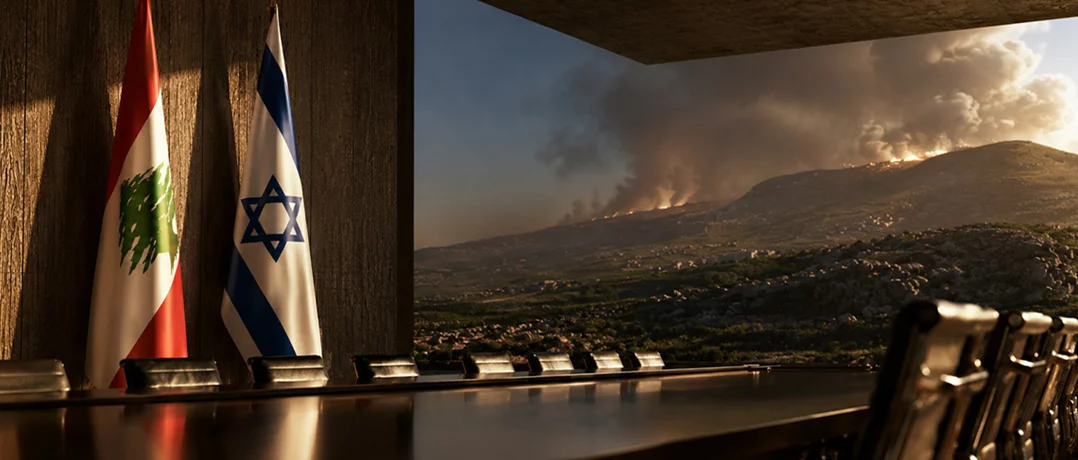
The seventh round of U.S.-mediated negotiations between Lebanon and Israel, which is set to resume for the third day today, entered a critical phase in Rome amid renewed military escalation along Lebanon’s southern border. While negotiators reported progress on several technical and political files, developments on the ground (including Israeli military operations, casualties among Israeli troops, airstrikes on southern Lebanese towns, and renewed displacement of civilians) created additional challenges for the diplomatic process.
The negotiations, hosted at the U.S. Embassy in Rome for the second time, have focused on implementing the security framework previously discussed between the two sides. Central issues include Israeli military withdrawals from parts of southern Lebanon, the deployment of the Lebanese Armed Forces (LAF), border demarcation, verification mechanisms, and arrangements aimed at maintaining the ceasefire. However, unresolved disagreements over security requirements and the role of Hezbollah continue to complicate efforts toward a broader agreement.
Military escalation along the southern border
The second day of negotiations, on 5 August 2026, coincided with one of the most significant security incidents in southern Lebanon since the latest ceasefire arrangements entered into force.
The Israeli military announced today that two reserve soldiers were killed and several others wounded after an explosive device detonated during military operations in the Majdal Zoun-Mansouri area of southern Lebanon on 5 August 2026. Israeli media reported that the explosion occurred inside a building that had been booby-trapped, causing casualties among members of the 55th Brigade.
Following the incident, the Israeli army accused Hezbollah of violating the ceasefire and launched a series of military operations across southern Lebanon. An evacuation warning was issued to residents of the town of Mansouri, instructing civilians to move at least one kilometer north into open areas.
Israeli airstrikes subsequently targeted several locations, including the areas between Zebqine and Majdal Zoun, the town of Tebnine, and later Burj al-Shamali near Tyre. Additional artillery shelling struck Mansouri, Majdal Zoun, Hadatha, Kfar Remman, and surrounding valleys, while the use of phosphorus munitions was used in some areas.
Lebanese authorities reported casualties resulting from the strikes, including fatalities and multiple injuries (among them 1 fatality and 11 injuries in Tebnine). Fires also broke out in wooded areas following drone strikes, while around 15 families reportedly left Mansouri after receiving evacuation warnings.
The second round of Rome negotiations
Despite the deteriorating security environment, negotiations continued for a second consecutive day at the U.S. Embassy in Rome.
The talks were divided into three parallel tracks covering political, military, and border-related issues. Delegations from Lebanon and Israel met separately with U.S. mediators as part of discussions aimed at advancing the implementation of the previously agreed security framework.
The Lebanese delegation proposed designating either Bint Jbeil or Khiam as an additional “pilot area” for the deployment of the LAF following an Israeli withdrawal. The Israeli delegation did not approve the proposal, leaving one of the principal agenda items unresolved.
Lebanon also formally requested the renewal and confirmation of a comprehensive 60-day ceasefire, with the timing of its official announcement to be determined through mutual agreement. Lebanese negotiators additionally raised concerns over Israel’s evacuation warning to Mansouri during the negotiations.
At the request of the U.S. delegation, discussions were temporarily suspended to allow American mediators to continue consultations before negotiations resumed the following day.
Progress on borders and verification mechanisms
Although disagreements persisted over several issues, measurable progress had been achieved in other negotiating tracks.
Discussions regarding border issues allegedly advanced significantly during the second day. The Lebanese delegation presented a comprehensive legal and historical dossier outlining the evolution of the international boundary, beginning with the Armistice Line, continuing through the Blue Line, and addressing the current situation on the ground.
Negotiators also discussed mechanisms for verifying compliance with future agreements. Conversations focused on identifying a potential third party that could oversee verification procedures in areas where the LAF would deploy after Israeli withdrawals.
Technical discussions addressed implementation procedures within pilot zones, including criteria for evaluating whether such areas could serve as models for broader implementation elsewhere along the border.
Outstanding points of disagreement
Several major issues remained unresolved during the negotiations.
Israel continued to link any substantial progress to measures concerning Hezbollah’s military capabilities, while expressing reservations regarding the LAF’s ability to maintain exclusive security control in areas vacated by Israeli forces.
The parties also failed to reach agreement on expanding the pilot areas, determining verification arrangements, or establishing procedures for inspections within private properties located inside future implementation zones.
While Lebanese negotiators stressed the importance of Israeli withdrawals and the return of displaced civilians, Israeli representatives continued to prioritize security guarantees and mechanisms intended to prevent the reestablishment of armed infrastructure near the border.
While the U.S. maintained its central role as mediator throughout the negotiations, diplomatic activity also extended beyond the negotiating room. Italian Foreign Minister (FM) Antonio Tajani announced that he had spoken with his Iranian counterpart Abbas Araghchi about regional developments, including Lebanon. Tajani expressed hope that the Rome negotiations would produce concrete results capable of reinforcing the ceasefire and contributing to a broader agreement, while highlighting Iran’s role regarding Hezbollah’s military activities.
Therefore, the second round of negotiations in Rome demonstrated both the opportunities and challenges facing diplomatic efforts between Lebanon and Israel. While negotiators reported progress on border documentation and verification mechanisms, significant disagreements persisted and renewed military escalation in southern Lebanon underscored the fragile security environment surrounding the talks.
-
-

-
The Beiruter
-
