

Through his platform We Love Bsharri, Charbel Rahme is documenting the people, heritage, and spirit of Bsharri while helping reconnect the village with its residents and diaspora.
Bsharri reclaimed through digital memory

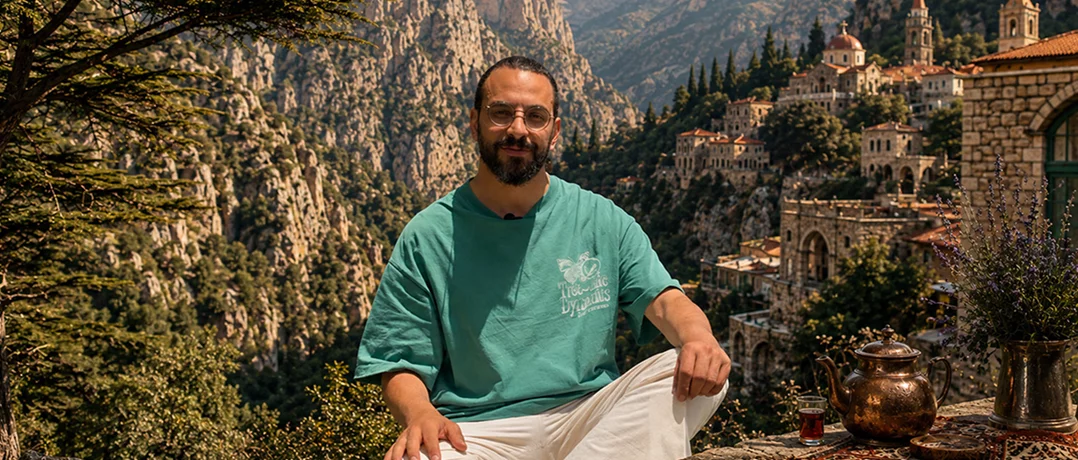
Tucked into the mountains of northern Lebanon, Bsharri is the kind of place that reveals itself slowly, to those willing to step off the main road and wander into its old stone streets. Charbel Rahme has been doing exactly that for seven years, camera in hand, sharing what he finds with a growing community of over 12,000 followers on his page, We Love Bsharri.
The Beiruter spoke with Rahme to find out the drive and passion behind his page. It is, as Rahme describes it, a mission to show Bsharri's authentic face, one that even its own residents sometimes overlook.
A village seen from the inside
"I noticed that people who came to Bsharri would look at it from a distance," he says. "They'd pass by, take a photo from afar, and leave. I felt the village could make people fall in love with it even more, if only they walked through its streets."
Through reels, stories, and short videos, Rahme documents the town's ornate stone architecture hidden behind layers of concrete, its winding alleys, its lesser-known characters, and the rituals of daily life that might otherwise disappear unrecorded. The result functions less like a documentary and more like a living archive, digestible, warm, and built for the scroll.
Nostalgia as a Tool for Connection
The response has been striking. Residents message him asking where a particular street is, saying they'd never noticed it before. Members of the diaspora, especially in Australia, where a significant Bsharri community has settled, write to say they spotted their grandfather's house in one of his posts, or recognized the alleyway where they played as children. "It rebuilds the connection between people and Bsharri," Rahme says. "It brings back that nostalgia. It revives bonds that still exist."
A place with a spiritual pulse
Rahme speaks about Bsharri with a reverence that goes beyond local pride.
"There's a very high spiritual energy in Bsharri," he says. "You have the Cedars, the Khalil Gibran sanctuary, the Qadisha Grotto, all on the same visual line. And on top of that, all the monasteries, the ancient houses, all the beautiful history." He pauses before adding: "Rocks in this region are millions of years old. There are studies being done on how this whole area was formed. This place has a very high spiritual energy."
The village's geography, he explains, is only part of the story. Bsharri has long been a place that produces remarkable people. "Everywhere you turn, there's a new view," he says. "And the village has given the world important figures, in literature, like Gibran Khalil Gibran, who raised the name of Bsharri and Lebanon across the world, in politics, in the arts." He speaks warmly of local figures, a village doctor, a poet, a storyteller, whose characters shaped the community's identity over generations. "Every person in Bsharri is a character in their own right. They have their own vibe, their own inner world. They are the ones who truly influence this place."
He is equally insistent that the women of Bsharri deserve their place in this story. Invoking Gibran's own words, "my mother's face is my nation's face", he reflects on the role mothers and female figures have played in shaping the village's culture and values. "The mothers of Bsharri have given the world people who love to learn, who love art, who love the environment, who love each other," he says. "That role is enormously important and it doesn't get talked about enough."
From corporate life to inner alignment
Rahme's parallel career as a certified life coach is not incidental to his work on the page. After years in media and corporate settings, he made a deliberate shift in his mid-thirties, stepping away to pursue writing, music, and life coaching from Bsharri, entirely remotely. He now runs workshops, group sessions, and one-on-one coaching, describing his focus as "inner alignment." "It's not toxic positivity," he is careful to note. "Life has a full side and an empty side. Where you choose to focus is where your energy goes." That same philosophy runs through We Love Bsharri, accountability has its place, but the frame is always the beautiful image, the story worth telling.
A call to come home
Rahme closes with a message directed at the diaspora and anyone who has drifted from their hometown: come back, at least once a month. Spend money locally. Be present. "We focus a lot on tourism, and that matters," he says. "But the foundation is the people. If those who left for work or for their children's schools don't return and contribute, the economic cycle stays broken. The village stays incomplete."
For Charbel Rahme, showing Bsharri to the world and saving it are one and the same thing.
-
-

-
The Beiruter
-
