

Through a global AI hackathon, one Lebanese entrepreneur argues that democratizing AI skills could redefine how countries compete in the AI economy.
Building Lebanon's AI advantage

Artificial intelligence is changing what makes countries economically competitive. But what if Lebanon's greatest advantage in the AI economy is one it has possessed all along?
For decades, Lebanon's greatest export has been its people. Engineers, physicians, entrepreneurs and academics have built careers around the world, creating one of the Middle East's largest and most influential diasporas. That migration has often been framed as one of the country's greatest economic losses, a persistent brain drain that has deprived Lebanon of talent just as it has needed it most.
Lebanese entrepreneur Roy Baladi believes artificial intelligence may begin to change that equation.
Speaking to The Beiruter, Baladi argued that as artificial intelligence transforms the global economy, a country's competitiveness may depend less on its natural resources than on the skills of its people. For Lebanon, a country with limited natural resources but a long history of producing globally successful professionals, that shift could create an unexpected opportunity.
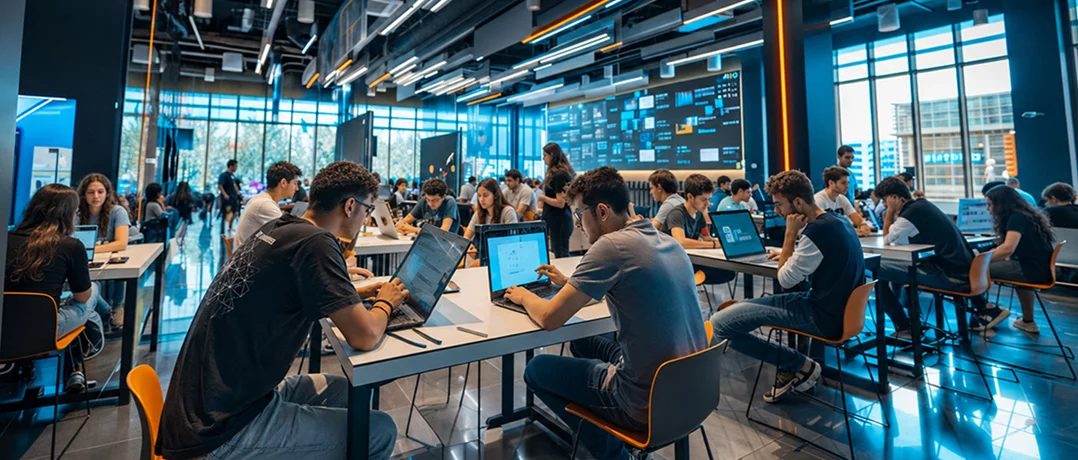
That conviction sits behind a free AI hackathon that has already attracted more than 45,000 participants from over 160 countries and could set a Guinness World Record by guiding tens of thousands of people through building AI applications during a week of live instruction. Yet for Baladi, the record itself is secondary. The larger ambition is to democratize AI skills and help more people develop the capabilities that will define economic competitiveness in the AI era.
Bringing talent home
Long before launching an AI hackathon, Baladi had spent years building initiatives aimed at helping people realize their professional potential.
After leaving Lebanon at 17, he spent four years on Wall Street before moving to Silicon Valley, where he helped build a startup that eventually achieved unicorn status. Rather than remaining in California, however, Lebanon's financial collapse in 2019 redirected his attention home.
A phone call from a friend became the catalyst. The proposal was straightforward: mobilize the Lebanese diaspora to hire professionals still living in Lebanon for remote work. The initiative became Jobs for Lebanon, a volunteer-led platform that has since facilitated roughly 5,000 job placements before expanding into Jobs for Humanity, which now connects employers with refugees, people with disabilities, and other underrepresented communities across multiple countries.
The experience reinforced what Baladi sees as Lebanon's defining economic characteristic.
"The remarkable thing is that Lebanon has produced so many successful people despite lacking some of the institutional advantages that other countries have," he said.
Unlike the traditional narrative of brain drain, Baladi argues that Lebanese talent abroad should not be viewed solely as a loss. Advances in remote work, digital collaboration and AI mean expertise can increasingly circulate across borders even when people do not.
That success, he argues, has been sustained in part by a diaspora that rarely severs its ties with home.
"The sense of family is incredibly strong," he said.
You may leave. You may build a life somewhere else. But you're never really disconnected. You can shoot off, but you're never cut off.
As remote work, digital collaboration and AI reduce the importance of geography, Baladi believes those enduring ties allow knowledge and experience to continue flowing back into Lebanon long after people have built lives elsewhere
AI as an investment in people
Much of today's public conversation focuses on automation and job displacement. Baladi sees something different. Rather than replacing human capability, he believes AI can dramatically expand it by lowering the barriers to creating businesses, building products and competing internationally.
AI is a tool," he said. "But unlike previous transformative technologies, fire, the wheel, electricity or the internet, AI is also a thinking tool.
For Baladi, the real transformation lies beyond using chatbots to answer questions. Increasingly sophisticated AI agents can research, write, analyze information, build software and complete complex workflows, allowing individuals to accomplish work that previously required entire teams. That productivity, he argues, has profound implications for countries like Lebanon, where human capital has long been the country's most abundant resource.
The technology's appeal, he says, is also its universality.
"AI is one of the most in-demand skills employers are looking for today and dramatically increases people's chances of finding meaningful, well-paid work,” Baladi said.
And it's not industry-specific. You could be a translator, a designer, an accountant, an entrepreneur. AI enhances every profession.
Still, he rejects the notion that AI diminishes the importance of human judgment.
"Critical thinking still matters," he said. "AI can generate business ideas and execute many tasks, but it's still most effective when humans give it clear direction. It can't replace human relationships or contextual knowledge."
Rather than diminishing the value of human capital, AI has the potential to amplify it, allowing individuals to accomplish more regardless of their profession or location.
Lebanon's comparative advantage
The hackathon is designed to put that vision of AI-driven human capital development into practice.
Supported by Lebanon's Ministry of Technology and AI and Saudi Arabia's Ministry of Human Resources and Social Development, the week-long program brings together instructors from organizations including Google, NASA and Tuwaiq Academy to teach participants of all ages—from seven-year-old children to retirees—how to build AI applications through hands-on projects rather than lectures.
Baladi ultimately hopes employers will recruit directly from participants' completed projects, rewarding demonstrated capability rather than certificates alone. More fundamentally, he believes AI education represents one of the highest-return investments Lebanon can make.
"If you look at Lebanon objectively, we don't have vast natural resources” Baladi said.
What we do have is people. That's our comparative advantage. The question is how you help those people reach their full potential.
Unlike physical infrastructure or extractive industries, knowledge is portable. In Baladi's view, that makes AI education more than workforce training. It becomes an investment in the human capital that increasingly underpins long-term economic competitiveness.
"If Lebanon invests in helping its people develop their skills, that's an investment that compounds over time," he said.
“Countries can lose industries, and they can lose natural resources. But knowledge travels with people. Human capital is one of the strongest long-term investments any country can make. It doesn’t disappear just because someone crosses a border.”
For young people wondering where to begin, Baladi's advice is simple: start building and experimenting. The purpose of the hackathon, he argues, is not simply to teach participants how to use artificial intelligence, but to give them the confidence to realize they can create with it. Once that mindset takes hold, people begin to see AI not simply as a product to use, but as a platform for creating their own ideas.
Lebanon is unlikely to rival larger economies in the race to build data centers or manufacture advanced semiconductors. But Baladi believes the country has a different advantage. If artificial intelligence lowers the barriers to innovation and expands what individuals are capable of achieving, then Lebanon's long-standing strength—its people—could become one of its most important competitive assets in the AI economy.
-
-

-
The Beiruter
-
