Lebanese artist Caroline Chaptini discusses her record-breaking recycled art, her latest Guinness World Records projects, and how she transforms plastic waste and war rubble into powerful symbols of hope.




Lebanese artist Caroline Chaptini discusses her record-breaking recycled art, her latest Guinness World Records projects, and how she transforms plastic waste and war rubble into powerful symbols of hope.

Caroline Chaptini has turned Lebanon's plastic waste crisis into a platform for environmental advocacy, public art, and global recognition. Since setting her first Guinness World Record in 2019 with a 28.1-meter Christmas tree constructed from 120,000 recycled plastic bottles, the Lebanese artist has gone on to create a series of record-breaking installations, including a giant bottle-cap crescent moon, a recyclable-material Lebanese flag, a bottle-cap mosaic produced with Sony in Dubai, a 10-meter plastic globe in Benin, and, most recently, the world's largest plastic cedar tree. Today, seven Guinness World Records bear her name.
Speaking to The Beiruter, Chaptini discussed two of her latest projects: a recently unveiled Lebanese flag mosaic and a deeply personal installation she is racing to complete in Tripoli.
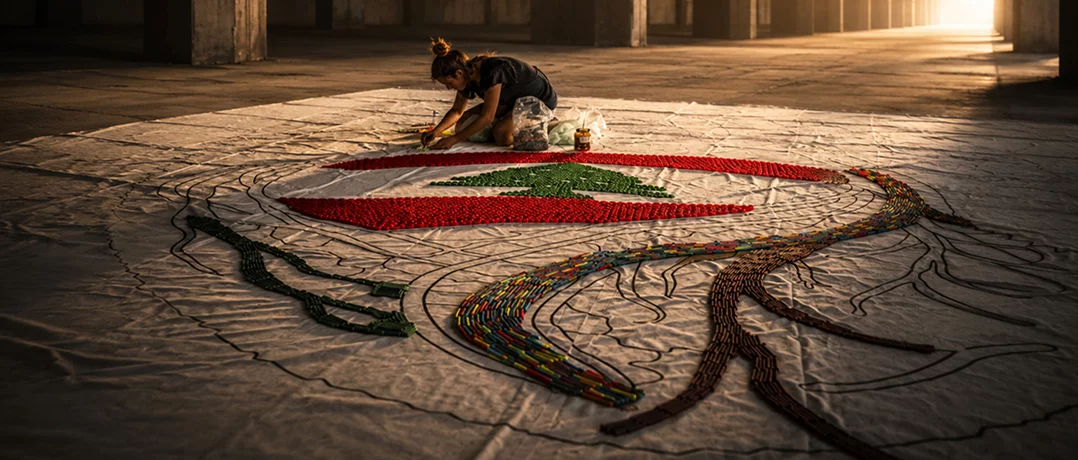
The flag is a large-scale mosaic of the Lebanese flag, assembled by a team of volunteers out of recycled and recyclable materials, the same signature technique Chaptini has used throughout her career, turning plastic bottles, caps, and other discarded items into the red, white, and cedar-green of the national emblem. This new version was built in a single-day timeline, which is what places it under a very specific Guinness category, one measured by size as well as how much a team can construct within 24 hours.
Chaptini was quick to correct a widespread misconception surrounding her latest flag project. "The flag is not yet a Guinness World Record," she said, noting that some media reports had inaccurately presented it as an official title. The distinction, she explained, is largely financial. Official Guinness submissions require a registration fee, which the municipality supporting the project was unable to cover. "So we decided to go ahead with the project regardless," she said.
Since then, however, Chaptini has found an alternative route. Rather than submitting the project through the municipality, she registered it herself under the Guinness category for the "largest mosaic made in 24 hours," using the Lebanese flag as the mosaic design.
The application has now been submitted under her name, although a decision is still several months away. "It usually takes around five months to receive a response," she said. "For now, it's simply a Guinness World Records application that is pending approval."
Chaptini's attention has now shifted to what she hopes will become her eighth Guinness World Record: a monumental sculpture titled The Pulse of Lebanon.
Currently under construction at the Rashid Karami International Fair in Tripoli, the installation is being created from rubble collected across southern Lebanon, the Bekaa Valley, and Beirut's southern suburbs, combined with other recycled materials. The work transforms fragments of destruction into a symbol of resilience and collective memory.
She estimates the project is about halfway complete. "I have around two weeks left," she said.
To qualify for Guinness recognition, the installation must also meet a participation requirement: 1,000 people must each contribute to the artwork. "If one thousand people participate, then I qualify for the record," she explained. The heart project, she noted, actually predates the flag mosaic. "I've already been working on it for about two weeks, and I still have another two weeks to finish it," she said. So far, the words Pulse and Lebanon have been completed, with work now focused on constructing the heart itself. "
Chaptini's journey into record-breaking art began unexpectedly in 2019, when she was 36 years old. "It all started as a joke," she recalled.Following her dietitian's advice to drink more water while trying to lose weight, she began keeping the empty bottles instead of throwing them away. Together with her six-year-old daughter, she used them to build a small Christmas tree.
"People loved it and kept asking why I didn't make a bigger one," she said. That simple family project eventually evolved into the towering Christmas tree displayed in Bsharri, the installation that earned her first Guinness World Record. "I never imagined people would respond the way they did."
Remarkably, Chaptini had no formal artistic training. "I'm actually an accountant," she said. "I also studied optometry and worked in eye clinics. None of my professional background has anything to do with art. I wasn't even someone who drew."
Today, she says, the records themselves have become secondary to the message behind them. "It's especially a message to women," she said, reflecting on the criticism she has faced throughout her journey. "I want them to know it's never too late. If you can dream it, you can achieve it."
She also believes the projects leave a lasting impression on the children who help build them. “When you tell children they're part of something as big as a Guinness World Record, they become incredibly excited," she said. "That's why I can't stop. Once you become a role model, you feel a responsibility to keep going."

