



Instagram is helping Lebanese entrepreneurs build businesses without storefronts, but its growing marketplace raises questions about consumer protection, taxes and the sales the state cannot track.
Business by DM: Inside Lebanon’s Instagram market
Business by DM: Inside Lebanon’s Instagram market
By Jessica Habchy | September 24, 2026

Reading time: 9 min
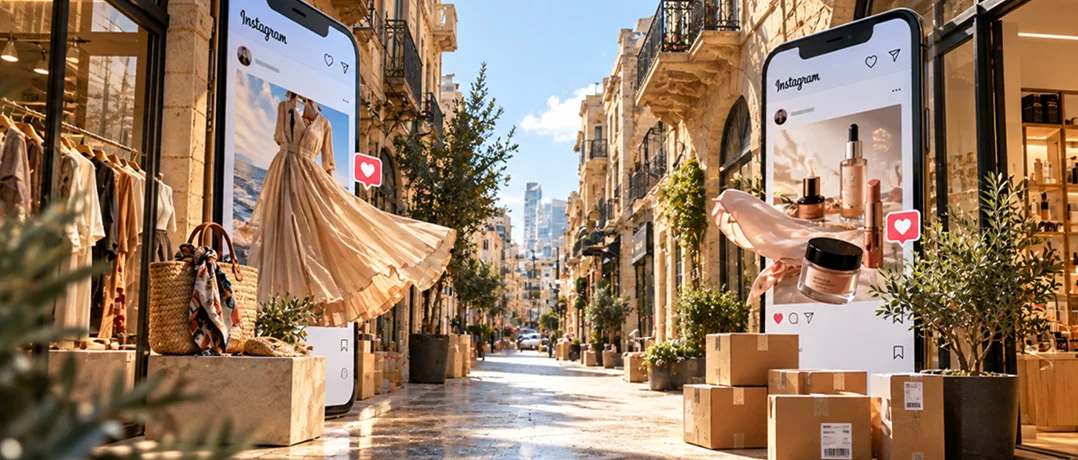
The shop is open. There is no door to unlock, no rent due at the end of the month, no window display to arrange and, sometimes, no cash register at all.
There is just a page.
For years, Instagram has been part of the way Lebanese buy and sell. A dress spotted while scrolling, a piece of jewelry ordered through a DM, a homemade product discovered through a Reel, a purchase confirmed on WhatsApp and, a few hours or days later, a delivery driver at the door.
None of this is new. What is less visible is the economy operating behind it.
For the seller, an Instagram page can remove some of the biggest costs of running a traditional shop. For the consumer, it makes buying almost effortless. But somewhere between the post, the DM and the cash handed over at delivery, bigger questions emerge: Who is selling? Who is protecting the buyer? How much business is actually taking place? And how much of that money can the Lebanese state see?
Millions of potential customers, one screen
The audience is difficult for any business to ignore.
According to DataReportal’s Digital 2026 report for Lebanon, the country had 5.38 million internet users in October 2025, equivalent to 91.8% of the population, as well as 4.58 million social media user identities, representing 78.1% of the population.
Instagram alone had a potential advertising audience of 2.95 million people in Lebanon in late 2025, according to data published through Meta’s advertising tools and reported by DataReportal. That was equivalent to 50.3% of Lebanon’s total population and 54.9% of the country’s internet users. Among adults aged 18 and above, Instagram’s advertising reach was equivalent to 71.9%.
The platform’s potential advertising reach in Lebanon also increased by 350,000, or 13.5%, between October 2024 and October 2025, according to Meta’s planning tools as reported by DataReportal.
These figures represent potential advertising reach rather than the number of unique active Instagram users. But from a business perspective, they show something important: a seller operating from a phone can potentially put a product in front of an audience that would be unimaginable for most small physical stores.
And Lebanese consumers are not simply scrolling.
A nationwide Ipsos Lebanon study conducted in May 2025 among 1,000 respondents aged 13 and above found that 77% had discovered Lebanese brands through social media, while 62% said they had tried products following influencer endorsements.
Instagram, then, is not simply where products are displayed. It is where they are discovered, promoted, recommended and, increasingly, sold.
Why businesses stay online
Farid Khalil, an expert in digital transformation and technology, explains to The Beiruter that Instagram’s decision to discontinue certain shopping features, including the “Shop” and “Shop Now” functions, came amid problems related to fake brands and what he describes as illegal commercial behavior on the platform, which generated numerous complaints.
Despite these changes, consumers have increasingly relied on online stores rather than physical ones, both in Lebanon and worldwide, although Khalil stresses that the trend varies significantly from one business to another. Some businesses still prefer physical stores because of the nature of their products, particularly when customers want to touch, test or ask questions about a product before purchasing it.
However, several factors are pushing more businesses toward online sales and encouraging them to use their Instagram pages almost as e-commerce stores, displaying their entire product catalogs on the platform.
One major factor is that Instagram itself facilitates this model. Businesses can showcase their products, provide information directly through images and captions, and increasingly use video content to explain or demonstrate what they are selling. The rise of user-generated content (UGC) and influencers has also helped businesses promote their products and reach consumers more directly.
According to Khalil, there are two particularly important reasons behind this shift.
The first is the widespread use of smartphones and internet connectivity. With a large share of consumers spending significant amounts of time online and accessing platforms directly through their mobile phones, businesses naturally want to be present where their customers already are. As consumers moved online, businesses increasingly followed them and established their stores there as well.
The second major factor is cost.
Operating a physical store involves substantial expenses. A business may have to purchase or rent a commercial space and continuously cover overhead costs such as electricity, water, maintenance, décor, municipal fees and employees.
“While online, it’s free,” Khalil explains. Creating an Instagram account does not itself cost money, and businesses can produce and publish their own content while operating with significantly fewer expenses than a traditional physical store.
Social media also makes advertising and the purchasing process easier. Businesses can promote their products online and provide consumers with simple calls to action, allowing them to send a direct message or move immediately to WhatsApp to complete an inquiry or purchase. At the same time, these interactions allow companies to collect valuable data about their customers.
And that is where Instagram’s economic advantage becomes clearer. It does not merely give a business another place to advertise. For some sellers, it removes several of the fixed costs that once stood between an idea and a functioning business.
The sale is digital. The payment often isn’t.
But Lebanon adds its own twist to the digital shopping model.
The storefront may be virtual. The money often is not.
The U.S. Department of Commerce, in its February 2026 guide to Lebanon’s e-commerce sector, notes that cash on delivery remains prevalent in Lebanese e-commerce despite the expansion of digital payment solutions. It attributes its continued use partly to consumer preferences and trust issues.
The World Bank’s Global Findex 2025 database, based on data collected in Lebanon in 2024, offers another glimpse into this behavior.
Among the 62 applicable responses to its question on how online purchases were usually paid for, 39 respondents, or 62.9%, said they paid cash when the order was delivered. Seven, or 11.3%, said they paid online, while 16, or 25.8%, used both methods.
Importantly, the World Bank warns that these case figures cannot be interpreted as summary statistics for Lebanon’s population as a whole because of the limited number of applicable responses.
Still, they point in the same direction as the U.S. Department of Commerce: Lebanon’s digital shopping economy continues to coexist with a strong reliance on cash on delivery.
It creates an almost entirely digital journey with a very physical ending.
The product appears on a screen. The customer discovers it online. The conversation happens through a DM. The order moves to WhatsApp.
Then someone knocks on the door, and the money changes hands.
When anyone can become a seller
That simplicity is one of Instagram commerce’s biggest strengths.
It can also be one of its biggest weaknesses.
Opening an Instagram page takes minutes. Establishing who is actually behind it, particularly when something goes wrong, can be considerably more complicated.
Dr. Mohammad Abou Haidar, Director General of Lebanon’s Ministry of Economy and Trade, told The Beiruter that demand for e-commerce increased significantly after the COVID-19 pandemic, particularly on Instagram. Over time, however, a growing number of violations began to emerge, which he divides into three main categories.
The first type of violation occurs when a customer receives the product they ordered, but its quality or specifications do not match what was shown in the picture. In such cases, the consumer is being deceived.
The second violation involves prices that are not clearly disclosed. A customer may order a product at a certain advertised price, only to receive it with additional fees, delivery charges and taxes that were not initially stated.
The third type of violation is more serious. The consumer receives a completely counterfeit product, and when they later try to locate the page that sold it, they discover that it no longer exists because the person behind the page has shut it down, making it difficult to pursue them.
Regarding the first and second types of violations, Dr. Abou Haidar said that the Ministry of Economy and Trade has followed up on numerous cases and files and has succeeded in securing consumers’ rights.
As for the third type, he stressed that the Internal Security Forces’ General Directorate is making tremendous efforts, particularly through the Cybercrime and Intellectual Property Protection Bureau. These units are providing significant assistance in such cases because they have the technical capabilities required to electronically track violators after obtaining authorization from the competent judiciary. According to Dr. Abou Haidar, their efforts are achieving positive results in this regard.
Online does not mean tax-free
But protecting the person buying the product is only one side of the equation.
There is another party in this transaction: the state.
If a business moves from a rented shop to an Instagram page, what happens to its obligations?
Legally, moving online does not mean moving outside the formal economy.
Lebanon’s Law No. 81 of 2018 on Electronic Transactions and Personal Data regulates electronic commerce and extends legal rules to transactions conducted electronically.
From an economic perspective, Article 135 is particularly relevant. Electronic commercial activities are subject to the same taxes and fees imposed on non-electronic commercial activities under applicable laws.
The principle, therefore, is relatively simple. A shop does not stop being a business simply because its storefront has become an Instagram profile.
The harder question is enforcement.
The money the state cannot see
For Khalil, this is where Instagram commerce becomes more than a story about convenience or changing shopping habits. It becomes a question of public money. He argues that online commercial activity remains insufficiently monitored in Lebanon, particularly when it comes to revenues generated through businesses operating primarily through social media. There is still no effective framework capable of tracking how much money these businesses generate online and whether those revenues are being properly declared.
This, he says, can result in tax evasion and lost revenues for the state. The impact extends beyond taxes on business profits. When commercial activity moves away from physical stores, it can also affect rental contracts, taxes and fees associated with commercial properties, and municipal revenues. As more people conduct business online, generate income and fail to declare it, Khalil says the Lebanese state risks losing significant financial resources that would otherwise be generated through the formal economy.
There is no reliable official estimate quantifying how much money the Lebanese Treasury loses specifically through undeclared commerce conducted on Instagram. And perhaps that missing number is part of the story. Lebanon can measure Instagram’s reach, but it still cannot clearly measure how much money is moving through the DMs and how much of it the state never sees.
Beyond the DM
Instagram has given Lebanese entrepreneurs something the traditional marketplace often cannot: a cheaper way in. A business can begin with a page, reach thousands without a storefront and turn a scroll into a sale. For many, that means fewer costs, fewer barriers and a chance to build a business with little more than a phone.
But behind every post that becomes an order, there is a real economic transaction. And as more business moves onto the screen, Lebanon faces a simple challenge: making sure the digital marketplace grows without becoming an invisible one.
-
-

-
Jessica HabchyJournalist
Focusing on economy and social affairs.
-
