A Paris exhibition on Byblos becomes more than history, it’s a political statement on Lebanon’s identity, heritage, and survival amid war.


A Paris exhibition on Byblos becomes more than history, it’s a political statement on Lebanon’s identity, heritage, and survival amid war.

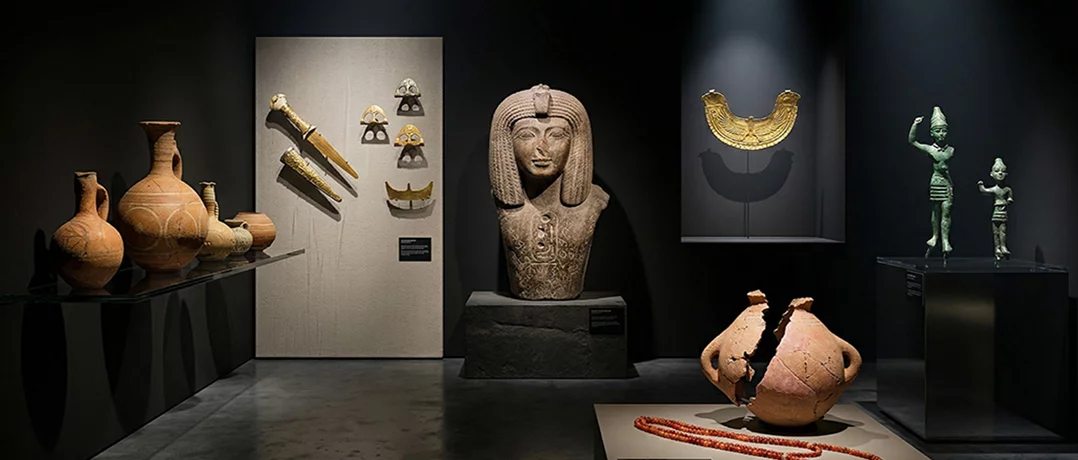
French President Emmanuel Macron has opened an exhibition at the Arab World Institute in Paris, with Lebanon's ancient port city of Byblos as the focus. Through the exhibition, the president was making a statement, about history, about sovereignty, and about what it means to stand beside a country at war.
The exhibition, Byblos: The Millennial City of Lebanon, brings together nearly 400 artefacts spanning over 7,000 years of civilization, tracing the life of one of the oldest continuously inhabited cities on Earth.
Byblos needs no introduction to Lebanese ears. Perched on the Mediterranean coast and inhabited since around 6900 BC, it is widely regarded as the world's oldest port city, a place where Egypt met Mesopotamia, where the alphabet took root, where the earliest traces of what we now call civilization quietly accumulated over millennia.
The Paris exhibition distils that extraordinary depth into prehistoric tools, Bronze Age jewelery, sculptures, and funerary objects that together tell the story of a city whose past is inseparable from Lebanon's identity. It is, in many ways, Lebanon's biography written in stone and gold.
And yet, the exhibition is not whole. Several display cases stand deliberately empty.
Originally planned for 2024, the exhibition was delayed as the conflict made transporting artefacts out of Lebanon increasingly treacherous. Insurance costs soared. Shipping routes grew unstable. A consignment of large stone artefacts was cancelled entirely following renewed military escalation. A third-millennium BCE obelisk, deemed too precious to risk, never left Lebanon.
Those empty cases are not a curatorial oversight. They are, as exhibition curator Tania Zaven put it, "a form of cultural resistance", a reminder that what is missing from these walls is missing because of war. In that sense, Byblos in Paris is two exhibitions at once: the one you can see, and the one that couldn't make it out.
The ceremony's political weight came into sharp focus when Macron spoke. His remarks were diplomatic in form but unmistakable in intent.
"At a time that certain people want to have us believe that security can only be achieved by invading a scary neighbor," the French president said,
Lebanon reminds us of just one thing: the force of universalism.
He went further, delivering what amounted to a direct rebuke: "No occupation, no form of colonization, neither here, nor in the West Bank, nor anywhere else, can guarantee anyone's safety."
It was a pointed moment, a head of state using an archaeology exhibition to deliver a message to Israel. France has long maintained a particular closeness to Lebanon, rooted in colonial-era ties, shared language, and decades of academic and cultural collaboration. French scholars helped excavate and document Byblos from the late 19th century onward. That history gives France both a platform and, in Macron's framing, a responsibility.
The exhibition was developed jointly with Lebanon's Ministry of Culture and the General Directorate of Antiquities, making it a bilateral act of preservation carried out under extraordinarily difficult conditions.
Lebanese Culture Minister Ghassan Salamé attended the opening on behalf of President Joseph Aoun, thanking France for its sustained support and expressing hope that it would continue as Lebanon looks toward rebuilding. Salamé has also been using his time in Paris to rally international backing for Lebanese heritage sites endangered by ongoing strikes, an effort that adds urgency to what might otherwise have been a purely celebratorial occasion.
For those of us watching from Lebanon, there is something both moving and quietly painful about seeing Byblos displayed in Paris. Moving, because the world is bearing witness, because France is saying, in the language of culture, that Lebanon's story matters and must not be buried. Painful, because the artefacts had to leave for them to be safe.
The empty display cases say it plainly: our history is safer abroad than it is at home. The exhibition exists despite everything. It arrived, incomplete but present, and it is telling Lebanon's story to the world at the very moment that story is most at risk of being interrupted. Byblos is 9,000 years old. It has outlasted empires, invasions, and erasures that history has since forgotten. The hope, watching from Beirut, is that it will outlast this one too.

