



The world may need to remove billions of tons of CO₂ from the atmosphere each year, but today's methods remain far from the scale required.
Can carbon removal help close the climate gap?
Can carbon removal help close the climate gap?
By The Beiruter | August 14, 2026

Reading time: 5 min
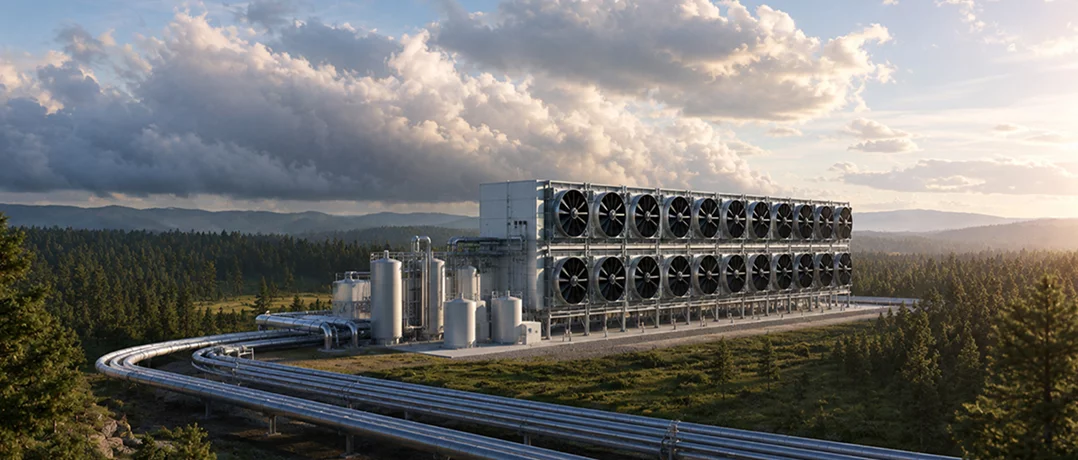
The world is running out of room to meet its climate targets through emissions reductions alone. Governments have expanded renewable energy, tightened climate policies and pledged to reach net zero, yet the United Nations Environment Programme's 2025 Emissions Gap Report estimates that current policies still put the planet on course for about 2.8 degrees Celsius of warming this century. Even if countries fully implement their existing climate pledges, projected warming remains between 2.3 and 2.5 degrees. That shortfall has pushed carbon dioxide removal, or CDR, higher on the climate agenda. CDR extracts CO₂ already in the atmosphere and stores it through methods ranging from forests to direct air capture and ocean-based technologies. The scale required could be enormous. The June 2026 State of Carbon Dioxide Removal assessment, produced by an international team of researchers, estimates that pathways pursuing the highest possible climate ambition require annual removal to reach 8.8 billion metric tons of CO₂ by 2050. Countries, however, currently pledge only about 3.6 billion tons for that year, leaving a removal gap of 5.2 billion tons. Carbon removal is sometimes grouped together with carbon capture, but the two address different parts of the climate problem. Carbon capture and storage generally intercepts CO₂ from an industrial source before it reaches the atmosphere. CDR takes CO₂ that is already in the air and moves it into biological, geological or other forms of storage. The distinction creates a fundamental limit on what removal can accomplish.CDR can compensate for residual emissions from sectors such as aviation, agriculture, shipping and heavy industry and eventually produce net-negative emissions, potentially lowering temperatures after the world reaches net zero. But removal is not a substitute for reducing emissions. In the State of CDR's highest-ambition scenarios, CDR accounts for about 16% of cumulative mitigation when net-zero CO₂ is reached, while reductions in emissions sources provide the remaining 84%. Delaying ambitious emissions cuts by a decade raises the eventual dependence on removal even further. Carbon removal is not one technology, and the options vary dramatically in how developed they are, how much they cost and how long they can keep carbon out of the atmosphere. For now, nature does nearly all the work. The State of CDR assessment estimates that planting and restoring forests removed an average of about 2.2 billion tons of CO₂ annually between 2014 and 2023. Newer methods removed just 2.04 million tons in 2025, roughly one-thousandth as much. Engineered approaches could offer something forests cannot. Direct air capture uses machines to pull CO₂ directly from the atmosphere and can then store it deep underground, potentially keeping it there for thousands of years. But because CO₂ makes up only a small fraction of the air around us, extracting it requires substantial amounts of energy. A July 2026 Brookings analysis estimates that direct air capture could eventually cost $100 to $300 for every ton of CO₂ removed. Ocean-based approaches could eventually provide another route. Some proposed methods would alter ocean chemistry or use natural marine processes to increase the amount of CO₂ the ocean takes out of the atmosphere. The potential scale is large, but scientists are still studying the ecological consequences, how accurately removals can be measured and how long the carbon would remain stored. Scaling CDR is only part of the problem. Policymakers also have to determine how long removed carbon will stay removed. A forest can store carbon for decades or centuries, but fire, logging, drought or land-use change can return it to the atmosphere. Carbon injected into suitable geological formations can potentially remain stored for far longer. The 2024 Oxford Principles for Net Zero Aligned Carbon Offsetting argues that credible net-zero strategies should favor removals with a low risk of reversal while continuing to prioritize direct emissions cuts. These differences complicate carbon markets. Buyers need to know not only whether a ton was removed, but whether the removal was additional, how accurately it was measured and how likely the carbon is to remain stored. Those questions are especially difficult for emerging ocean-based approaches, where monitoring systems remain less developed than for forests or engineered technologies. Even technically successful removal has an economic problem. Unlike electricity or steel, removing atmospheric CO₂ does not inherently produce a product with an established market. Governments and companies are therefore experimenting with ways to create demand for carbon removal, including carbon prices, subsidies, public procurement and voluntary or regulated carbon markets. Brookings argues that scaling CDR will require both government intervention and private-sector innovation, including reliable systems for measuring and verifying removals. Cost remains one of the clearest benchmarks. The U.S. Department of Energy's January 2025 Carbon Negative Shot Strategy set a goal of developing a portfolio capable of removing 1 billion tons of CO₂ annually by 2050 for less than $100 per net metric ton. The target accounts for emissions generated during removal and requires the captured carbon to remain securely stored. Current projects operating or under construction could raise novel CDR capacity to about 8.4 million tons annually by 2030, according to the June 2026 State of CDR assessment. Yet even that would be tiny beside the billions of tons envisioned for mid-century. Carbon removal may therefore become an important component of the world's climate strategy, but its potential depends heavily on what happens outside the industry. The faster emissions fall, the more manageable the removal challenge becomes. The longer deep cuts are delayed, the more the world will be betting on technologies and markets that have yet to operate anywhere near the scale required.Removing carbon is not the same as cutting emissions
From forests to machines
A ton removed is not always a ton stored
Creating a market for removal
-
-

-
The Beiruter
-
