



Money can buy the machinery of a technology powerhouse, but can it buy the innovation that makes one?
Can countries still buy their way into becoming technology powers?
Can countries still buy their way into becoming technology powers?
By The Beiruter | November 03, 2026

Reading time: 4 min
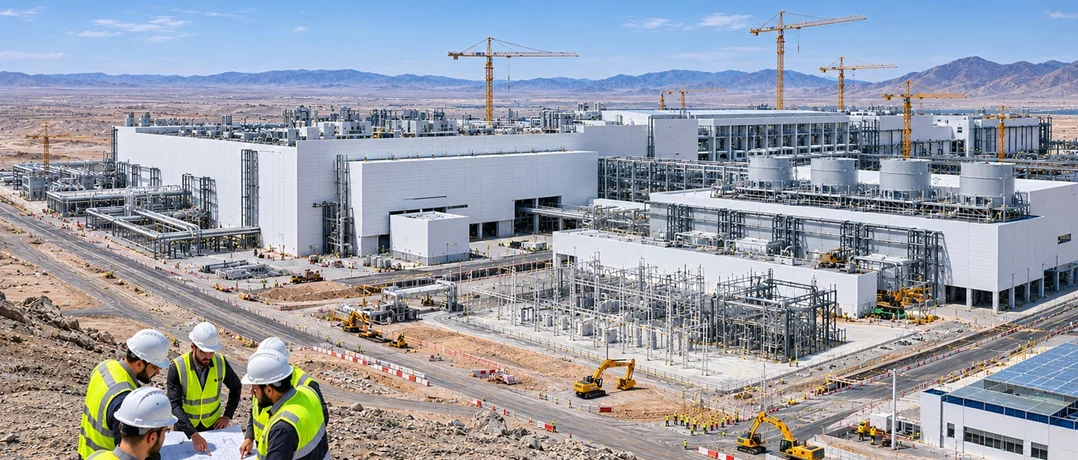
The race to become a global technology power is evolving into one of the world's most expensive development strategies. Governments are pouring billions into semiconductor factories, artificial intelligence infrastructure, and research institutions, hoping to secure a place in industries that will determine future economic competitiveness. In the Gulf alone, Saudi Arabia, the United Arab Emirates, and Qatar announced approximately $120 billion in AI investment plans in 2025, according to the International Monetary Fund. The spending represents an ambitious effort to transform energy wealth into technological influence, as governments elsewhere pursue similar strategies to attract investment and reduce dependence on foreign suppliers. Yet building a technology industry requires more than purchasing equipment or recruiting researchers. Taiwan's dominance in advanced chip manufacturing and Silicon Valley's concentration of leading technology companies are the products of decades of accumulated expertise and industrial development, advantages that even the wealthiest governments cannot easily reproduce. Countries have long sought to accumulate economic and political influence. Technological power may be the next great prize. In the Gulf, oil wealth is financing an ambitious wager on the next generation of technology, with governments hoping to accomplish in years what established innovation centers spent decades building. Saudi Arabia and the UAE are investing heavily in AI infrastructure, advanced computing, and international technology partnerships as part of efforts to diversify their economies. Their strategies seek not only to attract foreign companies but also to establish domestic industries capable of competing internationally. An IMF study published in October 2026 found that 44% of disclosed AI investment plans across the Gulf were concentrated in data centers, with another 40% directed toward other AI infrastructure, and 13% toward designated AI development zones. These figures concern announced projects rather than completed investments. Data centers can be financed and constructed relatively quickly, but their economic value depends on access to advanced chips, reliable electricity, specialized workers, and customers willing to purchase computing services. A government can fund the infrastructure of an AI industry long before it has developed the expertise needed to make full use of it. For all the billions flowing into advanced technology, some of the world's wealthiest economies are still struggling to turn their investments into homegrown innovation. The World Intellectual Property Organization's (WIPO) September 2026 Global Innovation Index ranked the UAE 25th globally, an improvement of five positions. Yet while the country placed 12th for innovation “inputs,” which include research resources, institutions and infrastructure, it ranked considerably lower, at 42nd, for the scientific and technological “outputs” those resources are intended to generate. The pattern was even more pronounced in Saudi Arabia and Qatar, which ranked 30th and 33rd, respectively, for innovation inputs, but fell to 62nd and 67th when measured by their outputs. Gulf economies, in other words, have become considerably better at assembling the ingredients of innovation than converting them into measurable results. Money can establish research facilities and attract scientists, but productive relationships between universities and businesses take longer to develop. Companies must commercialize discoveries, researchers need opportunities to establish enterprises, and specialized workers need industries capable of employing them. India and Vietnam complicate the assumption that wealth determines technological success, generating considerably stronger innovation outcomes than their investment conditions might suggest. In WIPO's 2026 rankings, India placed 25th for innovation outputs against 49th for inputs, while Vietnam ranked 35th and 54th, respectively. Consider what it takes to manufacture an advanced semiconductor. Producing a single chip requires sophisticated machinery, specialized materials and engineers with years of technical experience. Each stage relies on expertise accumulated through decades of manufacturing and technological refinement. Taiwan has spent decades developing an industrial ecosystem around semiconductor production. Its leading manufacturer, TSMC, produces almost every leading AI chip, according to Stanford University's 2026 AI Index, creating a major concentration of advanced manufacturing capacity. Other countries can subsidize competing facilities, but constructing factories does not immediately reproduce the technical experience or supplier relationships that underpin established production networks. Innovation also remains geographically concentrated. WIPO's 2026 rankings placed China's Shenzhen-Hong Kong-Guangzhou cluster first among global innovation clusters, followed by Japan's Tokyo-Yokohama region and San Jose-San Francisco in the United States. Together, these three clusters accounted for more than one-fifth of international patent applications filed through WIPO's Patent Cooperation Treaty. The proximity of universities, manufacturers, investors and established companies encourages knowledge exchange and new businesses, reinforcing these regions' advantages as their industries mature. Historical experience nevertheless offers grounds for optimism about state-led technological development. Beginning in the 1960s and 1970s, South Korea and Taiwan developed internationally competitive electronics industries with substantial government support, combining industrial investment with education, export-oriented production and the gradual accumulation of technical expertise. Their success depended less on spending than on directing investment toward industries in which domestic companies could develop internationally competitive capabilities. Today's technologies may offer countries a different route into advanced industries. Even without domestic semiconductor manufacturing, countries can develop AI applications, specialized software or digital services using technologies produced elsewhere. Yet adopting foreign technology is only a first step toward building an industry capable of generating its own innovations. For governments investing billions in technological development, financial resources can accelerate progress, but lasting competitiveness depends on the expertise and industries those investments leave behind. The ability to purchase technology is not the same as the ability to innovate.The Gulf's technological ambitions
The limits of financial investment
Why technology clusters are difficult to reproduce
Can governments accelerate the process?
-
-

-
The Beiruter
-
