



France is pushing for Lebanon’s inclusion in the IMEC, an infrastructure project that could boost trade and revitalize the economy, but success depends on Lebanon’s reforms and investment.
Can France secure Lebanon a seat in IMEC?

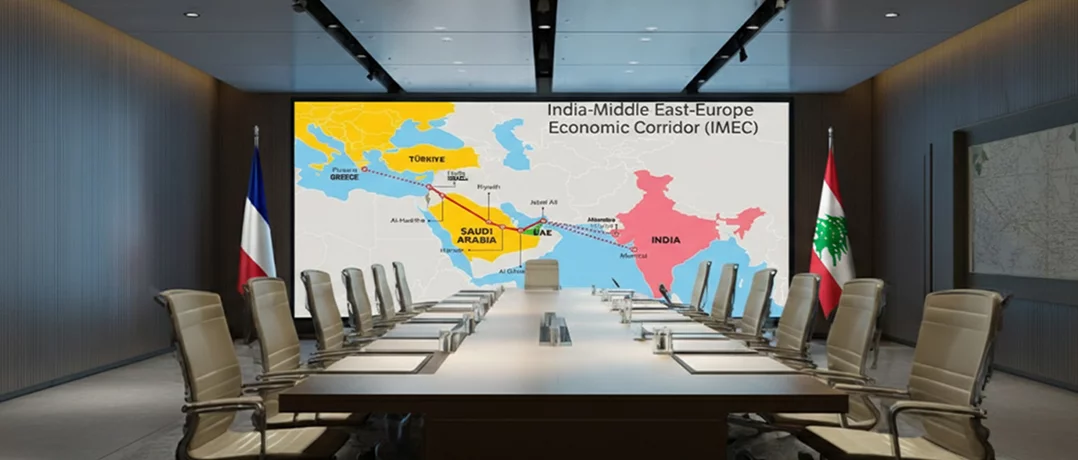
A meeting between the French presidential envoy for IMEC, Gérard Mestrallet, and Lebanese President General Joseph Aoun was held today at the Baabda Presidential Palace. This was not a mere, routine meeting, but one which carried an ambitious project to Lebanon. Mestrallet’s visit, according to informed sources, was aimed to address the project’s details and assess Lebanon’s readiness to join.
Indeed, reports indicate that France is actively seeking to integrate Lebanon into the India-Middle East-Europe Economic Corridor (IMEC), a vast transcontinental infrastructure initiative designed to link Asia to Europe through the Arabian Gulf and the Eastern Mediterranean. If realized, the move would transform Lebanon into a complementary gateway to the Eastern Mediterranean, reconnecting it to major global trade routes at a time when the country is suffering from profound economic collapse.
What is IMEC?
The India-Middle East-Europe Economic Corridor was officially announced on 9 September 2023, on the sidelines of the G20 Summit in New Delhi, India. A Memorandum of Understanding (MoU) was signed by India, the Kingdom of Saudi Arabia (KSA), the United Arab Emirates (UAE), the United States (US), France, Germany, Italy, and the European Union (EU), setting out political commitments to cooperate on building the corridor.
Beyond transport, IMEC envisions a broad infrastructure ecosystem extending over approximately 6,400 kilometers. Along the railway route, participating countries intend to lay electricity cables, fiber-optic networks for digital connectivity, and pipelines for clean hydrogen exports. The corridor is designed not only to facilitate trade but also to promote sustainability, green technologies, and enhanced energy cooperation.
It should be noted that the IMEC is not the only corridor being advanced in the region. China’s Belt and Road Initiative (BRI) as well as the Russian-Iranian backed International North–South Transport Corridor (INSTC) are also competitive corridors that involve key states in the Middle East. Hence, the IMEC serves as a geopolitical counterweight to the aforementioned routes to advance Western influence and benefits, challenging that of Beijing and Moscow.
French diplomatic push for Lebanon’s inclusion
According to informed diplomatic sources to the Beiruter the French presidential envoy for IMEC, Gérard Mestrallet, has been lobbying participating states to include Lebanon in the corridor’s evolving blueprint. His argument is both economic and strategic: Lebanon urgently needs a growth engine, and IMEC, given its scale and scope, could provide one. Mestrallet has reportedly stressed that the instability in Gaza since 7 October 2023, along with persistent regional tensions between Israel and Iran, has disrupted elements of the original project planning. In this context, and given the massiveness of the project, expanding the corridor’s Mediterranean outlets could enhance resilience and flexibility.
Lebanon was absent from the initial configuration. Early plans envisaged a route beginning in India, crossing the UAE and KSA, passing through Jordan and Israel, and then reaching Europe. This effectively positioned Israel as a mandatory land bridge between Asia and Europe within the IMEC framework. France’s proposal would adjust the northern corridor to extend from Jordan into Lebanon before continuing to Europe, while discussions allegedly include the possible future participation of countries such as Egypt, Oman, Syria, and Cyprus.
What could IMEC mean for Lebanon?
For Lebanon, inclusion in IMEC would represent more than a transport upgrade; it would be a structural economic shift.
Estimates suggest that participation could generate between 4,000 and 5,000 direct and indirect jobs, while annual economic gains and tax revenues could range between $3.5 billion and $4.5 billion once operations are fully underway. The Lebanese segment of the project is projected to cost between €170 billion and €190 billion, with an implementation timeframe of 8 to 10 years. Such investments could catalyze broader economic revitalization by attracting foreign capital, stimulating the construction and logistics sectors, and restoring confidence in Lebanon’s long-term prospects.
Strategically, joining IMEC would reposition Lebanon on the global economic map. After years of isolation driven by financial collapse, political paralysis, and regional spillover, participation in a flagship multinational initiative would signal renewed international engagement. It could also rebalance Lebanon’s geopolitical posture by embedding it within a cooperative, multilateral economic framework.
Whether this vision materializes will depend on diplomacy, financing, and, crucially, Lebanon’s own readiness to undertake deep reforms. If the political will aligns with international support, IMEC could indeed become the golden opportunity that restores Lebanon’s historic role as a bridge between East and West.
-
-

-
The Beiruter
-
