



Beachfront resorts, Gulf investment, and Hollywood blockbusters are transforming the Western Sahara. But Morocco is pursuing more than economic growth: it is wielding development to strengthen its hold over contested territory.
Can resorts redraw borders?

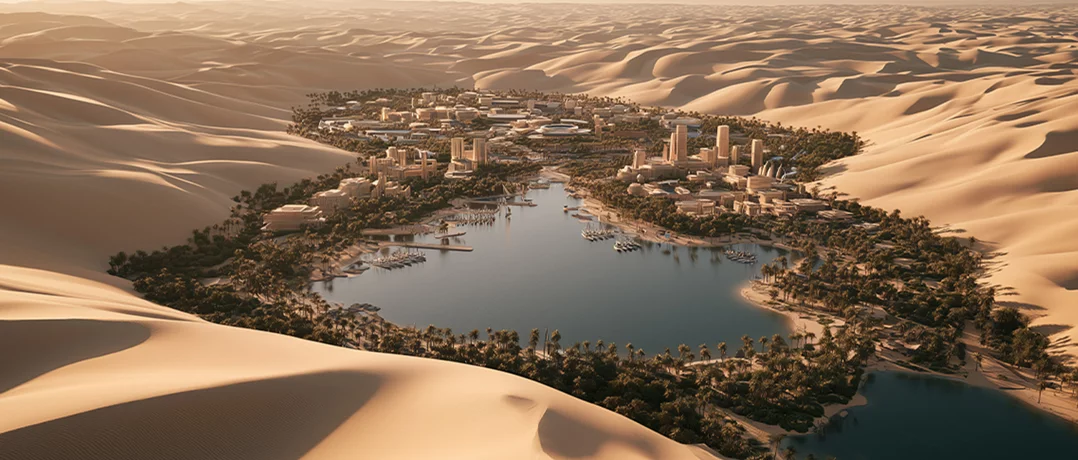
Where rolling white sand dunes collide with the Atlantic, luxury resorts, beach clubs, and kitesurfers increasingly populate the coastline. Nearly 750,000 visitors – a more than 50% increase from seven years ago, according to the Moroccan Ministry of Tourism – traveled to the region last year as airlines added new routes. Christopher Nolan's The Odyssey showcased its sweeping beaches to the globe, casting the desert as the backdrop for one of Hollywood's biggest blockbusters.
The Western Sahara may seem like a traveler's oasis, but it is also one of the world's most enduring territorial disputes, referred to by The New York Times as “Africa's last colony.” Roughly the size of Britain but home to only around 600,000 residents, the territory has remained contested since Morocco absorbed it after Spain's withdrawal in 1975. Hundreds of thousands of indigenous Sahrawis now live in refugee camps in neighboring Algeria or in the narrow eastern strip of the Western Sahara still administered by the Polisario Front, the Sahrawi independence movement.
From UAE-financed tourist cities to a burgeoning film industry, Morocco exemplifies a new way of asserting territorial control. It is leveraging foreign capital to make its sovereignty claims an accepted economic reality – even as fighting continues, with rockets launched as recently as May 2026.
International money is fueling the rebrand
Morocco's strategy of transforming the Western Sahara into a bustling tourist destination is being fueled by international investment, with no other country as committed to the cause as the United Arab Emirates.
The UAE, now Morocco's largest foreign investor, has set its sights on the deserted fishing village of La Güera, abandoned during decades of conflict over the Western Sahara. Emirati officials have anointed it the next “Dubai of Africa,” with plans for chalets, spas, and water parks designed to attract tourists and digital nomads alike. Abu Dhabi's interest in tourism is buttressed by diplomatic and structural support for Morocco's claim over what it labels its Southern Provinces: the Emiratis have opened a consulate and pledged $14 billion to develop energy and water infrastructure in the territory.
Morocco also has its sights on investment from the West. The tax breaks and film industry incentives that drew The Odyssey to Dakhla's White Dune are only part of a broader effort to attract global capital; Spanish hotel chain Senator Hotels & Resorts announced plans in 2024 to open a beachfront resort in the Western Sahara, while the French Development Agency (AFD) committed €150 million in investment there in 2025. The blossoming business relationship with Washington has become increasingly enthusiastic. "We will support U.S. companies looking to invest and do business in all of Morocco, including Western Sahara," U.S. Deputy Secretary of State Christopher Landau wrote in a 2025 post on X.
The developmental boom is energized by a deadline. Ahead of the 2030 World Cup, co-hosted by Morocco, Spain, and Portugal, Morocco is working to create a sanitized image of the Western Sahara, one better known for beach resorts than for territorial conflict. As visitors pour into Morocco for World Cup matches – and perhaps, indulge in coastal tourism along the way – many may find themselves lounging on disputed territory without realizing it.
Global legitimacy is following investment
Not long ago, the international community largely rejected Morocco's claims over the Western Sahara. The United Nations originally supported the Sahrawi people's right to self-determination: the 1991 UN-brokered ceasefire called for a referendum in which Sahrawis could choose between independence and integration into Morocco – a vote that never materialized. Some countries were more active in their opposition to Moroccan occupation, especially South Africa, which seized a cargo ship carrying 55,000 tonnes of Western Saharan phosphate, claiming it had been stolen from the Sahrawi people. Meanwhile, the Western Sahara Resource Watch, an NGO opposing entities “advancing Moroccan interests in occupied Western Sahara,” urged companies not to invest in the territory, warning that doing so would help “normalise and entrench the occupation.” For years, many companies heeded those warnings, keeping major private investment in the Western Sahara relatively limited.
Today, political caution erodes as global investment accelerates. The US recognized Moroccan sovereignty over the territory in 2020, followed by Spain in 2022, and France in 2024. By 2025, the UN Security Council adopted Resolution 2797, which described Morocco's autonomy initiative as the basis for a “serious and credible” solution. The new diplomatic reality was on full display this May, when the Polisario Front fired rockets into a Moroccan-controlled city, wounding one civilian. The United States, France, and the European Union all condemned the attack within 48 hours, while nearly identical strikes in 2020 and 2023 drew a muted international response.
Beyond the dazzling beach resorts and blockbuster film sets, little has changed for the Sahrawi people on the ground. Morocco governs 80% of the region, an increase from the two-thirds it had in 1991, and the same coastline that delights tourists and filmmakers was described by Professor Stephen Zunes in The Atlantic as “the worst police state I've ever seen.”
As governments, investors, and travelers become stakeholders in the development of Western Sahara, the international community develops a greater vested interest in Morocco consolidating control, rather than in defending the Sahrawi people’s right to self-determination.
Attracting international investment in the Western Sahara is more than economic policy; it is the mechanism through which Morocco ensures that an unresolved territorial dispute is treated as resolved.
-
-

-
Soraya JohnsonJunior research/writer
Focusing on political analysis, economic trends, and investigative reporting.
-
