



A successful test of an AI-powered seabed mining robot raises hopes of less destructive mineral extraction, but environmental concerns, commercial uncertainty and international regulatory disputes remain unresolved.
Can robots make deep-sea mining less destructive?
Can robots make deep-sea mining less destructive?
By The Beiruter | November 15, 2026

Reading time: 5 min
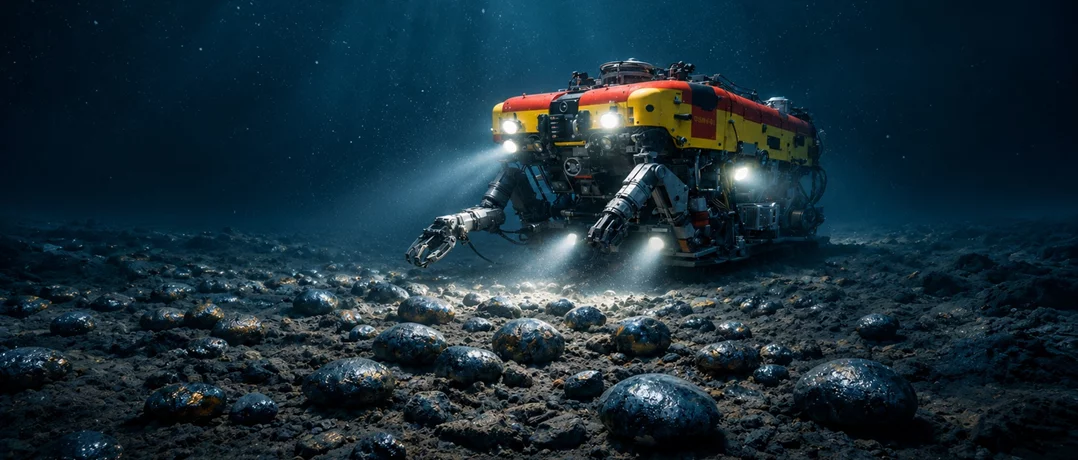
More than 4,000 meters beneath the Pacific Ocean, an autonomous robot has demonstrated a potentially significant advance in the contentious pursuit of deep-sea minerals. On November 9, Impossible Metals, a US-based deep-sea mining technology company, announced that its AI-powered robot had successfully retrieved approximately 450 grams of mineral-rich rocks during a September expedition, using a claw designed to avoid marine organisms. The achievement comes as governments confront growing demand for copper, nickel, cobalt and manganese, materials essential to batteries, electronics and industrial manufacturing. According to the International Energy Agency's (IEA) Global Critical Minerals Outlook 2026, announced mining projects are expected to meet only 75% of global primary copper requirements by 2035 under its Stated Policies Scenario, even after accounting for recycling. This projected shortfall is intensifying pressure to develop alternative sources of supply. Yet the prospect of exploiting mineral deposits beneath international waters remains deeply divisive. Conventional mining equipment can disturb vast areas of seabed and release sediment into surrounding waters, environmental experts say, threatening ecosystems that scientists are still struggling to understand. By promising to extract minerals without the extensive environmental disturbance associated with conventional mining, Impossible Metals is testing whether technological innovation can overcome one of the industry's greatest obstacles to commercial expansion. The deep ocean floor contains vast deposits of mineral-rich rocks, known as nodules, particularly in the Clarion-Clipperton Zone, an expansive region of the Pacific between Hawaii and Mexico. Conventional extraction proposals generally rely on large vehicles that travel across the seabed, vacuuming up nodules before transporting them to ships at the surface. Impossible Metals claims its technology offers a less disruptive alternative. Rather than sweeping across the seabed, its autonomous robots use artificial intelligence to identify individual nodules and robotic claws to retrieve them while avoiding visible marine organisms. The company argues that this selective approach could substantially reduce sediment disturbance and avoid certain forms of waste discharge associated with conventional mining. The September demonstration established that autonomous collection is technically possible at extreme depths, but its commercial potential remains uncertain. The robot recovered less than half a kilogram of material, compared with more than 3,000 tonnes retrieved during a 2022 conventional mining trial conducted by Nauru Ocean Resources, a subsidiary of The Metals Company, and Allseas. Although the trials had different objectives, the disparity highlights the gap between experimentation and industrial extraction. Commercial viability will depend on collection rates, energy requirements, maintenance costs and the number of robots needed. Evidence of conventional mining damage strengthens the case for robotics. Research published in Nature Communications in 2025 documented sediment disturbance from an experimental collector operating approximately 4,500 meters beneath the Pacific. Researchers detected suspended sediment as far as 4.5 kilometers from the vehicle, while concentrations close to the collector reached approximately 10,000 times natural background levels. Such disturbances can affect organisms living within seabed sediments and alter conditions across surrounding habitats. Mining operations that discharge waste into the water column introduce additional risks, potentially interfering with marine food chains and affecting organisms far from the extraction site. A December 2025 Nature Ecology & Evolution study examined the biological consequences of the 2022 Nauru Ocean Resources and Allseas trial. Researchers found that the number of animals living on or within the seabed declined by 37%, while the average number of species identified per sample fell by 32% in areas directly disturbed by mining equipment. Although they found no statistically significant decline in animal abundance in areas affected by drifting sediment, changes in the composition of marine communities were evident. Robotic collection could reduce several mechanisms responsible for these disturbances. Yet removing nodules also removes habitat for organisms that depend on their hard surfaces. Avoiding visible animals cannot guarantee protection for microscopic species or those living within surrounding sediments. The economic incentive for seabed mining is substantial, although mineral markets present different supply pressures. The IEA's 2026 outlook projects that announced projects will cover only approximately 92% of primary nickel requirements by 2035, compared with 74% for cobalt and 75% for copper under its Stated Policies Scenario. Supply concentration adds another geopolitical dimension. China accounts for approximately 75% of global cobalt refining and nearly half of copper refining, while Indonesia's share of nickel mine production is projected to exceed 70%. For governments seeking more secure mineral supplies, seabed deposits offer a potential source of diversification. However, extracting minerals from international waters would not necessarily reduce dependence on existing refining networks. Robotic mining also introduces its own commercial trade-offs. Selectively avoiding ecologically sensitive nodules could reduce environmental damage but limit recoverable volumes, potentially increasing costs relative to conventional collection. Established in 1994 under the United Nations Convention on the Law of the Sea, the International Seabed Authority regulates mining in international seabed areas. Its members continue negotiating rules on environmental safeguards, financial obligations and compliance. Impossible Metals must still secure regulatory authorization before proceeding with commercial extraction. The company could pursue an international pathway through the Authority or seek approval under applicable US legislation, although the latter raises disputes over jurisdiction and international legitimacy. Technological advances may strengthen the argument that seabed minerals can be collected with less environmental disturbance. They do not, however, resolve disagreements over acceptable ecological risks, the distribution of mineral revenues or the authority to approve extraction in waters beyond national jurisdiction. Autonomous robots could make deep-sea mining more politically defensible, but proving their environmental sustainability and commercial viability will require considerably more evidence than a successful expedition.A different approach to extraction
The environmental calculation
Minerals and market realities
Technology meets international law
-
-

-
The Beiruter
-
