From Beirut’s streets to Japan’s top league, Sergio Darwish’s journey reflects resilience, discipline, and carrying Lebanon onto the global stage.




From Beirut’s streets to Japan’s top league, Sergio Darwish’s journey reflects resilience, discipline, and carrying Lebanon onto the global stage.

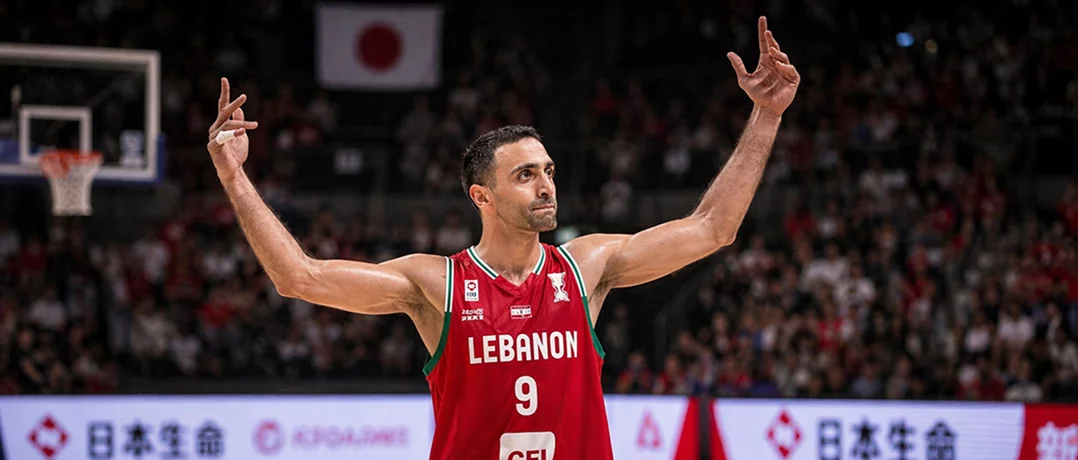
Sergio Darwish, Lebanon’s renowned international basketball player, began his journey the way the best ones do: with two brothers, a ball, and a parent who believed in what he saw. Growing up, Sergio and his brother, just a year apart in age, turned their house into an unofficial court. Basketball was always on the television, and eventually it spilled off the screen and into every corner of their lives.
Darwish tells The Beiruter, "We used to play a lot when we were kids, My dad saw how passionate we were and that we had talent."
His father enrolled them at Mont La Salle around age seven, but the real turning point came from an unexpected encounter. One day, while the brothers were playing in front of their mother's shop, Ismail Ahmad happened to pass by with his wife. He watched the kids for a while and saw something in them, a sharpness, a hunger that didn't fit their age. He spoke to their father, and before long, Sergio was wearing an Al Riyadi jersey. That's where a career was born.
The path from Beirut to the pros was anything but linear. Sergio crossed the Atlantic for High School to then enter the NCAA and play Division I college basketball at the University of Maine, a leap that tested him in ways he hadn't anticipated: learning to live alone, to fail quietly, to keep going when no one is watching. "Growing up is the hardest part," he says. “having to face the harshness of life head on”.
There's a moment Sergio Darwish still thinks about. “One night I was playing PlayStation in my dorm room, looked in the mirror, and saw my mouth twisting and my eye closing on its own.” He was thousands of miles from home, 18 years old, and his face was betraying him.
He went straight to the hospital. It was Bell's palsy: partial facial nerve paralysis. Months of difficult recovery with no family nearby took a deep toll on him.
"It was one of the toughest things I went through," he says simply. But ask him if it broke him, and you get a different answer entirely.
To succeed in anything, you have to go through struggles. You feel like you're nothing, like people are stepping on you, and you don't see the light at the end of the tunnel, but there is always a small light.
That small light has since grown into something much bigger. He graduated and kept moving. Tunisia first, then back home to Lebanon where he played for Champville, Beirut, and Sagesse, collecting wins and building a name. Today, Sergio Darwish is a professional basketball player competing in Japan's top division, but carrying Lebanon with him across the world.
Playing professional basketball in Japan is not a small thing. It is a full cultural transplant, new language, new rhythms, new rules of engagement, both on and off the court.
"At first it was hard. I was homesick the first couple of months," Sergio admits. But homesickness gave way to adaptation, and adaptation gave way to appreciation. "The league is very professional, the basketball is different, everything is about discipline and etiquette. You really learn from the culture."
What he didn't expect was how much the culture would learn from him in return. "People here didn't know Lebanon before I came," he says.
Now I see Lebanese flags in the arena. Fans write to me in Arabic, it's like they entered my culture. They follow Lebanon through me. They send me messages about what's happening there.
A young man from Beirut dribbles a ball in a foreign arena while fans halfway across the world wave his country's flag. In 20 years, he says, he'll look back and say "wow." For now, he's still living it.
If you ask Sergio Darwish what he would tell the next kid who picks up a basketball in a Beirut backyard and dreams bigger than his surroundings, he stresses:
"Get out of your comfort zone. Keep working on yourself. You never know what path God has planned, so always be ready for opportunities. And work hard, nothing comes easy."
It sounds simple. But coming from someone who recovered from facial paralysis alone in a college dorm, who built a career across four countries, who carries a nation's flag to an arena in Japan, it sounds less like advice and more like proof. Sergio Darwish is still writing his story. And from the looks of it, he is only getting started.

